
We took a look at three big, physical shifts in Portland’s arts spaces this fall.
I’ll be real with you: This package was a happy accident.
For this issue, I asked staff writer Garrett Andrews to write about the conflict that arose after Live Nation announced plans to open a music venue in the Portland area, one large enough to hold between 2,000 and 4,000 people — occupying the “missing middle” of music venues in a town that has plenty of small venues and a handful of very large ones. Some welcomed the news — but others ranged from apprehensive to angry about what it will mean for Live Nation to build a venue in Portland, the last major city in the United States that doesn’t have one.
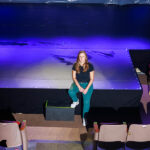
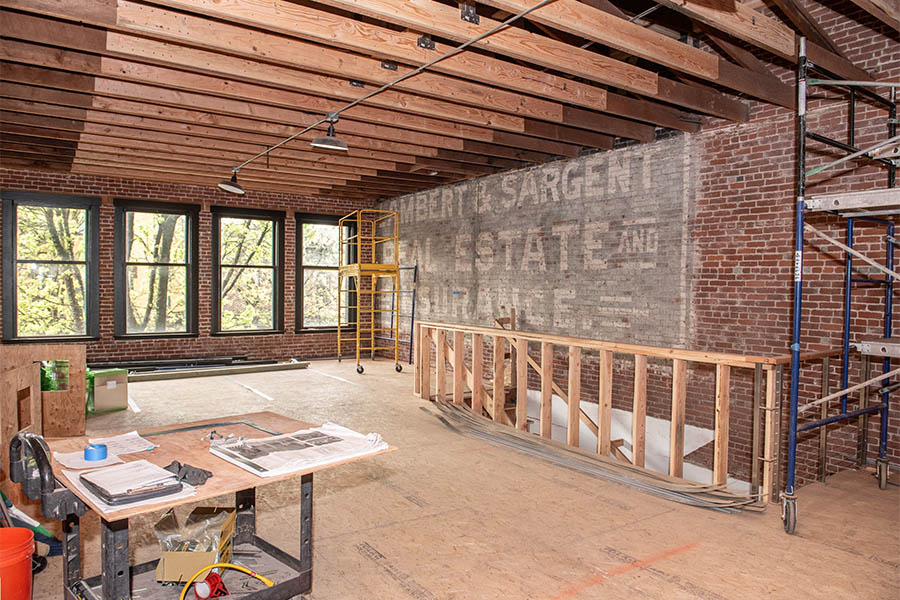
Separately, I looked into stories about Literary Arts’ move and expansion into a new space in the Central Eastside. The new space, which includes a bookstore and cafe as well as classroom space, is scheduled to open this fall. And I also spoke to Andre Middleton, the executive director of Friends of Noise, as his organization was finalizing a lease agreement that will allow them to build a new, all-ages venue in a building that until 2020 contained a strip club.
It wasn’t until I was partway through my own reporting process that I saw the common thread running through all three of these stories. They’re all about either arts spaces in Portland that are either completely new or newly accessible to the public. There are important differences in these stories. One is a small, relatively new nonprofit. Another is a large, for-profit company that is currently the subject of a federal lawsuit for anticompetitive practices. Another is a decades-old arts organization that is almost certainly one of the largest organizations exclusively devoted to the literary arts.
But considered in aggregate, these stories suggest that big things are happening in Portland’s arts community. And they aren’t the only signs of big changes afoot. As this issue went to press, Portland City Council was mulling the future of Keller Auditorium, which hosts touring Broadway shows as well as performances by the Portland Opera and Oregon Ballet Theatre. The Portland Art Museum has unveiled plans for a major transformation of its downtown campus.
And there are changes beyond Portland as well.
Brian Rogers, executive director of the Oregon Arts Commission, notes that there is a movement to renovate old theaters — ones originally built to show movies or touring Vaudeville acts, but that became other things, like retail storefronts, as television became more popular. But in recent years, local arts groups have taken the time and trouble to renovate old theater spaces for live theater or music performances, or to reopen as movie theaters. In North Bend, the 100-year-old Liberty Theatre recently completed a nine-year renovation project and now showcases performances by the Little Theatre on the Bay. The Baker Orpheum Theatre — once an opera house hosting touring opera performers as well as civic celebrations — now hosts performances by the Eastern Oregon Regional Theatre and other regional organizations. Rogers also notes that some community organizations have also worked to turn old schools into performing arts spaces, with the Chehalem Cultural Center in Newberg and the Lincoln City Cultural Center being examples of school buildings being repurposed for arts and culture.
All of these changes were years — and in the case of some rural renovation projects, decades — in the making. But they also give us a sense of what’s happening in Oregon in 2024. Monqui Presents’ interest in the Lloyd Center Mall suggests an interesting possible future for that space, which was struggling with high vacancy rates even before COVID-19 hit. Andrew Proctor, executive director of Literary Arts, told me that his organization’s move was possible partly due to a transformational gift from a late board member and a massive capital campaign — but also due to lower commercial property values. He argued that arts organizations are often at the vanguard of economic recovery for cities and neighborhoods, and can be a stabilizing force in challenging times.
How these projects — and others like them — will pan out, and shape the culture in the long term is hard to say. But we hope they offer at least a partial picture of what’s happening in the arts in 2024.
Here they are:
Sound the Alarm
As a proposed Live Nation venue clears final hurdles, Portland’s noteworthy music scene mourns and readies for a fight.
Reading the Room
Literary Arts’ investment in the Central Eastside is part of a bold expansion for the organization.
Loud and Clear
Andre Middleton founded Friends of Noise in 2015 with the express intent of creating a sustainable all-ages music venue. Now he’s found a place.
Click here to subscribe to Oregon Business.