Two decades in the making, the James Beard Public Market speeds toward a 2026 opening, though uncertainty remains.
After two decades and two failed attempts to build a world-class public market in Portland, Jessica Elkan understands if the public is skeptical.
The director of the James Beard Public Market remains excited to make her pitch and with a new downtown location in hand, she says the city is likely one year from a full opening that may do no less than revitalize downtown Portland and connect rural and urban Oregon.
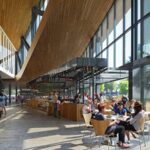
A market honoring Portland-born culinary heavyweight James Beard has been in development since 2005, when Portland restaurateur Ron Paul founded the Historic Portland Public Market Foundation. As now envisioned in plans by BCV Architecture of San Francisco (Collab Architecture is providing local design work), the market will utilize 38,000 square feet across two neighboring historic structures, the Selling and Ungar buildings. The market will host 40 permanent small businesses and sell thousands of Oregon products.
In addition to private donors, the project has received public money from Travel Oregon, Travel Portland and Prosper Portland. The matter of when the market will open and in what form remains in the air as a key piece of the $25 million project cost is discussed in Salem. A bill now before the House Ways and Means Committee would direct $10 million in lottery funds to the market’s construction. Beyond that, once constructed, Elkan says the market will be entirely self-sustained by vendor rents.
Before it was transferred to Ways and Means, HB 3377 received some Republican pushback. But Elkan is optimistic lawmakers will recognize the market’s potential as an economic engine for Portland and the state at large. She says two businesses have already leased space nearby in anticipation of the market’s opening: artist Mike Bennett and farm-to-table sushi counter Nodoguro.
Project leaders must yet finalize its construction timeline and permitting with the city, which has shuffled its design review process to accommodate the complex and multifaceted market.
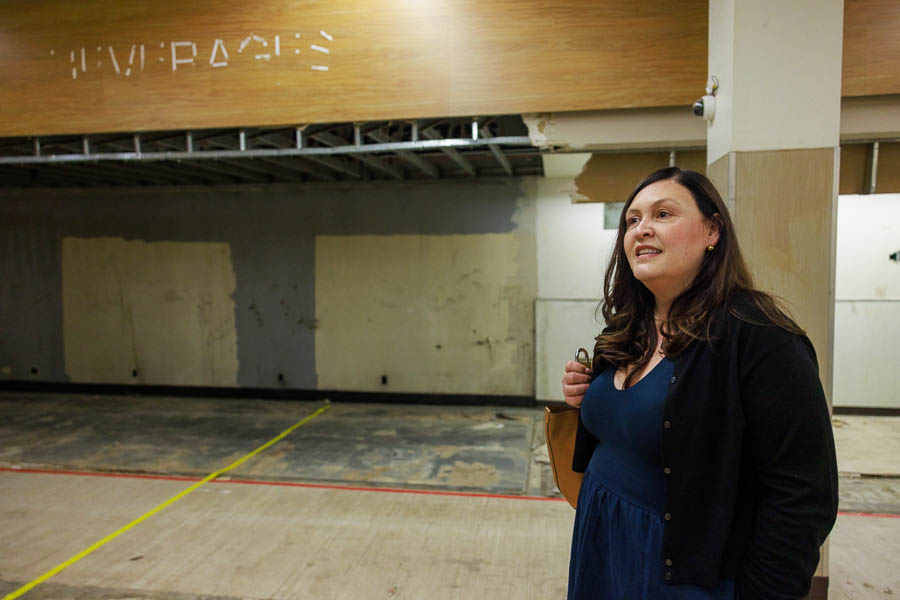
On a recent Friday, Elkan showed Oregon Business around the market’s new — century-old — downtown space and discussed timeline certainty and the massive potential of a public market in Portland.
This interview has been edited for space and clarity.
I read that we’re eyeing a September partial opening.
We are trying to figure that out right now. A lot of when we open will be based on the permitting process, as well as just what’s feasible. Originally, we were looking at the potential of some kind of first phase opening in September. But I think when we look at the magnitude of the project, we want to make sure that we’re not creating any undue harm by opening up partially when maybe scaffolding is still out on the exterior..
There’s urgency to this. And we also want to make sure that when we do open, that we’re really opening in a way that’s best for the vendors, and in a way that’s best for the customer experience. This market will be around, hopefully, for a very, very long time. So rushing it to open, you know, may not be the best. So we’re still figuring that out.
From an opening standpoint, we’re really pushing toward summer of 2026. We’re working on firming up a more specific date but summer of 2026 is looking very likely.

You say there’s urgency. Why is that?
I think the urgency that I’m feeling, and the organization is feeling, is that we need to revitalize our downtown central city and we know that this project can be the anchor tenant in Portland’s renaissance. And that not only will it create new small businesses — roughly 40 permanent small businesses will be in the market — but thousands of different products will be sold that showcase all of Oregon’s makers and agricultural jobs.
Additionally, we know public markets around the world and nationally have been models for economic development and economic recovery. The Seattle Pike Place Market generates around $200 million of economic impact a year, creating a tourist destination for roughly 20 million people a year. And it’s providing hundreds of jobs.
We see that potential here, and so that’s where that urgency comes from. It’s around economic development, revitalization and getting people to come back to downtown. But it’s also about providing economic opportunities, not only to the vendors here, but in the trickle effect it can have on the whole state. And all of the different producers and makers that are part of this.
Can you tell us about this location and how you found it?
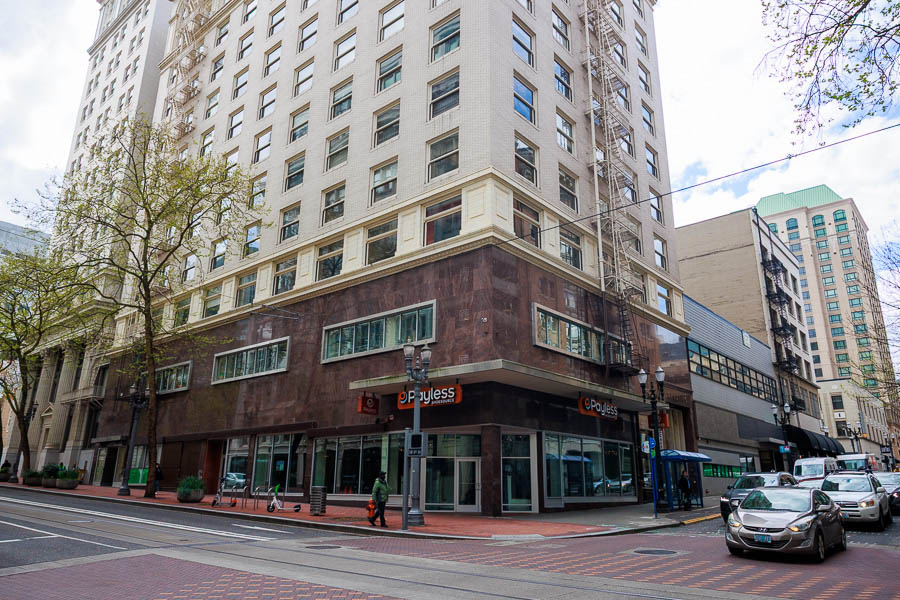
So we’re in the historic Selling Building. It’s on the National Historic Registry. It’s a 12-story building and it’s been home to many different retail establishments over the years. Most recently, it was a Payless shoe store. The building was an A.E. Doyle building and it’s owned by the fourth generation Oregon family, the Schlesingers. We’re working with the Schlesinger family on a philanthropic partnership for the long-term lease of this space.
Historically,our organization has struggled with identifying a permanent location. That’s been the biggest challenge for the James Beard Public Market. In other cities around the world, usually what happens is a municipality, some kind of government,will give an old terminal or other building for use as a public market, and then a nonprofit will operate it — or sometimes a national government will operate it, like with the Granville market in Vancouver, British Columbia.
As you might have read, there were different sites over the decades. There was the Morrison Bridgehead and there was a site near OMSI, and none of them really manifested. They were visionary ideas to put a public market back in Portland, and it just didn’t happen.
What’s really needed is an operating model that serves the mission of the organization, which is to benefit the community and our vendors. Having a philanthropic developer partnership with Schlesinger family, and then the ability to buy the adjacent building next door, which will allow us to operate a model where vendor rents cover the costs to operate the James Beard Public Market. So there’s the Selling building, there’s also the building next door, the Ungar Building, and they both represent roughly 38,000 square feet of downtown retail space. A Portland city block is 40,000 square feet. So we’re just shy of a full Portland city block.
How does this compare with previous visions of the project?
It’s in line. Ideally, when you’re looking for a public market location, you’re looking for access to transportation. Obviously, here we have the bus stop and we have the MAX line. You also look for foot traffic, and Pioneer Square is one of the most heavily foot-trafficked parts of downtown Portland. Pre-pandemic, it got around 15 million people. You look for lots of residents or tourists. So here, there are around 9,000 hotel beds in this downtown area. You build a public market for residents, but you’re also looking to bring tourists and make it a destination. So the hotel beds are a big, big factor. And then, of course, you have all of the events and activities in Pioneer Square. So all of those things came into play. You also want a space that’s roughly 25,000 square feet. That’s kind of the sweet spot. This gives us around 40,000 square feet.
But the most important piece of it is we own a building. That’s very different than having a long-term lease, where we are kind of at the whim of a landlord. Having that kind of permanency, owning a building, has really moved this project forward. And that’s really given a lot of confidence to the community that this long-awaited vision is really going to happen this time.
How important is the funding bill in Salem?
The capital construction request that we have for $10 million of lottery bond funds is critical in that urgency piece. We know that the construction request fits nicely with the goals of the lottery bonds, which is construction as well as economic development.
Based on our [state] constitution, funds that are lottery bonds have to be used for construction. For us, this is a strategic ask, and we know that we are not going to be going back to the public sector over and over and over again for this project. The idea is that we become self-sufficient, because our vendor rents cover our operating costs. We need this one-time investment from the public and private sectors to get this open and then the economic output in the job creation and the small business creation we’ll see is an additive.
So that funding is critical. We’re asking the state to fund 32% of the total construction cost, which we feel is a really great value proposition. We will not be subsidized by the public sector or the private sector. We will be able to be self-sustaining and operating within our business model.
I imagine it’s stiff competition to become a vendor.
Yeah, we opened up our applications on Jan. 30 and we closed it March 30. We got over 100 applicants. So the vendor application process has closed but we have not selected all the vendors.
What are you looking for in vendors?
Well the mission here is to promote Oregon’s bounty, so we’re looking for vendors who use local, seasonal ingredients. And we’re looking for vendors who are either experienced operators or for whom this is going to create a pathway to economic opportunity. So, somebody who has a really great idea for a product, or they have a really great business idea but maybe they haven’t been able to get their own brick-and-mortar. Or maybe a food cart isn’t the right model for their product.
We want to be able to create entrepreneurial onramps for a diverse array of vendors. And public markets historically have been places for underserved communities, new arrivals and individuals who maybe can’t access capital. A public market provides that seven-day-a-week opportunity where they can operate. And there are markets all over the country where maybe someone is selling pudding, or they’re selling soup, or they have a specific sauce that they’ve perfected. People can do really well in markets with just one or two items. So we’re looking for vendors who are really excited about what a public market can do. And we’re looking for vendors who are passionate about their craft.
And another part of this is that we’re honoring the legacy of James Beard. A lot of people don’t realize that James Beard was born and raised here. The public markets in Portland played a huge role in influencing his life. He and his mother would go to the Yamhill Public Market and that’s where they would shop for their cheese and get their vegetables and fruit. And I imagine James Beard has walked by this building many times. So part of it is we’re bringing back a part of Portland history, but it’s also an opportunity to bring back public market culture. We had public markets before. We were actually one of the earliest cities in the country to have public markets. We’ve had three different ones, one starting in the 1800s, and the last one shuttered in 1941, the Yamhill Market. So in many ways, it’s kind of a throwback.
Click here to subscribe to Oregon Business.