
The Central Oregon town of Shaniko — once a hub for wool shipments — went bust more than 100 years ago. But locals are slowly working to bring the ghost town back to life.
In a cramped backroom “speakeasy,” local Selina Kephart, 64, pushes a shot of whiskey toward me. I shake my head no, despite the old-time legend that a fellow was shot in Shaniko simply because he wouldn’t have a drink with another fellow.
Next to me, Craig Nichols, 72, the manager at neighboring R2 Ranch, leans over his guitar to grab his own whiskey from atop a vintage wooden stereo the size of a picnic bench. He takes a slug, tips back his cowboy hat and croons HARDY’s 2022 country-rock murder ballad, “Wait in the Truck,” to an audience of three, adding an extra verse at the end that he wrote himself.

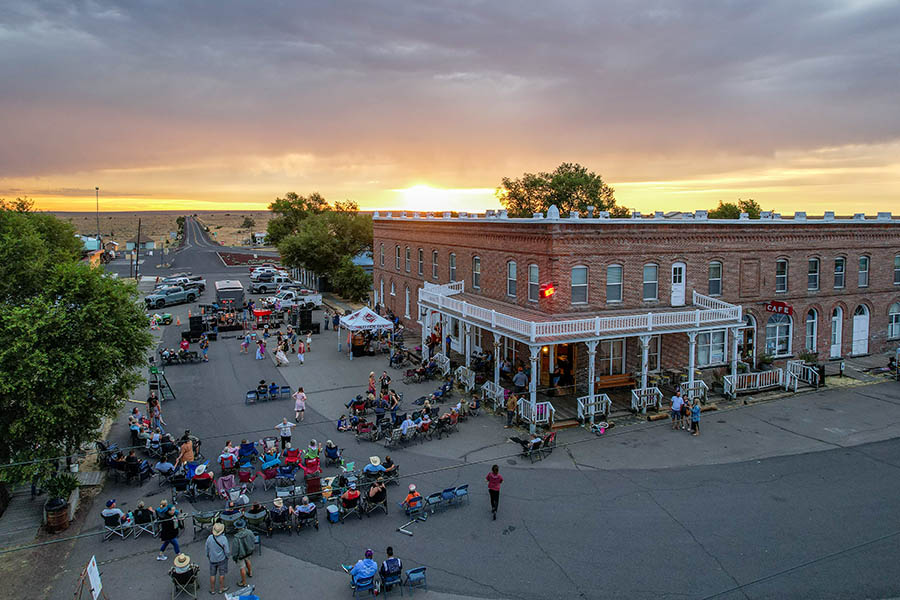
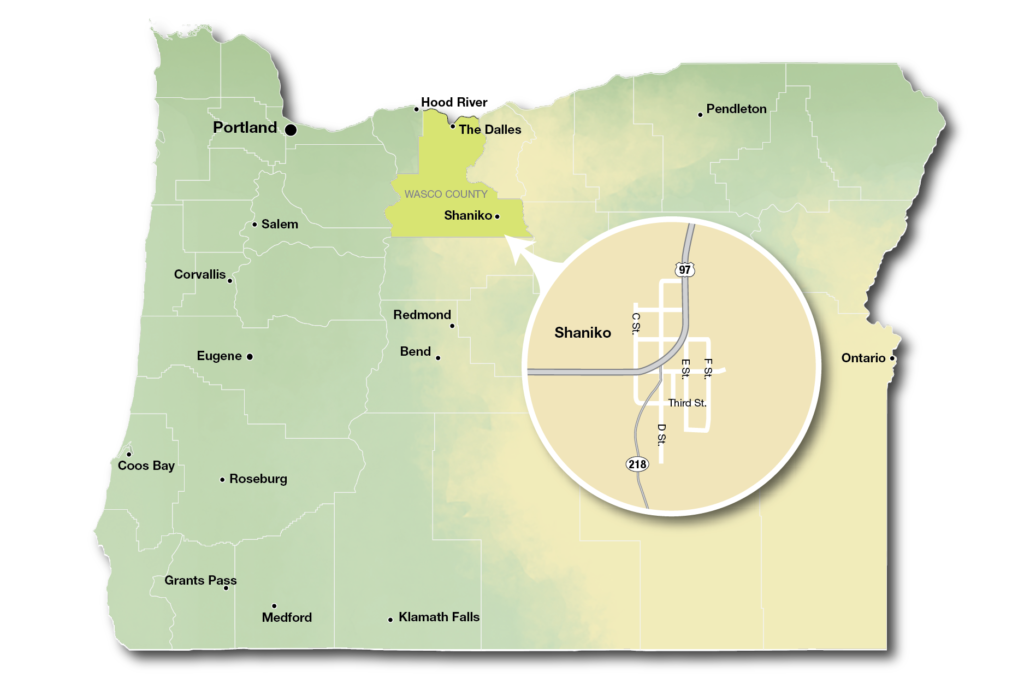
Spontaneous music is not uncommon in the Central Oregon ghost town of Shaniko (pop. 31), a 40-minute drive northeast of Madras. Though the town has been in various states of decline since it busted in 1911, Shaniko is having a moment. Music seems to be at the heart of it, drawing tourism for music festivals and Second Saturday back porch concerts. But beyond that locals are working hard to lay a sustainable foundation for growth, striving for a balance between preserving the past and surviving the present. The Shaniko Wool Company, for example — a Wasco County farm group that markets and sells sustainable merino wool — supplied wool for Team USA’s uniforms for this summer’s Olympics, which is fitting given the region’s history as a wool-shipping powerhouse.
As it turns out, breathing life back into a long-busted ghost town requires a lot of work, even more love — and a little luck.
“There’s been a resurgence in Shaniko, with the hotel and gas station reopening,” says Scott Marrs, the manager of Shaniko Hotel. “Cowboy music, bluegrass, and ragtime are a good part of the momentum. But car and quilting groups are also coming. Everyone feeds off of everyone else’s enthusiasm. It feels like it’s snowballing.”
The Main Street Approach
That isn’t to say the town doesn’t still battle old existential challenges. “Shaniko faces the same dilemma as many rural small towns,” says Amy Hause, deputy director of Rural Development Initiatives, a nonprofit that supports economic development in the Pacific Northwest. “Meager tax base, no housing, no school, no child care, few jobs — it’s a complex nut to crack. But a lot can happen in communities that rebuild from their assets, which is what Shaniko seems like it’s doing with its music and historical appeal.”
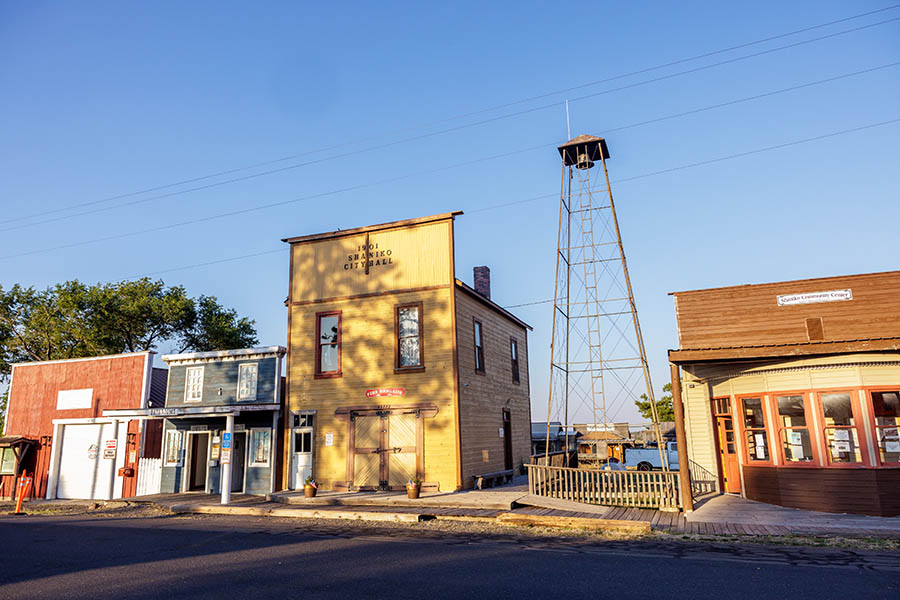
Hause points out that Shaniko has unassumingly taken the Main Street Approach, a common development framework that encourages incremental, community-based revitalization aimed at rebuilding the downtown main street and supporting local business.
Shaniko’s main street — or E Street and 4th Street in the town’s case — is a crossroads in the middle of a sea of grasslands. Snow-peaked Cascades interrupt the distant horizon, and the strong winds smell of sage. If you sneeze while passing through, you might miss the blip of rickety plank boardwalks, century-old wood-framed buildings, and a historic hotel that have somehow survived the collapse of the wool industry and three major fires.
Though Robert Pamplin owns the majority of Shaniko’s properties (see sidebar, p. 47), Ernie Martin owns a good deal of the rest, including historic buildings on the main drag, south of Shaniko Hotel. In 2022 Martin put a huge effort into saving and beautifying the dilapidated properties, which his father, Ed Martin, first purchased in the ’60s. Before passing away in 2008, the Salem native managed to save four historic buildings from being destroyed. He was famous for saying “Like hell” when anyone tried to tear something down.
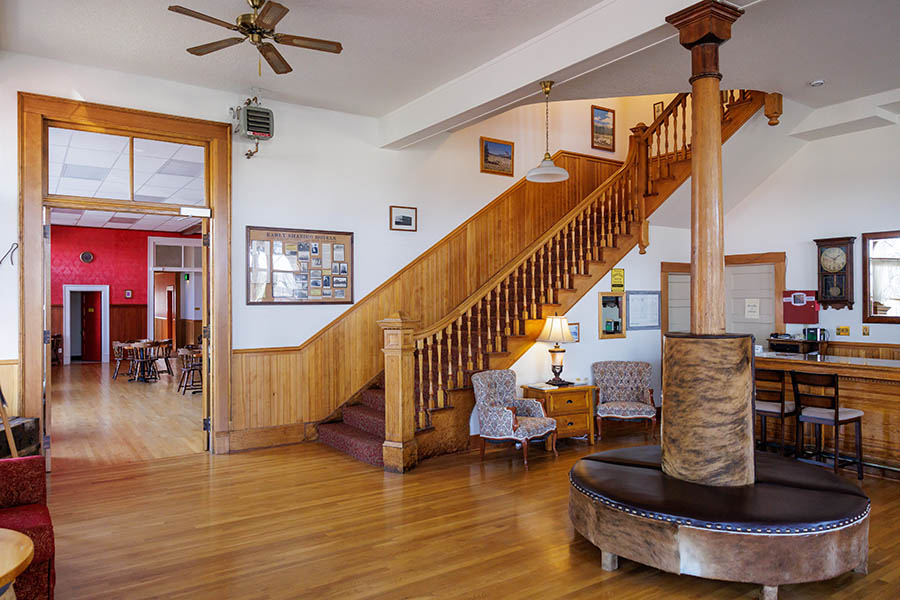
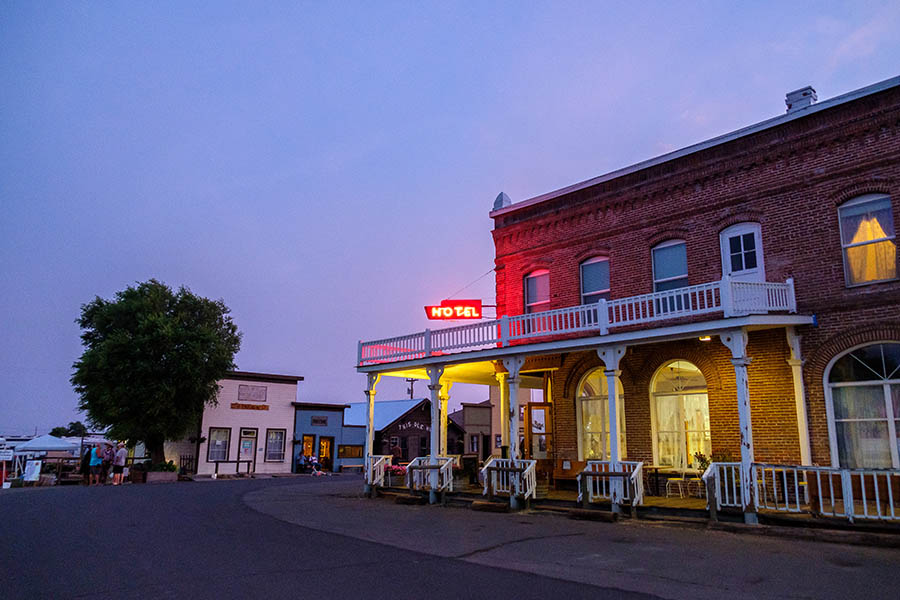
Though Pamplin’s Shaniko Hotel is the centerpiece of the town, reflecting early 20th- century Western architecture, kitty corner from it is an example of Martin’s restoration: He refurbished the old schoolhouse coat room, which he calls the “Stage Stop,” and it has gorgeous Western-themed photography on exhibit inside.
“My dad was a visionary for Shaniko,” says Martin, who notes that his father organized the first Shaniko Days festival 50 years ago. “I’m proud of what he did here, and I hope I can take it to the next level, maybe build a Conestoga wagon camping park or cowboy cabins. You could say I’ve also been bitten by the Shaniko bug.”
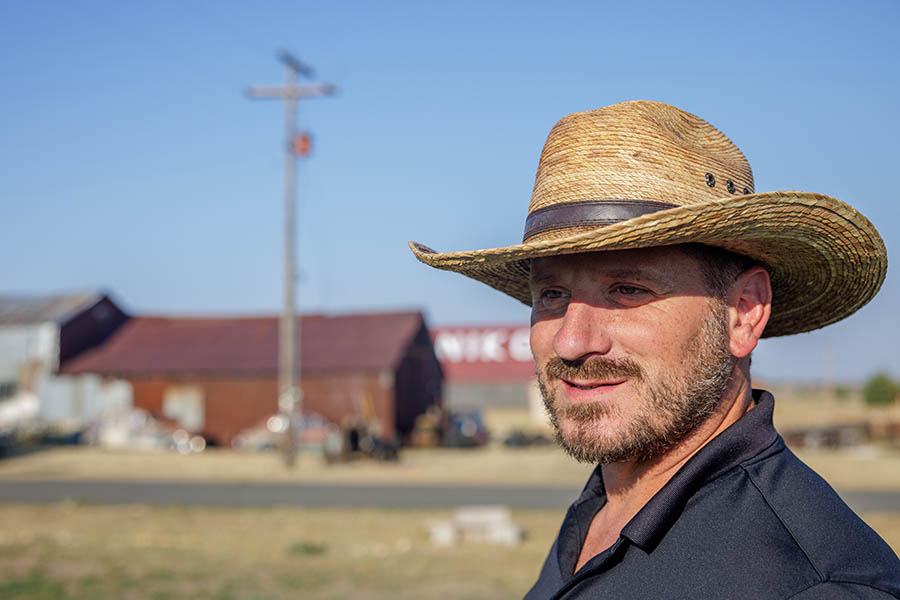
Although Martin is working hard on his nine properties, parts of the ghost town still look like they’ve been kicked in the teeth. And they have, almost literally: A semitruck crashed through the ice cream parlor years ago and it has yet to be repaired. In the face of all the obstacles, Shaniko holds an irresistible allure for history buffs, music lovers, and people simply drawn to rough-edged authenticity.
When musician Pam Brown, 39, and her husband, Mark Haskett, 53, were up from San Francisco for the Tygh Valley Bluegrass Jamboree in 2018, they stopped over in Shaniko and played music on the stairs of the closed hotel. The next thing Brown knew, she was pulling an American flag out of her Westfalia to hoist up the town’s naked flag pole. Then the couple and a small group of locals sang “My Country, ’Tis of Thee.”
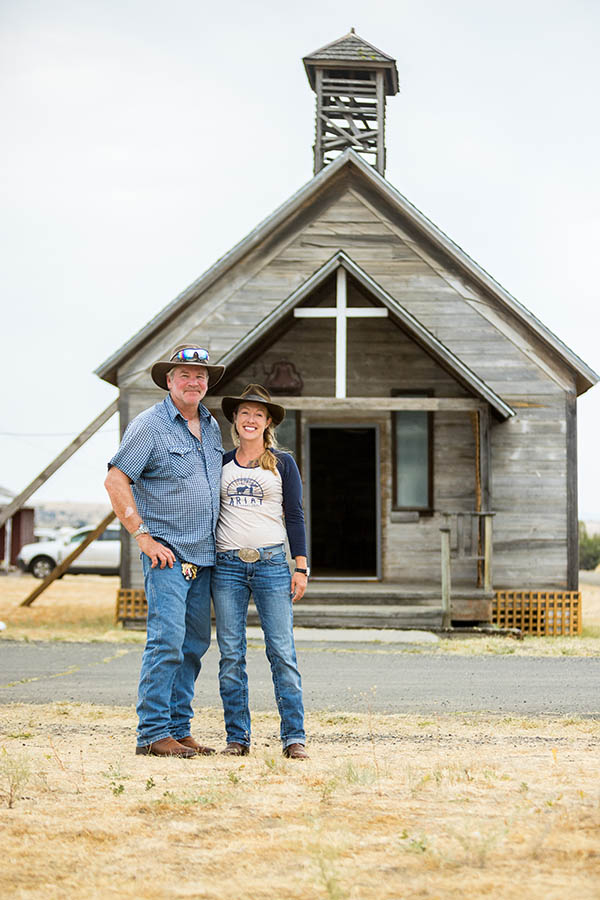
“That was my Shaniko moment,” says Brown, who used to work in marketing for a real estate firm. “Even though we weren’t looking to move, I was warmed up when Mark suggested we buy the closed-down gas station. Now we’re here.”
Not only has the couple opened the gas station, which draws visitors in Shaniko’s direction, Brown became the local liaison for Travel Oregon’s Destination Management Studio in Central Oregon, which aims to drive visitation to rural communities.
Additionally, the couple bought the town’s chapel, which they love to use as a music venue. This year they threw the first annual Memorial Day weekend Hoot, Holler & Sing Bluegrass Campout, which drew 40 people. The event garners support for their nonprofit Shaniko Music Sanctuary — which brings music education to the South Wasco County School District and has reignited music in the schools after nearly a decade without a program.
“I had a carful of folks coming through the gas station who only spoke Italian,” Brown says. “We ended up playing music. I tell you what, if that Italian guy didn’t sing some Johnny Cash. Music breaks down barriers. Whether you share a language or not, music teaches listening. Sometimes in this world, we are waiting for our time to talk, but playing music, you have to open your ears and respond.”
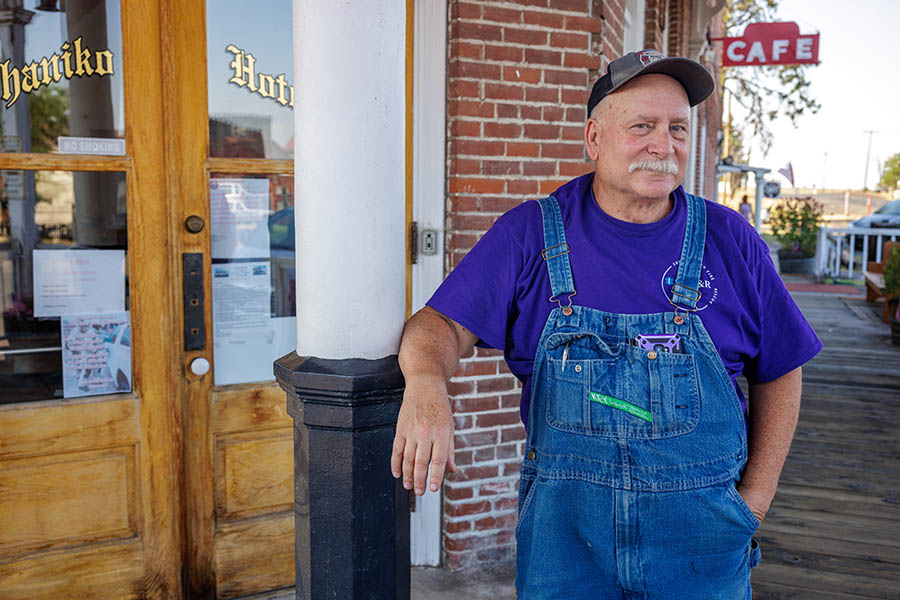
Like Brown, Marrs also fell under the spell of Shaniko and moved there in 2017 with his wife, Diana, after he retired as a maintenance and facilities manager with the State of Oregon. “Once Shaniko gets a hold of you, it’s got you. It’s a mystery.”
Marrs was key to reopening the Shaniko Hotel in 2023 after a 15-year closure. Its owner, Robert Pamplin Jr., had closed it after a heated dispute over water, neither leasing nor selling the hotel afterward.
When he moved to Shaniko, Marrs realized that the town was in a no-man’s land for emergency services. “If you called 911, an ambulance was an hour away,” says the former volunteer firefighter.
Subsequently, Marrs and fellow volunteer David Long founded the South Wasco Fire & Rescue Association (SWFRA), a nonprofit that responds to fire and medical emergencies for 400 square miles. But even with grant support, they needed a funding source.
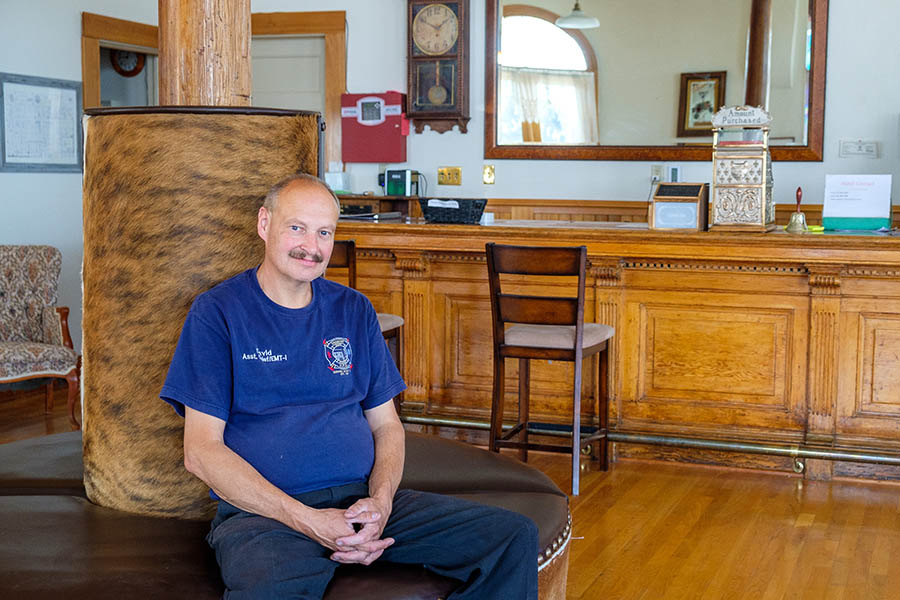
Having Fire & Rescue was in Pamplin’s interest because he owns the 80,000-acre R2 Ranch in the area. “In Central Oregon, it’s not if you are having a wildfire but when,” says Nichols, the R2 ranch manager. “Our buildings and property are vulnerable.”
After brainstorming with Nichols, Marrs hatched a plan to reopen the Shaniko Hotel and Firehouse RV Park down the road (another of Pamplin’s properties) and funnel the profits to the SWFRA. Pamplin greenlighted the plan.
In August 2023, Shaniko Hotel and Shaniko Firehouse RV Park opened for business. On a volunteer basis, Marrs manages the hotel and RV park. He is also the town’s volunteer water master and fire chief. The hotel and RV Park’s (paid) assistant manager is Long, who is also the Shaniko City Council president and volunteer assistant fire chief.
Recapturing the Magic
That workload is par for the course in small communities trying to grow.
“Most rural development is accomplished by people going out and doing stuff, which can mean individuals wearing 17 different hats,” Hause says.
“Everybody here makes other people look lazy,” says Kephart, owner of Raven’s Nest antique store in Shaniko. “Along with everything else they do, Scott and Diana Marrs always help me out with Second Saturday.”
On the second Saturday of each month, Shaniko hosts a music jam and potluck. The nearly decade-long tradition almost petered out in 2019 before Kephart decided to take over. “I just love music, but I did it to bring the community together. Everyone is welcome, whatever your politics, race or where you live,” she says.
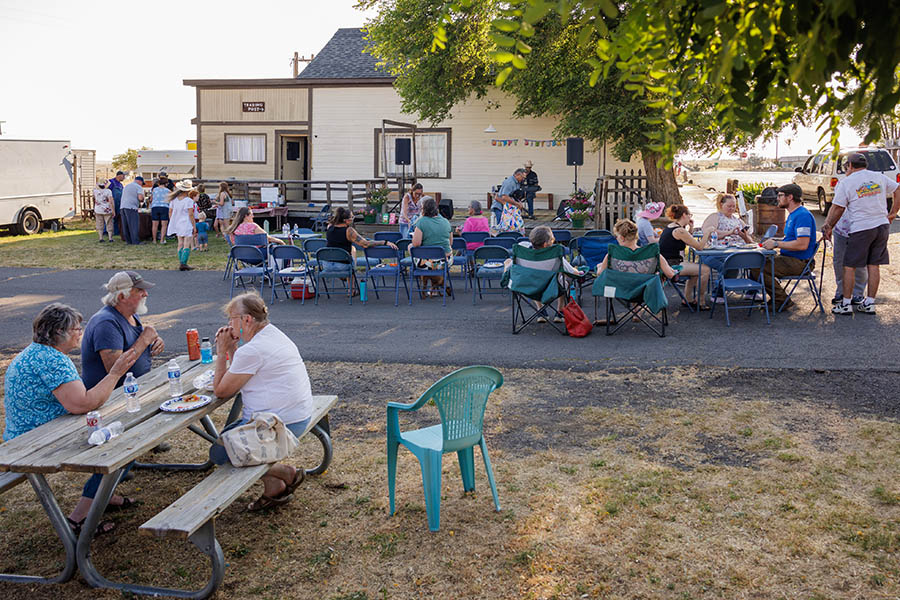
Musicians take to the little stage behind the Raven’s Nest around 6 p.m., and 20 to 50 people come out to listen and eat each other’s food. Sometimes the dramas of Shaniko could make reality TV producers blush, but that all is put aside for these couple of hours where everyone comes together.
Like Second Saturday, Shaniko Days, the town’s hallmark music festival, was languishing. Sandy Cereghino, who has been organizing Shaniko Days since 1988, laments the sag in tourism after the hotel closed in 2008. “The success of Shaniko Days is hitched to the success of the hotel. We have limped along all this time with no place for people to eat or stay.”
The hotel reopening last year made a huge difference for Shaniko Days. Plus they booked Countryfied, a very popular headliner, and that added to the momentum. This year the 50th anniversary of the festival, Countryfied is returning and the crowd is expected to be much bigger than previous years. “Could be 300 or 3,000;— we don’t know,” conjectures Cereghino.
Shaniko leans on tourism to fuel its comeback. “Small towns like this have to figure out how to sustain themselves with drive-by traffic and tourism,” says Jessica Metta, the executive director of Mid-Columbia Economic Development District. “Their local population just isn’t large enough to support businesses.”
However, there are common challenges for small towns looking to develop themselves as tourist destinations, such as failure of local stakeholders to collaborate and loss of authenticity. “Communities should embrace their history,” says Kristin Dahl, who created the Destination Development Department at Travel Oregon and founded Crosscurrent Collective, a destination-development consultancy. “It’s important for locals to come together collaboratively, understand the roots they’re building on, and determine the stories to celebrate and stories to honor in silence.”
Cereghino, who got married in Shaniko in 1988 and has been a part of Shaniko ever since, is one of a handful of locals trying their best. “Shaniko was magic at one point. It can be again.”
History of Shaniko
In 1879 tiny Shaniko was named after its first postmaster, August Scherneckau (phonetically similar). Its ship came in around 1900 when the Columbia Southern Railroad connected Biggs Junction to Shaniko. Quickly the town became known as the Wool Capital of the World. Millions of pounds of wool were stored in the warehouse for export annually, not to mention wheat crops. In 1909 the Ruralite newspaper noted that “little old Shaniko is in the swim of a genuine western boom . . . there is not a vacant room, residence or habitable shed in all of Shaniko. Some families are living in tents.”
More than a dozen saloons dotted the growing town. “Saloons were the first places to play music in pioneer towns,” says Debra Holbrook, Shaniko’s city recorder and resident historian. “Shaniko has strong musical roots. Sheep herders and cowboys have always been known for singing to their livestock.”
In 1911 an alternative rail line was built, diverting traffic and commerce away from Shaniko. In 1959, as the town’s population dwindled, the Oregon Centennial Commission named it Ghost Town of the Year, cementing its reputation as a destination for ghost-town aficionados and attracting the attention of those interested in preserving historic buildings.
Efforts to revive Shaniko have their own history: In the Shaniko Hotel lobby, articles (not unlike this one) are on display from the 1960s and ’70s in which writers — all of them likely dead now — herald Shaniko’s imminent comeback. Maybe this time it will stick.
Pamplin’s Shaniko
In 2000 Shaniko Hotel came up for sale down the road from R2 Ranch owned by Robert Pamplin Jr., longtime business magnate at the helm of sprawling investments from gravel to wineries. As a historic preservationist, Pamplin’s interest was piqued. “He started reading up on the history and bought the hotel. Then he started buying up other properties that came for sale — over half of the real estate in Shaniko — like the ice cream parlor, wool barn, RV park,” says Craig Nichols, who has worked for Pamplin at R2 for 25 years.
For seven years, Pamplin, who has recently been in the news for a pension- plan controversy and the decline of his business empire, worked in good faith to revitalize Shaniko. However, the relationship eventually soured. Conflict arose, as it often does in Central Oregon, over water. In 2008 the Shaniko City Council and the State of Oregon denied Pamplin an easement for a well on one of his lots. He wanted a more reliable source of water for his properties. In response, he shut down the hotel, cafe and RV park and abandoned plans to build housing for tourism workers. For 15 years he wouldn’t sell or lease the hotel. It was a huge blow to a town that was already teetering.
It wasn’t until August 2023 that Shaniko Hotel and the RV park reopened. Pamplin agreed to let Scott Marrs, the fire chief of South Wasco Fire & Rescue Association, manage it on a volunteer basis, allowing the profits to funnel to the fire and rescue organization, which provides protection for Pamplin’s R2 Ranch and surrounding areas.
This spring Pamplin’s 539-acre ranch was listed for sale. On it sits a 100-year-old, six-bedroom, five-bathroom house filled with Western movie memorabilia and Western-style decor. The property was originally listed at $4 million; by the end of July, the asking price was $2 million. By early September, when this issue went to press, the listing had been removed. Listing agent Joe McDonald told Oregon Business the property had not been sold but had been removed from the market.
Per the listing, Pamplin signed the listing contract on May 28, just days before it was announced that Pamplin Media Group — which owned 25 newspapers in Oregon — had been sold to Mississippi-based Carpenter Media Group, which owns 180 publications in the U.S. and Canada.
The June press release announcing the sale of the newspapers cited Pamplin’s age and health as the primary drivers for the sale. Pamplin, who is 83, declined to be interviewed for this story, but Nichols told OB in June that about half the land Pamplin owns in the area — about 40,000 acres of 80,000 — was for sale. The cattle were also sold this spring, and Pamplin’s staff is no longer farming the property, according to Nichols. In early September Nichols said Pamplin was not in a hurry to sell, but that the property had recently been appraised and he would consider a sale to the right buyer.
The status of Pamplin’s assets, including the Wasco County land, was further muddied in mid-September when federal regulators sued both Pamplin as an individual and the R.B. Pamplin Corp. The Department of Labor’s suit, filed Sept. 12 in federal court, alleges that he violated the Employee Retirement Income Security Act by engaging in more than 100 real estate transactions transferring land owned by Pamplin Corp to the company’s pension fund. The DOL has requested that the court require Pamplin and his company to “restore all losses the Pension Plan has suffered resulting from their fiduciary breaches, plus interest.”
— Ellee Thalheimer
Shaniko’s Music Scene
• Shaniko Days
First weekend in August
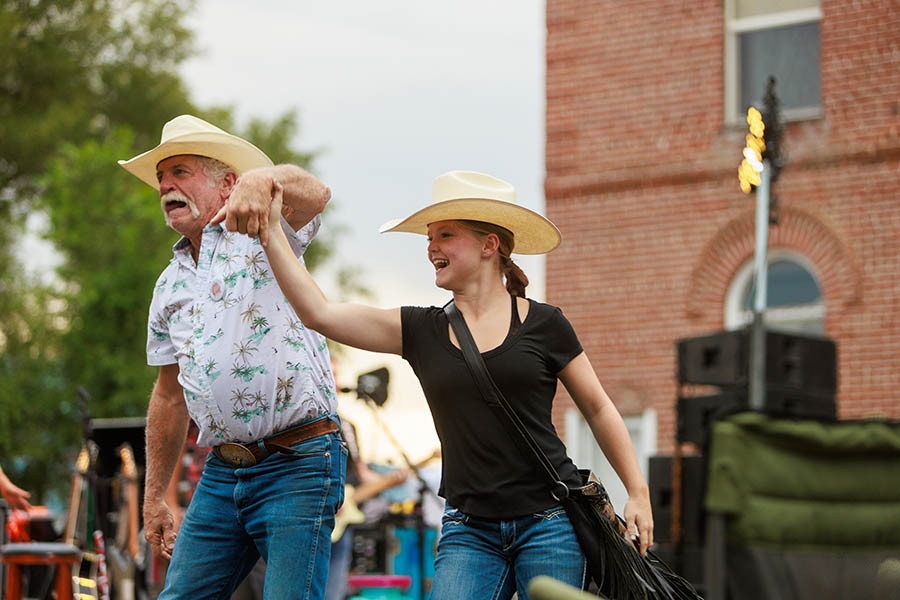
Over the last 50 years, Shaniko Days has brought gospel, country and bluegrass music to Shaniko, enlivening its dusty intersection with gunfighting, gospel music, cloggers and street dancing. The weekend-long festival draws people from all over.
• Hoot, Holler, and Sing Bluegrass Campout
Memorial Day weekend
After a successful first year in 2024, gas station owners Pam Brown and Mark Haskett will annually host this weekend of music and camping to benefit their nonprofit Shaniko Music Sanctuary, which brings music education to rural Wasco County.
• Second Saturday Potluck and Music Jam
Monthly, 6 p.m.
Once a month, folks from the area bring a casserole or a tray of cookies and listen to music that Selina Kephart lines up. Sometimes the audience joins in as well. The event is held out back of Kephart’s antique store, the Raven’s Nest.
• Shaniko Ragtime & Vintage Music Festival
First weekend in October
This 22-year-old ragtime festival was born from an impromptu jam session inspired by a Shaniko saloon piano, first tuned in 1912. Over the weekend, Keith Taylor and other musicians come together in Shaniko and other small venues of North Central Oregon to celebrate the music of yesteryear. (Editor’s Note: After the September issue went to press, OB learned that the Ragtime Festival will not be taking place in Shaniko in 2024.)
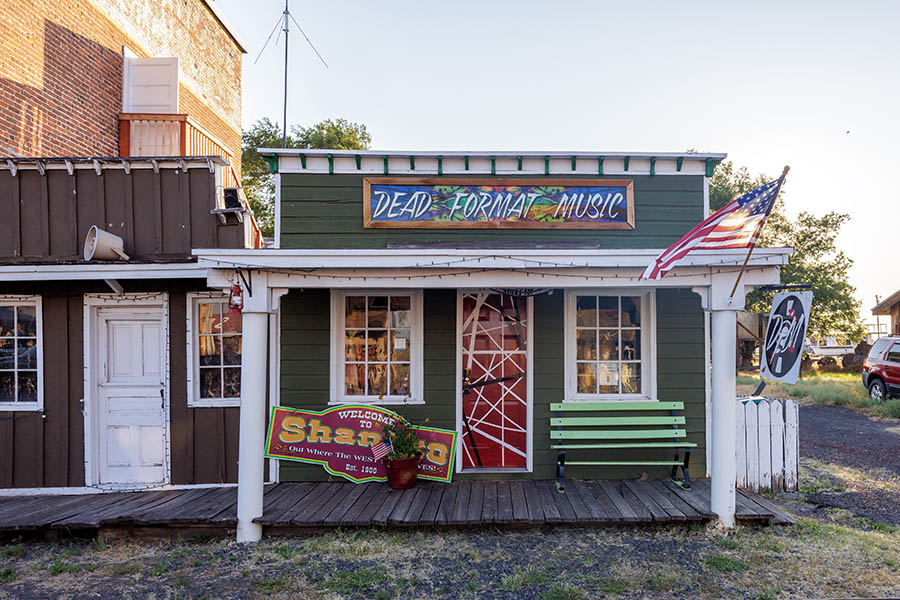
• Dead Format Music
Various hours
On the same block as the hotel, this tiny storefront sells records, guitar strings, picks, DVDs, and VHS and cassette tapes. It also broadcasts a renegade classic-rock and old-country music station, 99.9 FM, “The Ghost.”
Editor’s Note: This story has been updated from the version that ran in the September 2024 print edition of Oregon Business to include updated information on Robert Pamplin’s real estate holdings and legal issues.
Click here to subscribe to Oregon Business.