
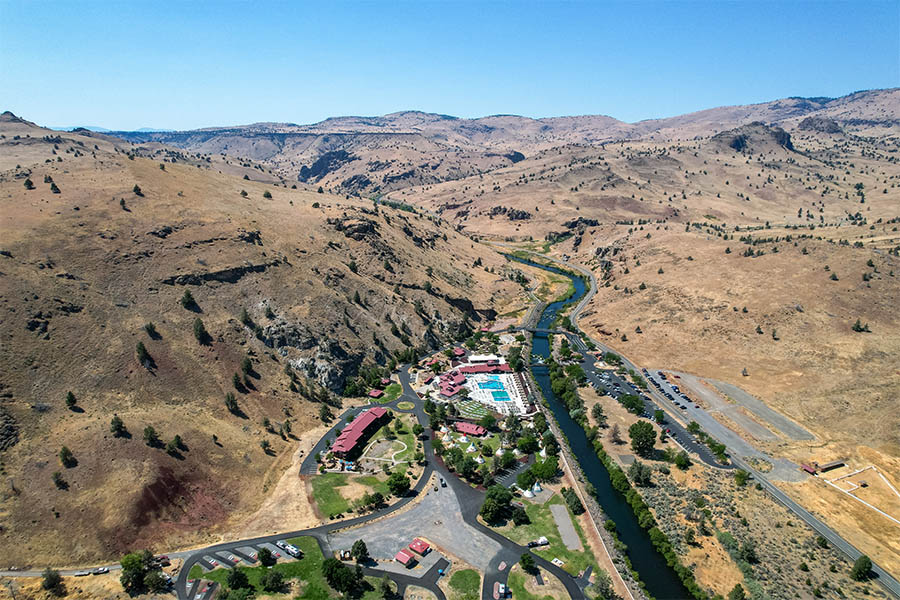
The Confederated Tribes of the Warm Springs team up with Mt. Hood Skibowl to revive the Kah-Nee-Ta Hot Springs Resort.
Growing up on the Warm Springs reservation in the 1960s, Charles Jackson’s first job — after mowing neighbors’ lawns — was in the maintenance department at the tribe’s new hot springs. He spent the days jumping on and off the back of his grizzled supervisor’s Datsun pickup, emptying 50-gallon garbage drums.
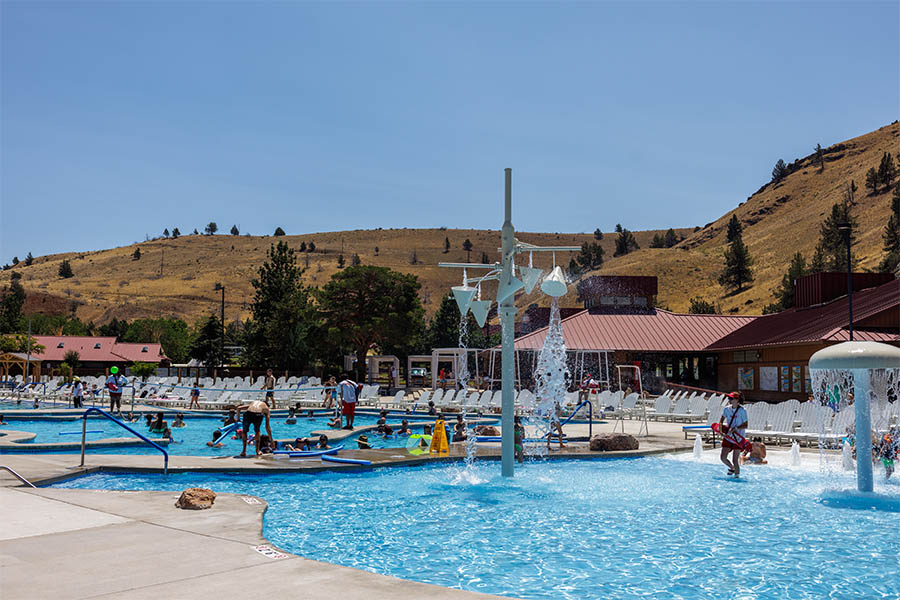
Then he realized that the lifeguards at Kah-Nee-Ta Village probably had more fun. Starting in 1966, he worked around the resort’s Olympic-size pool every summer, as well as part-time and on weekends while in high school. “I thought it was the greatest job a kid could ever have,” says Jackson, who is now a tribal elder at the age of 75.
The Kah-Nee-Ta Hot Springs Resort is around 100 miles southeast of Portland, 50 miles from Government Camp, and 70 miles from The Dalles. Generations of Oregonians have trekked through the high desert to visit its mineral waters. Even if you’ve never been there, you’ve been there. Because while Kah-Nee-Ta itself is 15 miles off of Highway 26 on the 1,019-square-mile Confederated Tribes of the Warm Springs Reservation, both those waters and the tribe are part of the same history and ecosystem as Mt. Hood and the Columbia River.
In September of 2018, Kah-Nee-Ta was shut down — yet another economic blow to a consistently poverty-stricken Oregon community that had already lost its forest-products mill in 2016, and also a symbolic one given the water’s role in tribal culture. For the next six years it sat unvisited, if not entirely forgotten. Even as the tribe struggled to come out of the COVID-19 pandemic, and was focused on securing $22 million in desperately needed federal funding to update the reservation’s water-treatment plant, Jackson and others were also taking steps to bring the hot springs back, this time with an outside partner. Renovated, reimagined and reopened in July of 2024, Kah-Nee-Ta remains owned by the tribe through its Warm Springs Economic Development Corporation, which also entered into a 15-year management and operations agreement with Mt. Hood Skibowl.
It’s a natural pairing, both historically and geographically. Skibowl owner Kirk Hanna and his brother Derek Hanna — sons of car-wash entrepreneur Dan Hanna — grew up going to both Mt. Hood and Kah-Nee-Ta. In 1987 Kirk, who was then in his late 20s, purchased Skibowl out of bankruptcy and began to turn it into the day-trip and vacation spot it is today, including the addition of night skiing and the summertime Mt. Hood Adventure Park. Today Hanna has 10 loosely related companies, including the Collins Lake Resort, the Ratskeller bar and pizzeria at Government Camp, Mt. Hood Outfitters, and the Lake Simtustus Resort.
“It’s a pretty soulful land,” says Kirk. “A special place. Just dropping in there and experiencing the water and the culture. There was a void when it shut down.”
Tribal members have always come to Mt. Hood, both for fun as skiers and snowboarders (including school and community bus trips) and as ski resort employees. Their access to fishing and huckleberry picking around areas that lie within Mt. Hood’s resorts is also guaranteed in perpetuity by the Treaty of 1855, which moved three distinct tribes — Warm Springs, Wasco and Paiute — onto a single reservation (thus, the “Confederated Tribes,” and a continued tradition of three different chiefs).

When Skibowl began a series of renovations on the east side of the mountain, Kirk thought that the resort could also add some balance to a region where the river is still named after Columbus, and Government Camp by settlers to commemorate a U.S. cavalry regiment. “I kind of woke up and looked around … and understood that the history wasn’t told in the area,” he says.
The Wiwnu Wash Mt. Hood Tribal Heritage Center opened in 2012, and each year since then, Skibowl has had a celebration on the mountain. Now the mingling of Oregon tourists with tribal members and traditions will happen once again year-round, at Kah-Nee-Ta.
Shifting Waters
The Confederated Tribes of the Warm Springs have always been known for being entrepreneurial. In Jim Souers’ opinion, the tribe was in the “top third of all tribes in the nation in terms of developing business enterprises on their reservations.”
Souers, now the CEO of Warm Springs Economic Development Corporation, is an enrolled member of the Cheyenne River Sioux Tribe of South Dakota. But he was born in Central Oregon and grew up on the Warm Springs reservation (his father worked for the Bureau of Indian Affairs’ Roads Department). Now 64, he still remembers how other tribes used to come to Warm Springs to learn about economic development. The mill that became Warm Springs Forest Product Industries was purchased by the tribe in 1962; it acquired and opened Kah-Nee-Ta around the same time.
The springs had originally been allotted to the tribe when it moved to the reservation. It was then sold to a local non-Native doctor, who’d begun charging a few dollars for admission to what was then not much more than a hole in the ground. “Before Columbus found the Americas, our people were using these hot springs,” says Jackson.
The tribe bought it back, taking advantage of Bureau of Indian Affairs and U.S. Economic Development Administration grants to develop tourism, as well as settlement money from the 1957 destruction of Celilo Falls — a historic fishing spot of both economic and spiritual significance — due to The Dalles Dam.
Kah-Nee-Ta was originally owned and managed directly by the tribe; that eventually gave way to distinct business structures with independent boards, which is how the Economic Development Corporation operates today. In addition to Kah-Nee-Ta, it oversees a composite-products company that makes door cores (in 2009 it supplied them for Burj Khalifa in Dubai, the world’s tallest building) and several other enterprises, including construction, environmental services and a cannabis company.
Kah-Nee-Ta began expanding in 1972, with the addition of a golf course, a lodge, tennis courts and horse-riding trails. Then in 1995 came the Indian Head Casino, inside of the lodge. It all worked well enough in tandem, but, Jackson and Souers say, Kah-Nee-Ta Village (as the hot springs area is known) eventually came to be an afterthought compared to the casino. But Indian Head’s location 15 miles from town also limited its potential customer (and employee) base. After a failed attempt to relocate closer to the Gorge, Indian Head moved to a spot right on Highway 26 in 2012. And while the hot-springs village remained profitable on its own in the ensuing years, the emptied-out casino and vacant lodge put the overall endeavor in the red, leading to its 2018 closure.
“The closure had a dramatic impact on the tribe,” says Souers, “especially as an employer.” Unofficially, he says, unemployment on the reservation was at 30% or higher between the closure of Kah-Nee-Ta and the start of the COVID-19 pandemic. (State unemployment data does not account for tribal unemployment, but the U.S. Census Bureau’s American Community Survey publishes estimated unemployment data every five years, with 13.2% for Warm Springs; in Jefferson and Wasco County, unemployment hovered between 4% and 5% in 2024.)
Charles Jackson is currently secretary/treasurer and a board member for the Warm Springs Economic Development Corporation. Known to his friends as Chas, he’s the third generation to be involved in tribal affairs, after his grandfather, Charlie, a cattleman who was the chairman of the tribal council for a lot of years, and his father, Vernon, who served as executive director/general manager of the tribe. Vernon was a key figure in the purchase of the mill, while his son was involved in much of Kah-Nee-Ta’s expansion, including the casino and the lodge.
Souers, who attended Oregon State after graduating from Madras High School, had a long career in tech and startups all over the country but primarily Silicon Valley. Back in the Portland area as that phase of his career wound down, he was already interested in helping the place he grew up in in some way. Then he saw a job posting for Warm Springs’ economic development CEO. It seemed meant to be, as did the return of Kah-Nee-Ta. It was Souers who took the lead in discussing Kah-Nee-Ta with Kirk Hanna.
“I said, ‘I think this can open and be successful again, what do you think?’” Souers remembers.
“I do too,” Kirk replied.
Coming Back
When word got out of the reopening, old visitors started clamoring to come back, and former employees were able to come back to work. During one visit by Oregon Business, the order taker at the restaurant during breakfast had previously been a housekeeper. At another, right when the resort reopened, tribal member Starla Green was the kitchen manager while her teenage daughter (and then-reigning Miss Warm Springs), Kahmussa Green, was working at the customer service desk. Their family is also directly descended from Xanita, the 19th-century tribal woman from whom Kah-Nee-Ta takes its name.
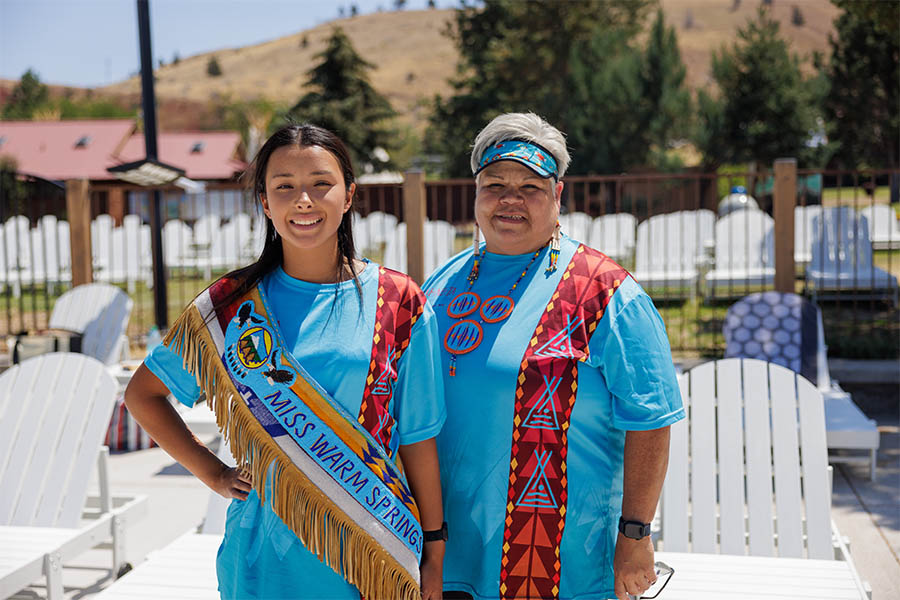
The rejuvenated resort is employing as many as 100 people (full- and part-time), though a lot of jobs are also seasonal (there’s no better time than winter for a hot spring, but summer is still peak). Skibowl handles the HR and also point-of-sale devices (it’s a cashless resort); 70% of the staff — including 50% of managers — are tribal members, according to Souers.
It’s both a paying job and one that provides work experience for teenage tribal members who can’t otherwise find jobs right on the reservation; there just aren’t very many food-
service or retail businesses in Warm Springs itself. There’s also a tribal bathhouse, and discounts and monthly free days for members.
“They’re the owners,” Souers says. “Quite often I’ll run into a tribal member, and we get introduced, and I say, ‘Well, I work for you.’”
Souers remembers going to Kah-Nee-Ta for a soak after playing in high school football games. Back then you might leave smelling of chlorine, and the water wasn’t very hot. Now the water in the pools comes out of the rocks at a temperature of 130 degrees Fahrenheit. “That’s too hot to put your pinky in, much less your tush,” says Jackson with a laugh.
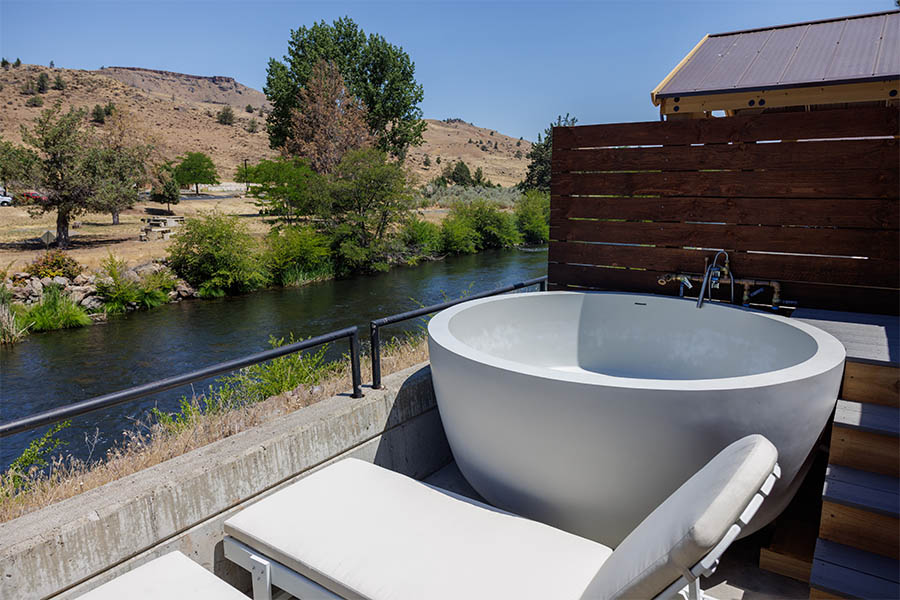
The water is mixed to be between 85 degrees and 110 degrees and contains 32 minerals. There are five hot springs (three for soaking, plus a heated pool and a heated “lazy river”), two separate ones for children (one hut tub, one heated pool), plus three cold-plunge tubs and 20 cabanas with private tubs (an idea they got from visiting the wildly successful Great Wolf Lodge chain of water-park resorts, which is also a tribal business).
And the water also no longer reeks of chlorine. According to Kirk, Kah-Nee-Ta is one of just two hot-springs resorts in America — the other is in Durango, Colo. — to use a purification system called Aqua Fusion, which infuses ozone bubbles into the water.
A Four-Season Destination
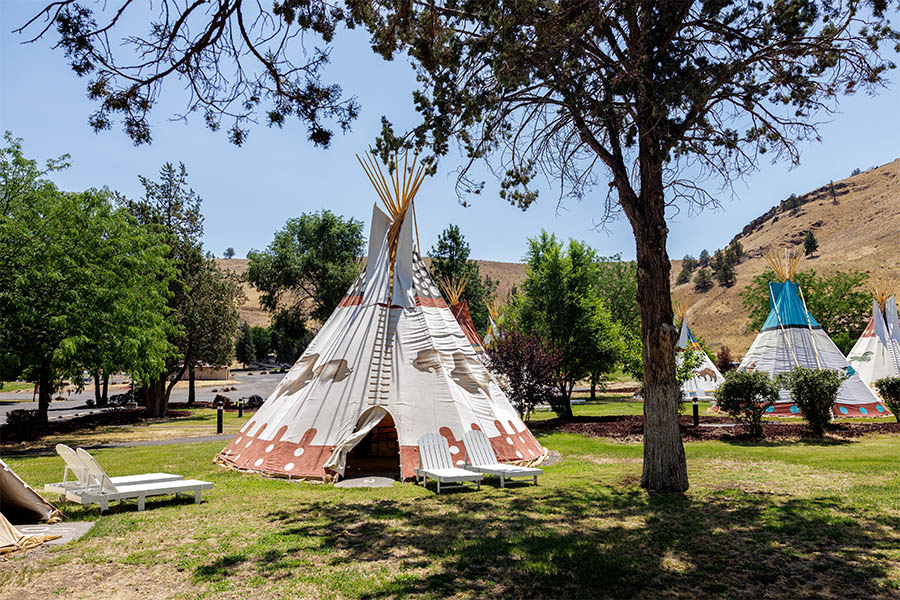
The previous iteration of the resort didn’t really emphasize the sacred, healing nature of the waters. It was more of a family “fun in the sun” experience, as Souers calls it. In that sense, while the casino’s departure helped kill Kah-Nee-Ta Version 1, its distance from the casino has allowed for Version 2. “We’ve now made this a hot-springs resort from a business standpoint,” Souers says. But it’s a hot-springs resort that also offers cultural tourism: Anyone who gets into the water at Kah-Nee-Ta is both explicitly and implicitly taking in the heritage, history and culture of the tribe, and the meaning of the land. Plus, they are also meeting and talking to members of the tribe while there. There are also salmon bakes with actual local fish, whether it’s wild or farmed (the hatchery is just upstream). The tipi accommodations feature work by local artists. One depicts “she who watched over the water,” a petroglyph/story from Celilo Falls, except now the water she is watching over is Kah-Nee-Ta. There are also plans for more storyboards and interpretive trails. They want people to see the Museum at Warm Springs and Tananawit Art Gallery, too (both off of Highway 26, near the casino).
They want more than just people from Portland and the Northwest. Kahmussa Green said the resort had already hosted visitors from around the U.S. — as far away as Minnesota — with most saying they remembered visiting in its previous iteration. The goal is to reach a national base of customers who might embrace eco/cultural tourism and see it as a four-season region, an entire Cascade mountain range vacation week that could stretch from Kah-Nee-Ta to Hood River, including several of Skibowl’s other properties (Lake Simtustus, in particular, is only 10 miles from Warm Springs). More expansion at Kah-Nee-Ta is hoped for, including a nine-hole golf course (it was previously 18), a bigger RV park, an outdoor amphitheater/event venue and an indoor water park.
All of which is ultimately mean to benefit the tribe and tribal members. “The tribe has an expectation that enterprises are going to employ people but also contribute back money into the tribe,” says Souers. When Skibowl made its pitch to partner up, he says it projected revenue that he found to be overly ambitious, which could have led to both unrealistic expectations and missed targets. Instead, Kah-Nee-Ta hit it in 45 days.
Kah-Nee-Ta in its later years was not making enough money to declare a dividend and put money back into the tribal coffers. When it was time to approve the new venture, the tribal council naturally wanted to know when they might expect that. But instead of having to wait for actual bottom-line profitability, Kah-Nee-Ta came up with a structure that essentially means the customers are paying the dividend directly — a tribal-development fee, which is kind of like a cross between a resort fee and a hospitality tax. Guests don’t strictly see it on their bill, but 8.5% of every dollar in revenue is set aside for it, and 80% of that becomes a quarterly dividend distributed to tribal members.
“We’re going to be able to achieve the kind of success that we wanted while employing a large number of tribal members and culturally connecting people [to the tribe],” says
Souers.
Click here to subscribe to Oregon Business.