
Hemp advocates have praised the crop’s durability and versatility for decades. Now Oregon State is partnering with Native American tribes across the West to study potential uses for hemp in economic development.
By Christen McCurdy
The Colville Indian Reservation includes fruit orchards, wheat, barley and alfalfa, as well as some specialty crops.
In 2018 the tribe — whose land is bounded by the state of Washington — decided to try a new one: hemp.
That was the year Congress removed hemp (and hemp seeds) from the Drug Enforcement Agency’s list of controlled substances — and authorized U.S. farmers to start growing the crop, the male cannabis plants, which are grown for industrial and consumable use, not for their psychoactive qualities.
It was an experiment, says Jackie Richter, conservation district manager for the Confederated Tribes of the Colville Reservation.
“It’s the first time as a farmer-producer that I’ve ever grown a crop where we didn’t have an end product or an end buyer, so that presented a multitude of challenges,” Richter tells Oregon Business. “But that was OK, because we were trying to learn how to farm this [crop]. How do we cut it? You know, what kind of equipment do we need, what kind of nutritional needs does it have? We spent the first growing season doing just that.”
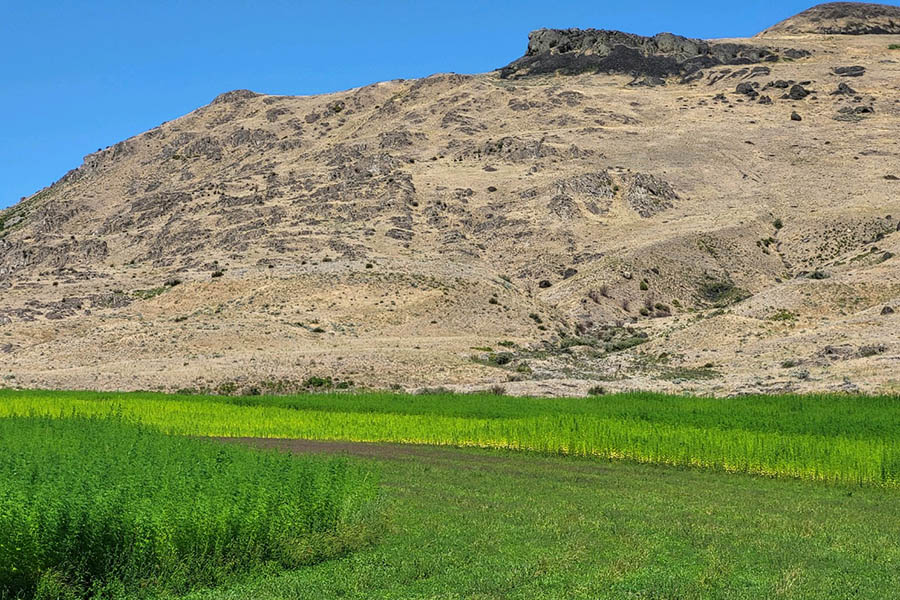
The second growing season, the tribe grew more than 200 acres of hemp but continued to face practical challenges — like harvesting with combines better suited for grain crops — and also finding a market. Eventually the tribe sold that year’s crop to Queen of Hearts, a company that sells hemp-based food products, which was at that time operating out of The Dalles and has since relocated to Hood River.
“That was a really cool experience. They were able to process it into oil,” Richter says.
The third year, the tribe experienced cross-pollination between male and female plants. At first, Richter says, that didn’t seem like a problem.
“We thought, ‘No problem. We will go with biomass,’” she says, referring to waste products that can be refined for CBD oil or products like paper, depending on which part of the plant is involved. But it was a problem, because lots of other farmers had the same idea. “Everyone thought they were going with biomass and the market was incredibly flooded, and you couldn’t even give it away,” she says.
Then COVID hit, and the tribe decided to hit pause on hemp production.
Earlier this year, though, the Colville Tribes became part of a federally funded project to develop manufacturing capabilities for materials and projects made from hemp. In March Oregon State University’s Global Hemp Innovation Center was awarded a $10 million grant, funded by the U.S. Department of Agriculture’s National Institute of Food and Agriculture, to develop manufacturing capabilities for hemp-derived materials. The center will partner with 13 Native American tribes on the project, in the hopes that it will spur economic development across the West.
Jeffrey Steiner, who directs the center at OSU, says the Confederated Tribes of the Colville Reservation were early adopters in the hemp-growing field, growing and crushing the first hemp oil west of the Rocky Mountains. And other tribes were starting to show interest in the crop before the grant was announced.
“There are tribes that have been growing hemp, there are tribes that have marketed hemp products, there are even tribes that have manufactured biobased materials — say bio-based plastic substitutes,” Steiner says, including the Yakama Nation as well as the Shoshone-Bannock tribes, whose reservation is bounded by Idaho geographically.
“The tribes will individually decide how they want to interact with the project, and we basically will be functioning like a consulting engineering firm — an information source helping them think through what they want to do individually,” Steiner says.
The first records of hemp cultivation date back to ancient China, with archaeological data suggesting it was one of the earliest crops cultivated in the region, and early written records suggesting its cultivation continued for thousands of years, according to the International Hemp Association, using the crop for fiber, paper, food and medicine. Europeans began cultivating hemp by the 16th century; like the Chinese, they both used the plant for fiber and ate the seeds. They brought hemp with them to the Americas, cultivating it in Chile in 1545 and in New England in the early 1600s. In the 19th century, the American South became a major producer of the crop, grown for cordage and sailcloth — but hemp was eventually displaced by cotton and other cheaper fiber crops. The plant is not indigenous to the Americas, but records show Native Americans began cultivating hemp as early as 1605 in Jamestown, presumably with seeds acquired in trade with colonists.
In 1937 Congress passed the Marijuana Tax Act, which put all cannabis plants under federal control. Hemp was still legal, but growers had to register with and be licensed by the federal government. While the federal government relaxed some of those standards during World War II in order to meet a demand for rope and fiber, the crop mostly remained under tight control for decades.
The past decade has seen a sea change in social attitudes and legal restrictions regarding hemp’s psychoactive sister. As of April, marijuana was legal for recreational or medical use in about 24 states. The drug is still federally illegal, but Democratic presidential candidate Kamala Harris has said she supports decriminalization. (Former President Donald Trump has said he favors leaving the matter to the states.) For a few years, hemp existed in the same legal limbo. But the 2014 Farm Bill made hemp research legal, and the 2018 Farm Bill removed hemp — which it defined as cannabis and derivatives of cannabis whose THC contents do not exceed 0.3% of the product — from the definition of marijuana laid out under the Controlled Substances Act.
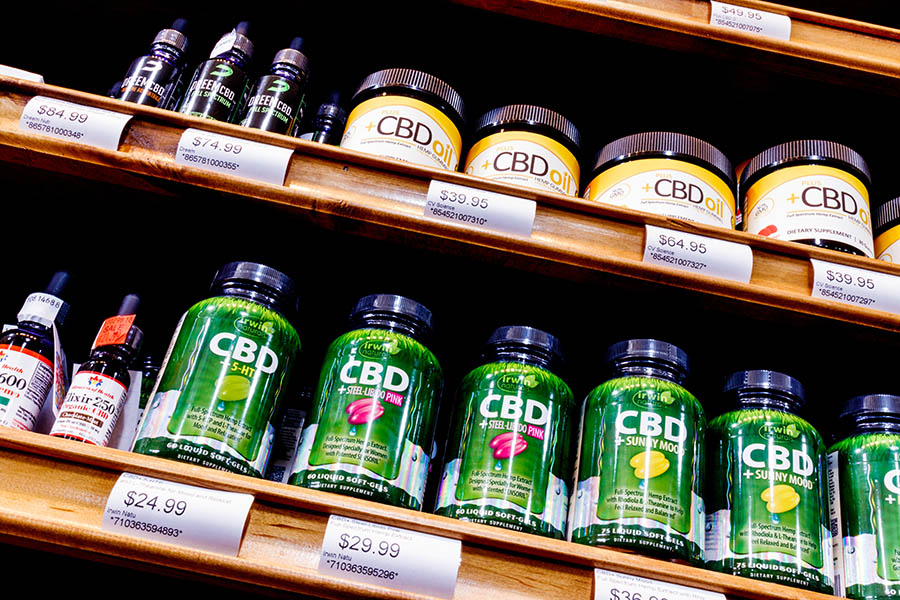
Nearly overnight, it seemed, hemp-derived products were everywhere — specifically CBD, a chemical linked with pain relief and relaxation. In the mid-2010s, a shopper in a state where recreational weed was legal might be able to find a topical CBD oil at a dispensary. A few years later, CBD was utterly mainstream — an additive in bath salts available at grocery stores, as well as products like diffusers or pillowcases.
Tribes showed interest in the current hemp boom as early as 2015, when the Menominee Indian Tribe of Wisconsin decided to grow hemp independently — only to see their crop destroyed by Drug Enforcement Administration agents just before it was harvested.
But in October 2019, the U.S. Department of Agriculture published a rule that explicitly acknowledged tribes’ authority to regulate hemp production in their territories. According to a 2023 article published by the Foundation for Food & Agriculture Research, tribes submitted more than 34 hemp regulatory plans to the USDA, and as of October 2023, USDA-approved tribal hemp plans outnumber state programs 53 to 42.
Oregon decriminalized the cultivation of hemp in 2009 but didn’t license the first hemp producer until 2015, according to information published by OSU’s Global Center for Hemp Innovation, which launched in 2018.
The center originally focused on hemp production, but those early crops also suffered from a saturated market, Steiner says. Now the center is focused on grant-funded projects to research the crop and figure out where there may still be untapped markets. The current, tribe-led project builds on a previous $10 million grant project to study the hemp market in the western U.S.
The Confederated Tribes of Warm Springs has sold CBD products with the brand name Daminwa — a Kiksht word meaning “of all time” — since last summer. A referendum put before tribal members this spring that would allow the tribe to begin growing its own cannabis and open a dispensary didn’t get enough votes to move forward.
But the tribe, which is part of OSU’s project, is still interested in exploring the potential role of hemp on the reservation, says Jim Souers, CEO of Warm Springs Economic Development Corporation.
One potential use of hemp, for example, is as a building material called hempcrete — fiber compressed into bricks that are fire-retardant and mold-resistant. Souers says there is some interest in manufacturing hemp building materials on the reservation, but more research is needed.
“We’re in the pre phase, the beta stage, whatever you want to call it, where we’ve got to create some samples that are meaningful enough for someone like OSU to determine that, yes, you have these distinct fibers, and give them maybe to a company or maybe a couple others, and see what they think,” Souers tells OB.
According to Steiner, the first stage of the grant is to help develop a Native American-led intertribal manufacturing consortium. Down the road, the center will work with tribes to work out the details Souers alludes to — materials characteristics, configurations of manufacturing equipment and technology, as well as work on optimizing the quality of the product itself. The grant also includes a provision for making hemp production a part of education and workforce development.
“The beginning spot is now following through with each of the tribes, and then creating this business consortium that combines them to the degree they want to be involved in that, and then moving the project forward from that place,” Steiner says.
For her part, Richter says the Colville Tribe is working with universities to grow different varieties of hemp in smaller quantities to study how they do in the local climate. And she’s hopeful the OSU project will improve understanding of the barriers in the industry.
“We did everything backward. We started growing a crop and had no home for it, and I don’t want people to experience that,” Richter says. “I think that hemp is an amazing crop and I think it’s incredibly versatile. I mean, I lost count of how many different ways it can be used — like, 25,000 different ways that it can be used. It’s kind of amazing, but at the same time, we’re not using it, and why not? Why aren’t we using it? Why don’t we have a clothing market? What are the barriers? My other big, big hope is that this grant will help highlight the barriers, and then we can figure out how to get around them.”
Click here to subscribe to Oregon Business.