
As it considers deep layoffs, the aerospace giant’s quality executive stepped down this week.
With its workers back on the jobsite, Boeing is now considering painful choices as it attempts to right its financial ship.
Chief Executive Kelly Ortberg announced plans last month to cut 17,000 employees. And on Monday, Boeing’s quality chief, executive Elizabeth Lund, announced her retirement — less than a year after taking the job. A 30-year Boeing veteran, Lund’s brief tenure involved preparing and implementing a safety and quality plan for federal regulators, the company said Monday in an employee memo.
Boeing has struggled with quality problems and losses in its commercial and defense units. This year dozens of Alaska airline customers — and the airline itself — have sued Boeing, alleging that failures in the manufacturing process in the 737 Max 9 led to the loss of a fuselage panel on a January flight from Portland. That incident had no fatalities, but in 2018 and 2019, Boeing 737 Max 8 planes crashed in Indonesia and Ethiopia, killing 189 and 157 respectively, prompting the Federal Aviation Administration to ground the 737 Max 8, and drawing ongoing scrutiny to Boeing’s 737 Max program. The company’s defense division has also struggled with cost overruns, including one of $7 billion on the KC-46 midair refueling tanker and a $2 billion loss on upgrades to two Air Force One planes.
In response to these declines, the jet maker has all but eliminated its pension program, one issue of many that has angered its union. Ortberg has raised $24 billion in equity to shore up the company’s finances, according to the Wall Street Journal.
Lund, who leaves in December, oversaw quality control for Boeing’s commercial airplanes unit. The position of vice president for quality was created by Boeing’s board with Lund in mind.

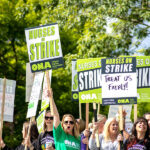
In August, the 33,000 machinists who build Boeing’s jet aircraft in the Pacific Northwest voted to strike. The walkout hobbled the critical jet manufacturer, grinding its sprawling global supply chains to a halt and costing the company a half-billion dollars per week. In response to the strike, Boeing management furloughed workers, froze pay increases and reduced executive pay.
The union rejected two earlier offers that failed to contain a requested 40% wage increase. Then, earlier this month, 59% of members of the International Association of Machinists and Aerospace Workers voted in favor of a new four-year labor agreement that features a 38% wage increase over the contract period. That means, in four years, the average machinist at Boeing will earn $119,000 annually, according to the union.
As the Wall Street Journal reported this week, Boeing is now in the process of ramping back up following the eight-week strike. The process of re-firing its supply chains and restarting the factories that build the 737 and other planes could take weeks.
Fallout from the strike includes layoffs and furloughs at Boeing’s many suppliers, including Spirit AeroSystems, which Boeing has agreed to purchase.
Now headquartered in Arlington, Virginia, the plane maker has deep ties to the Pacific Northwest. The company was founded in Seattle in 1916.
Click here to subscribe to Oregon Business.