
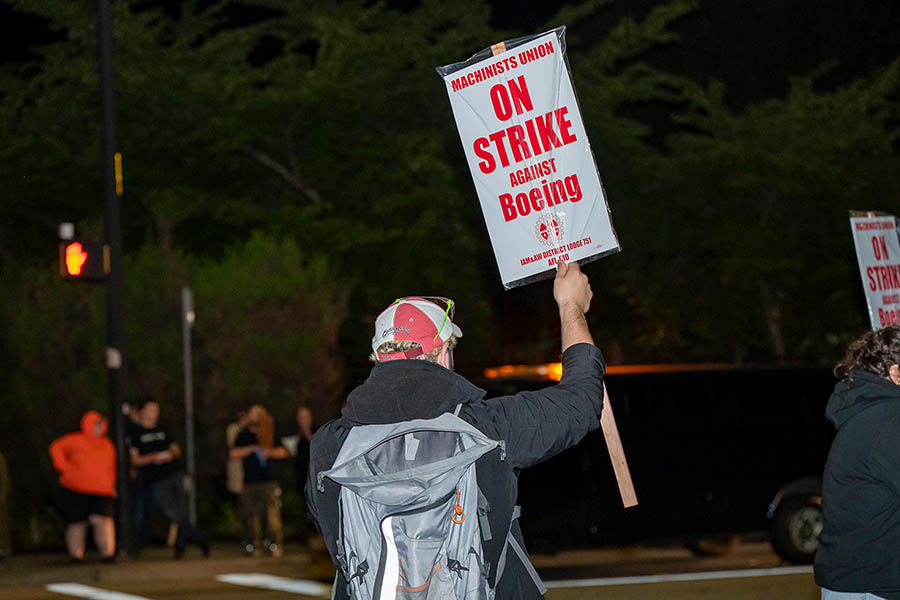
Around 1,200 Oregon workers hit the picket line; the company responds with furloughs.
A worker strike continues to rattle aerospace giant Boeing and has so far cost the jet maker more than half a billion dollars.
Around 33,000 striking workers, members of the International Association of Machinists and Aerospace Workers, walked off the job Friday.
On Wednesday, the company responded to the strike with furloughs of tens of thousands of white-collar workers to cut costs and avoid a cut to its credit rating, the Wall Street Journal reported. CEO Kelly Ortberg wrote in a memo to staff the furloughs will continue for one week out of four until the strike concludes.
The company has already frozen hiring and delayed pay increases in response to the strike. Executive pay will also be cut 25%.
“While this is a tough decision that impacts everybody, it is in an effort to preserve our long-term future and help us navigate through this very difficult time,” wrote Ortberg, who started the job five weeks ago.
Union leaders have said they want to win back pensions but are willing to consider alternatives to bolstering retirement benefits.
The strike, which has halted production of the 737 and other jets, could cost the company $500 million per week, WSJ reports.
The company employs 1,282 people in Oregon, most out of its Gresham manufacturing plant. A wholly owned subsidiary, Insitu, employs a further 400 people near Hood River.
RELATED: Playing Defense
Striking workers held a rally Thursday morning at Boeing’s Portland plant. Speakers included state Sen. Chris Gorsek, state Rep. Dacia Grayber and the president of the Oregon chapter of the AFL-CIO.
Several other unions have joined in solidarity strikes. The union representing Alaska Airlines pilots voted to approve a strike, though one is not currently planned.
A Boeing spokesperson sent Oregon Business a fact sheet showing the company’s statewide economic impact, which is said to be $627 million per year. He didn’t respond to follow-up questions.
The rally came on the heels of a new round of negotiations that began Tuesday with help from a federal mediator and continued Wednesday. The union’s bargaining committee, in a Sept. 18 message to members, expressed frustration with Boeing.
“The company was not prepared and was unwilling to address the issues you’ve made clear are essential for ending this strike: Wages and Pension,” the union told members.
Longtime Boeing workers described anger and bitterness over union concessions dating back to 2008, including the elimination of pensions and Boeing’s decision to build its 787 Dreamliner at a nonunion factory in South Carolina.
Click here to subscribe to Oregon Business.