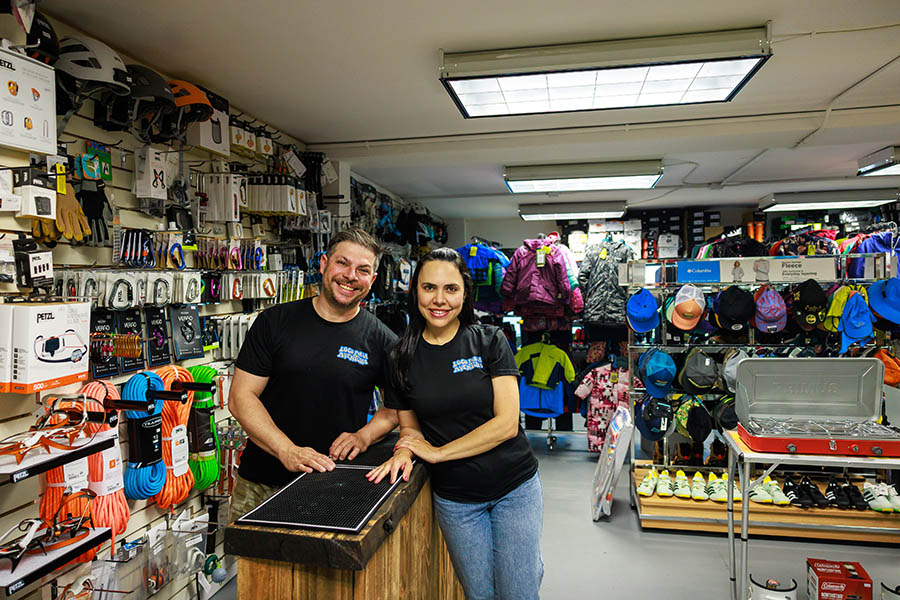
The opening of BaseCamp follows the closure of several outdoor stores in the urban core — but the founders are not deterred by choppy economic waters.
Anibal Rocheta and Maria Teresa Lopes of Loco Por La Aventura buzz visitors up into their secure and cozy 1,600 square-foot outdoor store, a second-floor location in close-in southeast Portland. The colorful aisles are neatly and densely packed with brand name items from Scarpa to Nalgene. The gear is both new and used, with rentals available.
On June 13, Loco por la Aventura opened BaseCamp Mountaineering Center (544 SE Oak St, Suite 2060). It’s the first Latino-owned outdoor store in Oregon. Its opening also closely follows the closure of several outdoor stores in the urban core in recent years, including REI, Andy & Bax and Next Adventure.
“We want to get people outside,” says co-owner Maria Teresa Lopes, who together with her husband Anibal Rocheta ran the Loco Por La Aventura guiding company for five years before opening the store. “We want to build a community hub and host free educational workshops and trips.”
Their guiding business previously has relied on grants to subsidize Latino-centered trips. But Rocheta and Lopes didn’t want to continue relying on those as a funding source, in favor of a more stable form of financing. Enter the idea of BaseCamp: a non-profit that will funnel profits into free or low-cost, multi-lingual outdoor programming.
“When people shop here, they buy with purpose. Portlanders will like this,” says Lopes.
Before immigrating to Portland in 2015 as political refugees, Rocheta was an outdoor guide and owned an outdoor store in Venezuela for over a decade. In Portland, Rocheta and Lopes were intent on continuing to pursue their passion for the outdoors.
In the inauspicious year of 2020, they started Loco por la Aventura, a Gresham-based outdoor guiding company. Despite the challenges of the pandemic years, their business grew a substantial following. They organized hiking, mountaineering, snowshoeing, rafting, camping, mountain biking, and rock climbing trips – all guided in Spanish.
“We want to be the bridge between outdoor recreation and the Latino community, which can experience barriers of money, language, and transportation,” says Lopes, who spearheads community engagement. “That being said, our store is for everyone, not just Latinos.”
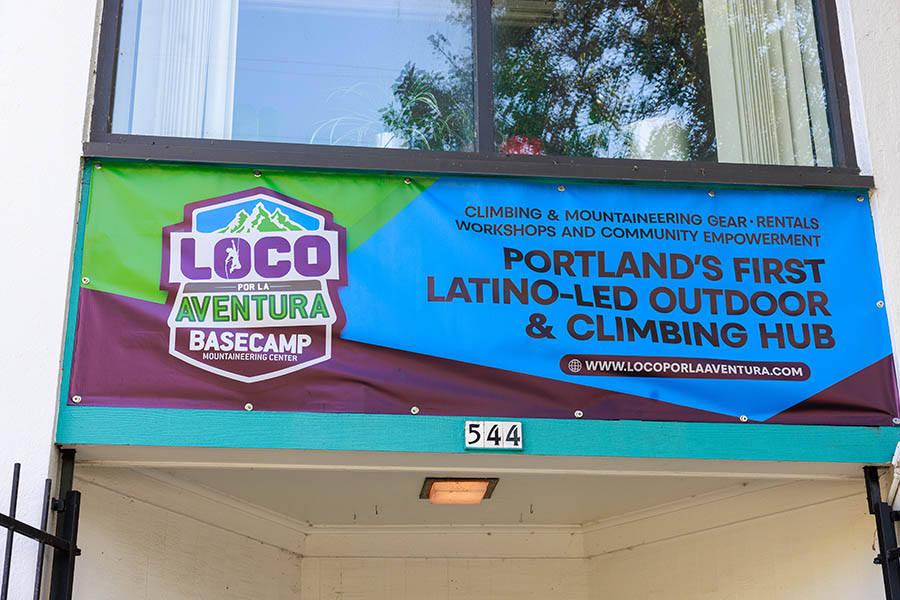
The opening of BaseCamp closely followed the announcement that Next Adventure, a seller of new and used outdoor gear, would close after 28 years in business just blocks from BaseCamp’s location. It also comes two years after the closure of 80-year-old military surplus and outdoor store Andy & Bax — also on the central Eastside — and the closure of REI’s Pearl District location, its only store in Portland’s urban core. The former Andy & Bax and REI buildings remain vacant; as of this writing, Next Adventure was still open and selling off its inventory.
According to Next Adventure co-owner Deek Heycamp, the store struggled with property damage, theft, and the safety issues which have deterred commercial foot traffic in the urban core since the pandemic – not to mention the recently added financial burden from new tariff policies.
“But there were a number of other factors influencing our decision to close,” says Heycamp, co-owner and co-founder of Next Adventure. “First of all, I’m in my 60s and excited to chase the snow whenever it comes, guilt-free, for the first time in 28 years. Also, as a brick and mortar store, our job was to build community, which we did through organized trips, but changes in Oregon law stopped those. Then COVID hit, shifting buying patterns online.”
The legal change Heycamp refers to is a 2014 Oregon Supreme Court ruling that rendered liability waivers largely unenforceable in the state, which jacked up insurance costs to prohibitive amounts for many outdoor recreation outfitters. This session a group of Oregon legislators, led by Rep. John Lively (D-Springfield) introduced a bill to protect the owners of recreation businesses from claims of ordinary negligence, but as of this writing that bill appeared dead in committee.
BaseCamp will contend with this challenge as well as the other challenges, including an increase in unsheltered homelessness and perceptions of the urban core as unsafe. While those perceptions may be outsized (homicide rates and property crimes have decreased), there are still real problems in the urban core. Outdoor retailers are uniquely affected by problems related to unsheltered homelessness, as there is a high demand for the items they sell among people who sleep outside. Shoppers who in the past traveled from far and wide to visit a place like Next Adventure are shopping in the suburbs — REI, for example, maintains five stores in Portland’s suburbs, two of which opened in the past two years — or online.
That doesn’t deter Rocheta, author of a mountaineering book whose title translates to “nothing ventured, nothing gained” (Nadie Logra lo que no se Atreve, 2023). “We are more excited than fearful; we are from Venezuela, after all. We see this hole in the market as both a business opportunity and a chance to help revitalize the Portland community.”
Another potential challenge: increased hostility toward immigrants in general and Latinos in particular. An Instagram post shared from the BaseCamp and Loco Por La Aventura pages shows surveillance video of a white man breaking one of the front-door signs at BaseCamp. “I don’t know if this was random or if it has something to do with the fact that this is the first Latino-led BaseCamp in this area. I’m not jumping to conclusions—but I just wanted to share what’s going on. To be real, it does make us feel a bit unsafe. And that sucks. We opened this space with love, with effort, and with a big dream to build something for our community,” the post reads. But it goes on to say: “That said, we’re still here. We’re still working. We’re still putting our best into this.”
Observers say BaseCamp is well poised to not only succeed, but possibly provide a blueprint for other retailers.
“BaseCamp is a fresh concept in outdoor retail; it understands today’s consumers,” says Matthias Paisdzior – co-owner of local outdoor gear brand GOT BAG and board member of the Oregon Outdoor Alliance, an organization which supports and advocates for the outdoor industry. “They connect with a younger, more diverse community and represent the future of retail. A store has to be an experience because, if not, you just buy online.”
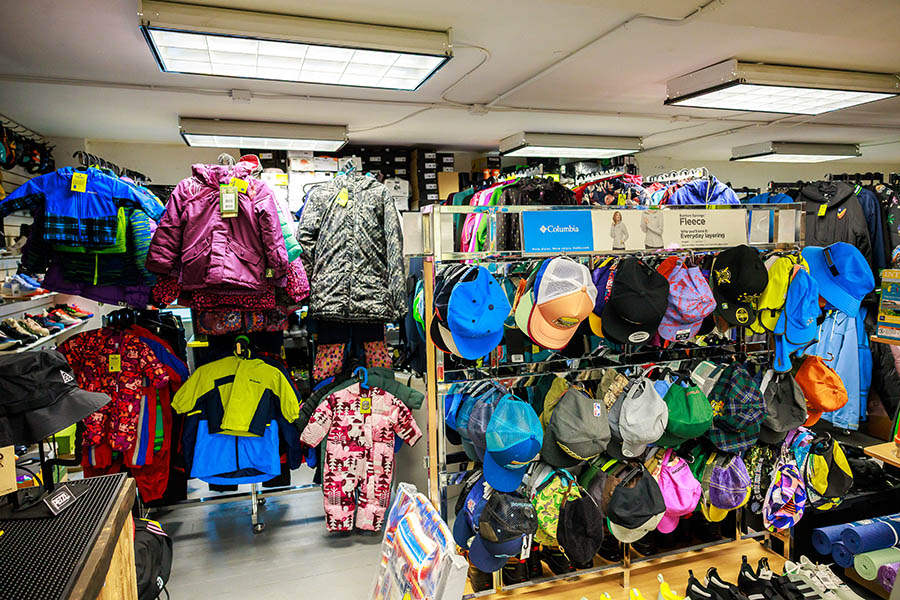
A store like BaseCamp should thrive in a place like Portland, which has a strong outdoor culture and the highest concentration of athletic and outdoor industry employees in the country, around 30,000 including both small businesses and big corporations like Nike, Adidas, and Columbia Sportswear. Huge events that draw national and international participation, like Sneaker Week and the MADE Bike Show, help define Portland as an epicenter for outdoor aficionados.
Despite that and the lack of nearby competition, BaseCamp is not an assured slam dunk. Portland has had a rough go of it since the pandemic with a slower recovery than many other similarly sized cities.
“I’m quite certain Portland will come back,” says Heycamp. “The negative narratives about Portland can eclipse the reality of the situation. Portland is still great, despite its challenges. Brick-and-mortar retailers will be a part of its recovery. We as social beings want and need the connection they provide.”
There are a myriad of initiatives aimed at bolstering the central city’s economic recovery. For example, the No Vacancy Project aims to fill ground floor brick-and-mortar storefronts in Old Town with vibrant businesses while aiding them with wrap-around resources and technical support. Also, in the outdoor industry arena, backers of the newly proposed Made in Old Town campus — which would include nine buildings in Portland’s Old Town — say the project will provide access to world-class footwear and outdoor apparel equipment to encourage innovation and sustainable solutions through sample-making.
“Portland’s athletic and outdoor industry has a unique willingness to collaborate and help each other. Along with its concentration of talent, that’s one of its greatest strengths,” says Sucheta Bal, the Athletic and Outdoor Industry Liaison for Prosper Portland, the public agency tasked with fostering economic development in the city.
Partnering with the Oregon Outdoor Alliance, Prosper Portland supports events like executive round tables that broadcast industry needs to the city; Portland Beer Thirty networking happy hours to connect industry workers; and initiatives like Women in Footwear Design meetups, and the JUMPSTART Small Business Program – which all aim to create a friendly environment for businesses like BaseCamp.
“For a successful recovery, support from the city is essential,” says Paisdzior, who plans on optimizing GOT BAG’s business model to respond to the financial drag of tariffs. “I hope they can see that a safe, vibrant city is worth investing in – through tax incentives, zoning laws, rental policy, and urban planning that specifically addresses safety. We will see.”
Click here to subscribe to Oregon Business.