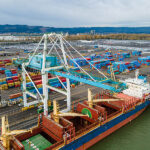


Private company Harbor Industrial will operate the state’s only shipping facility and the state will spend $35 million on improvements.
After months of uncertainty, a deal was struck this month intended to ensure cargo container service continues long into the future at the Port of Portland’s Terminal 6, the state’s lone international container port. The new private operator is confident it can reverse course at the troubled shipping facility.
Earlier this month, the Port of Portland named maritime services company Harbor Industrial as the new operator of its Terminal 6 facility. The Los Angeles-based business has a steep road ahead. The terminal has lost money each year — a $13-million loss is projected for 2024-2025 — and investment is badly needed in the facility and shipping channel.
These challenges speak to why few governments today operate international ports and instead leave the task to private companies.
Harbor CEO Tim McCarthy thinks Harbor will be able to quickly recover lost market share.
“We believe this milestone is a fundamental positive shift in support of the Oregon importers and exporters, to ensure an ongoing, reliable and efficient gateway for Oregon businesses,” Tim McCarthy, Harbor CEO, says in a statement. “This progress will help the Oregon shippers secure a more cost-effective path for their goods while providing job growth for the local communities.”
Harbor Industrial will take over management in 2025, assuming lawmakers spend a pledged $20 million on capital improvements at the facility. A further $15 million is called for in Gov. Tina Kotek’s proposed budget to dredge the Lower Columbia River channel to maintain navigability.
RELATED: Report: Continued Shipping at Terminal 6 Would Cost Millions
Harbor is a known quality at the terminal. For the past seven years, it has provided stevedore services, overseeing the offloading of cargo and managing relations with local labor unions. McCarthy tells The Capital Press the company has traveled the world recently to woo shipping companies that stopped calling on Portland between 2015 and 2020, amid contentious disputes involving the prior operator of the port, International Container Terminal Services Inc. (ICTS).
The tentative agreement was announced Dec. 6. Formal terms will be drafted over the next six months as operations continue “seamlessly,” according to the port’s statement.
Situated at the confluence of the Columbia and Willamette Rivers, the 420-acre Terminal 6 has handled shipping containers since 1975. The facility saw shipping volumes grow steadily until the mid-1990s, when it handled around 75% of the region’s import and export cargo. The terminal was profitable until 2004 but revenues have declined significantly since then.
Despite losses, the port today handles 30% of the region’s incoming cargo and remains an important link for truck, rail and barge. It’s a major agricultural exporter and a hub for importing and exporting vehicles. Container service supports 1,500 jobs in the region either directly or indirectly and generates $20 million in annual tax revenue, according to the Port.
The Port of Portland is the lone government entity to operate an international container port on the West Coast. As a public body, is’s occasionally ill-suited to deal in the volatile business of international shipping. As well, it lacks funding mechanisms available to comparable privately run facilities. The port’s current volume of 59,000 vessels per year is far below what’s needed to operate sustainably.
The terminal faces a few natural disadvantages, as well. Located 100 miles upriver from the Pacific Ocean, at the confluence of the Willamette and Columbia rivers, accessing it requires a pilot and longer travel time than other West Coast ports. The Columbia River near the facility also has a maximum depth of only 43 feet, and the trend in shipping is larger and larger boats. Beyond that, the terminal’s cranes are out of date and must be raised to accommodate modern ships. Many worry that without investment, the terminal will become obsolete.
Earlier this year, the port announced it would end container service at the terminal due to these longstanding issues. Gov. Kotek responded with a request for a business plan outlining what the port needs to run the terminal sustainably. The resulting document outlines an ambitious plan to double shipping volume in five to seven years.
Harbor expects its extensive knowledge of Terminal 6 and the global shipping industry will help as it works to reverse fortunes in Portland. As a private company, Harbor has lower overhead costs, and with its many facilities around the world, the company can draw on its various engineering, maintenance and cargo-handling resources.
A representative of the International Longshore and Warehouse Union (ILWU) expressed support for the plan and mentioned several advantages of the arrangement to The Capital Press. A private business can modernize equipment and negotiate with ocean carriers faster than the port, which has a lengthy, public decision making process. Beyond that, Harbor Industrial has operated with a collaborative approach to labor, compared to ICTS, which is said to be more confrontational.
In addition to labor, business reps on the port’s Industry Advisory Council support the tentative deal. They represent major users of the terminal like Columbia Sportswear, Bossco Trading and Kroger.
Click here to subscribe to Oregon Business.