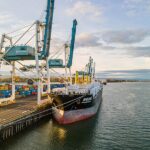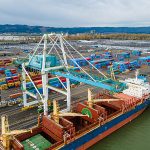

A financial forecast prepared for Gov. Kotek says container service is feasible but costly.
It won’t be cheap or easy to maintain container operations at Terminal 6 long into the future.
That’s according to a report prepared by the Portland of Portland that puts a price at $40 million in state funding and calls to locate a private operator.
The Oregonian was first to report on the recently released business plan.
For years, Terminal 6 has operated in the red, losing $13 million in both 2022 and 2023. To contend with operating losses, the port has increased rates for container carriers and restructured its management costs. It also met with labor unions to improve efficiency. But due to lingering struggles, the port had planned to end container service after a number of failed efforts to find a new private-sector operator.
Gov. Tina Kotek sought to infuse $40 million to maintain container service and requested the port produce a plan to sustainably operate the terminal. To achieve long-term financial sustainability, the port would have to double container volumes to 120,000 by 2032 and increase volumes to 180,000 after 2032. Her plan requires partial approval from the Legislature.

The $40 million would fund terminal operations, improvements and channel maintenance. A private operator would be selected next year and would assume control in June 2026.
The port now moves 60,000 containers annually. But from 2010 to 2017, the terminal was subject to a yearslong work slowdown as a former private operator, Philippines-based ICTSI Oregon, clashed with longshore workers. The company pulled out and shipping lines resumed.
RELATED: Global shipping is in crisis. What’s next for the ports of Portland and Vancouver?
Container service at Terminal 6 supported around 696 jobs and 871 indirect jobs and it accounts for $20 million in annual state and local tax revenue.
Were service at Terminal 6 to end, companies would have to spend $19.2 million annually to truck products north to use ports in Seattle or Tacoma, according to the report. The cost to ship a container would increase about $585.
Some argue the terminal’s location 100 miles upriver and with a 43-foot depth makes it obsolete for modern container ships. But leaders at the port, including executive director Curtis Robinhold say Portland’s status as a “niche port” can secure its financial future.
“Supply chain resilience along the West Coast is critically needed, as we saw during COVID, geopolitical unrest in the Red Sea, and drought conditions affecting the Panama Canal.”
Click here to subscribe to Oregon Business.