Immersion Research, an industry-leading maker of kayaking gear, has embraced small-batch manufacturing in downtown Hood River.
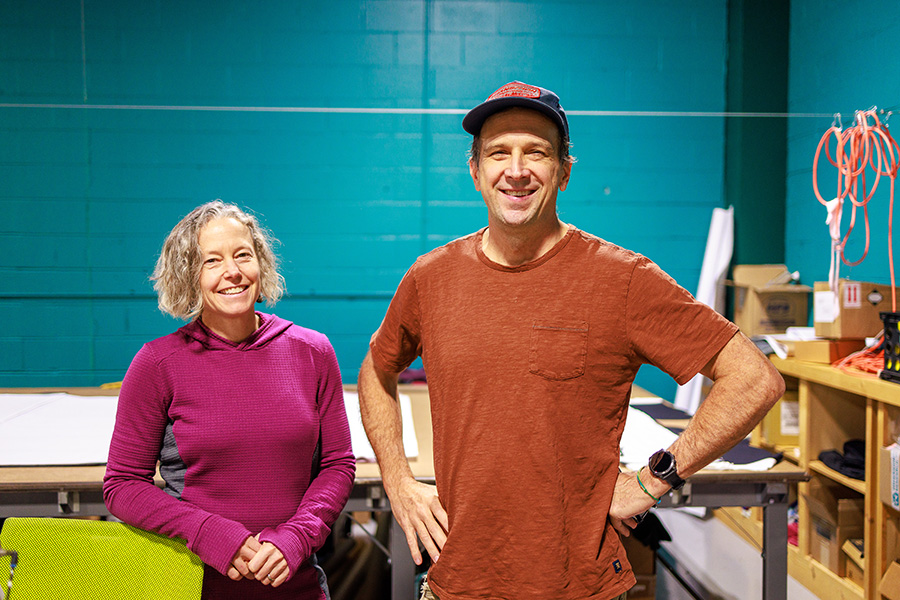
Walking into Immersion Research’s storefront and sewing studio in downtown Hood River, customers are greeted by racks of fleece clothing that encourage them to browse and touch. Think thick, fluffy pants, shirts, and hoodies — clothes ideal for anyone stepping out of an icy cold river in March. In the attached space, busy workers sew and cut.
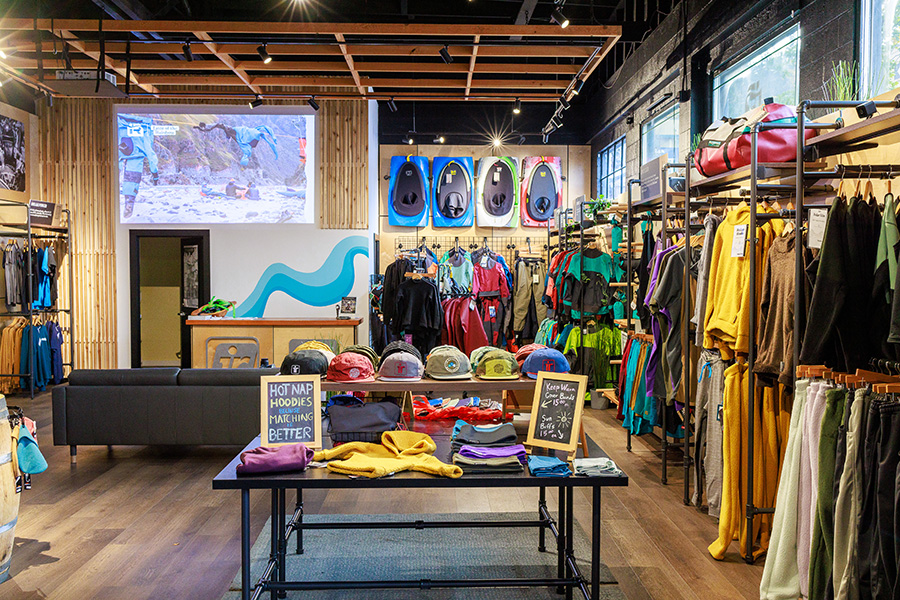
Kara Weld, 55, who co-owns the company with her husband, John Weld, 56, points out the meticulous details of a fleece pullover, from a windproof chest layer to a zipper pouch over the kangaroo pocket, each aspect tailored for kayak life. In addition to fleece clothing, Immersion also makes specialty gear like paddle pants, dry shirts, dry suits, spray skirts, throw bags and changing robes.
Immersion is the only stand-alone technical whitewater kayak brand in the U.S., and it opened a second location in Hood River in 2017. At that time its owners, the Welds, were 20-year veterans of the industry, operating on the East Coast. They started out making gear in-house, then ran a medium-size sewing factory before outsourcing much of the manufacturing overseas. When they moved west, they continued small-batch in-house manufacturing, though the majority of their products are still manufactured overseas.
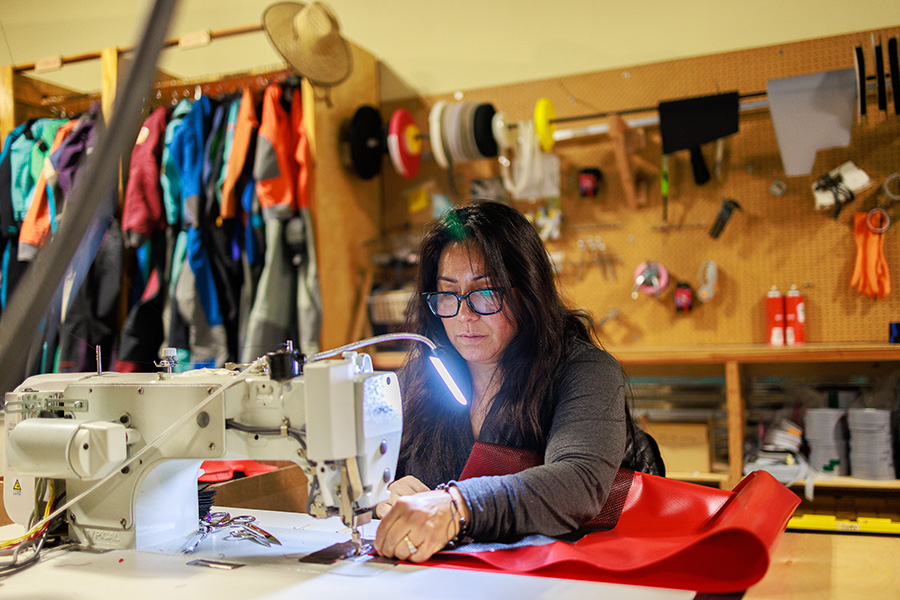
The company has 12 employees between its locations in Oregon and Pennsylvania, and embraces a hybrid business and manufacturing model. Products like spray skirts and dry suits are manufactured overseas for wholesale, but the company also runs small manufacturing studios with storefronts at both locations, where they make fleece clothing on-site and sell directly to customers.

The decision to open a storefront and sewing studio in Hood River hasn’t been without its challenges, but so far, the Welds have made it work. Their story represents the perseverance, innovation, challenge and opportunity for businesses in Oregon’s outdoor industry — a significant player and success story in the state’s overall economy.
The outdoor industry is a pretty big sector for the state,” says Valerie Egon, the regional development officer representing Hood River County for Business Oregon. “Depending on which data sets you look at, the sector is worth $7.5 billion to $12 billion; that’s 2% to 4% of the state’s GDP.” And it’s doing better in Oregon than most of the rest of the country: While the national outdoor gear and apparel sector has seen a 9.1% decline over the past 10 years, Oregon’s sector grew by 12.3%.
The splashiest examples of Oregon’s outdoor industry are titans like Nike, Adidas, and Columbia Sportswear, but smaller companies abound and are an important part of the industry ecosystem. They fuel the stoke with innovation and draw talent to the area, which, in turn, benefits the larger companies. According to 2023 data from the U.S. Bureau of Economic Analysis and the Oregon Employment Department, more than 86% of the 711 businesses in Oregon’s outdoor sector have 20 employees or fewer. (The 10 largest outdoor gear and apparel companies — big players like Nike, Columbia and Pendleton, which are captured in the business-services-targeted sector, not the outdoor gear and apparel industry sector — are excluded from this data set.)
Hood River sustains a particularly robust cluster of niche small-batch manufacturing companies. “Within walking distance, there are five outdoor-gear businesses with sewing machines, like Alpine Sea and Sailworks,” John says. “It’s cool that I can ask a neighbor to borrow a Serger or to laser-cut something for me. This community was unexpected.”
In 1997 the Welds lived in Confluence, Penn., a small town in northern Appalachia near the Youghiogheny River, the hub of the mid-Atlantic whitewater- kayaking scene. John was a kayak guide, and Kara was a decorated professional kayaker, who worked at a daycare to make ends meet. They were tired of “living the dream” and wanted financial stability.
“I was tinkering around on a sewing machine and made board shorts for a friend,” John says. “My buddy, who owned a store, said he could easily sell more of them. Soon after, I bought a bunch of industrial sewing machines from a guy going out of business. I really didn’t know what I was doing.”
It turned out the board-short look captured the trend of an emerging movement. Whitewater kayaking was skyrocketing in popularity. It shifted from a canoeing-with-your-dad vibe for an older set to an extreme sport for people in their 20s, more akin to snowboarding and surfing. John took stylistic cues from those edgy sports and integrated them into his kayaking garments.
“We were the only ones merging fashion sensibility with technical gear,” Kara says.
The business exploded, leading the Welds to rent out half of an auto-body garage, where they sewed everything themselves. “A tarp separated us from the guy next door spray-painting hoods,” John says. “It was a dicey place to create clothes.”
Three years later, the Welds had 50 employees and were producing board shorts and rash guards in a high school that had been converted into a sewing factory, which they eventually bought.
“Running a sewing factory and corralling workers takes a completely different skill set from designing clothes,” John says. “We didn’t know any better back then.”
They realized they wanted to refocus on product design and marketing. Not only did they want to quit running a sewing factory, but domestic manufacturing didn’t work for them. To do it, they needed a variety of complex machinery to make different gear, and they didn’t need workers all year round, making employment tricky. High-quality overseas contract sew houses had the necessary machines and could complete their order in a matter of days or weeks, which helped cash flow.
“Sometimes people wag their fingers at us for not manufacturing in the U.S.,” John says. “Even if we wanted to use a contract sew house in the U.S., we couldn’t. They don’t exist here because of labor costs, taxes and a lack of will to do this kind of low-tech manufacturing.”
By 2010 most of the company’s manufacturing was overseas, and IR grew in notoriety. By 2015 its spray skirts — very complicated pieces of gear which keep water out of kayaks — were all the rage and almost an industry standard. John guesses nine out of 10 people whitewater kayaking on television will be wearing an IR spray skirt.
By 2017 the Welds were ready for a change. They wanted to raise their two kids in a place like Hood River, for the lifestyle and better schools. Plus, the axis of whitewater kayaking was shifting from the East Coast to the Pacific Northwest.
“Pennsylvania is a great area for kayaking, but it doesn’t have the same glamour as Hood River,” John says. “It’s like skiing in Vermont versus Jackson Hole; Hood River is the North Shore of kayaking. Moving here raised the game for us as a brand. We’re constantly in contact with the best kayakers in the world, who are here to run the White Salmon and Little White Salmon rivers. They come in all the time and help us with product development and marketing. In Pennsylvania this business was seen as a hobby, making weird gear for weird people. It’s hard not to internalize that. Here our work is legit.”
Michael Held, a regional services manager at Business Oregon, notes that Hood River is a good example of a microeconomy in the larger ecosystem of the outdoor industry in Oregon. “In Hood River, the outdoor lifestyle attracts industry talent, creating a concentration of knowledge and skills. It’s a great place to test products, to see them used in real life and informally grow a business over a pint at pFriem or on the slopes. I love to see when sectors grow their own legs organically.”
But there are also challenges to being in Hood River. In addition to general obstacles inherent to the outdoor industry — climate change affecting recreation, the COVID-
related inventory overhang, workaday inventory overhang, and the challenge for smaller businesses to keep up with the latest innovations and trends — the housing crisis is huge. The city was ranked the seventh most expensive micropolitan area in the U.S. by The New York Times in 2024.
“Housing prices in Hood River are out of hand. The best thing for a business is to have employees stick around. How can I do that if they can’t afford housing?” says John Weld. One of his employees interjects that he found a rental from a fellow whitewater kayaker, and that’s how he moved Hood River to work for Immersion.
Around the time they moved to the area, Immersion started being recognized for its dry wear — technical gear designed to be watertight — which is manufactured overseas. Yet the Welds couldn’t resist their proclivity to create products in-house.
“I wasn’t sold on having a sewing studio,” says Kara. “But John pushed for it; he is a maker at heart.”
When they stumbled onto a storefront for rent that had studio space in the back, there was no question about going forward.
“We have about half a dozen competitors. But our crazy experience of running a sewing factory makes us stand out. It’s a part of our company DNA. When we saw an opportunity to make products on a small scale, we went for it,” John says.
This is possible in part because Hood River commercial real estate prices are more commensurate with what storefront owners can pay — in contrast with residential real estate prices in the same area, which have spiraled upward. Plus, the Welds are able to buy leftovers of Polartec fleece from huge corporate orders at discounted prices.
There is also an odd wrinkle in the tariff code that levies an inordinately high tax on fleece apparel. A fleece hoodie shipped back into the U.S. after being manufactured overseas will be taxed at nearly a 30% rate (28% for women’s clothing, 29% for men’s). That means the cost of producing a hoodie in the U.S. has a chance to be competitive with hoodies manufactured abroad in sew houses.
“Making things is a lost art here in the U.S. The sewing studios are a small part of our business, and not the most lucrative, but it’s a fun and important part of our story. Any good brand has to tell a story,” John says.
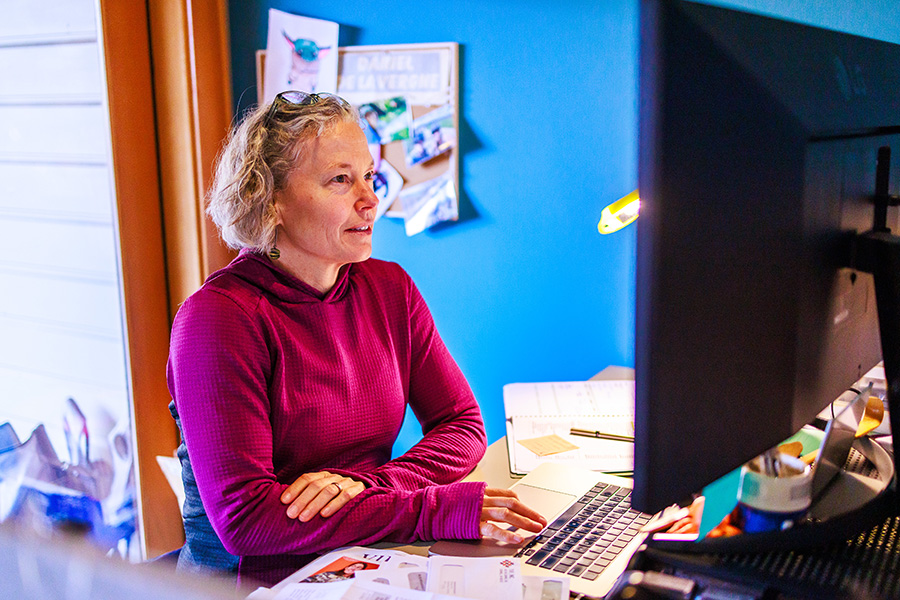
Kara Weld adds, “We are lucky to be so connected to our customers, and in many ways, we are telling their story through ours. We are people who get up early to bushwack in the rain to run a gnarly section of river.”
Businesses in the outdoor industry get a leg up
A number of organizations are dedicated to supporting the success of businesses in Oregon’s outdoor industry. Bend Outdoor Worx is the country’s first outdoor startup accelerator and has a 14-week program, which includes mentorship, e-commerce coaching, branding, accounting and legal consulting. The Outdoor Industry Association is a national advocacy organization that tackles issues of policy, education, economic climate and conservation, whereas the Oregon Outdoor Alliance focuses all its energy on the region. The organizations facilitate statewide networking events, speaker series and education panels aimed at growing the industry. Business Oregon, the state’s economic development agency, bolsters smaller companies and startups in the outdoor industry through direct loans, education and consulting, and the Outdoor Gear and Apparel Grant Fund, which accelerates early- and growth- stage startups in Oregon’s outdoor gear and apparel industry.
Click here to subscribe to Oregon Business.