
Q&A with Denise Arnold, RN and section leader with Oregon Nurses Association
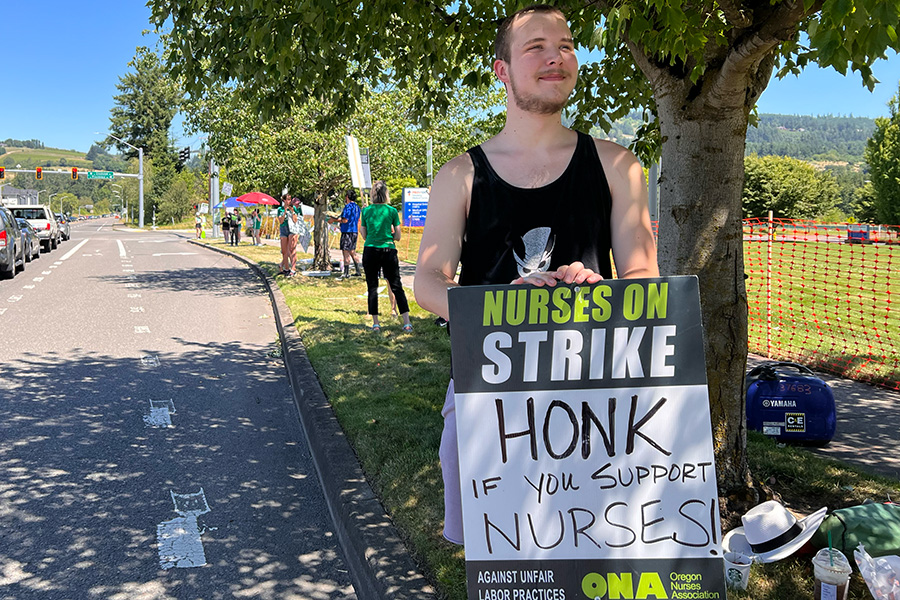
When Providence nurses walked off the job for three days in June in what was billed as the largest nursing strike in Oregon history, it was far from the end of the story.
Though nurses at six of eight Providence hospital systems around the state returned to work under the terms of their old contracts, negotiations continue and further strikes are possible. Nurses belonging to the Oregon Nurses Association say their pay and benefits lag and staff-to-patient levels are still unmanageable, even after a new Oregon law was passed adopting minimum nurse-patient ratios.

Denise Arnold, a Newberg-based intensive care nurse, is one of the union leaders pushing for change. She’s currently working under the terms of an employment contract that expired Jan. 1. She says not having a valid contract makes recruiting even more difficult. And it wasn’t easy before. It’s a tense time to work in healthcare. Assaults on health care workers are up. Educational debt and officials struggle to fund pathways to the nursing profession that don’t leave students with a decade or more of debt.
Providence, with 23,000 caregivers, eight hospitals and 100 clinics around the state, denies many of ONA’s assertions. CEO Jennifer Burrows (an RN herself) staunchly defended the health provider’s position in a recent op-ed in The Portland Tribune.
Arnold, 41, met with Oregon Business this month at the ONA headquarters in Tualatin, where she discussed the status of a new nursing contract, assault in the workplace and what TV show gets the nursing profession right.
What’s the latest on contract negotiations? Will there be another nurse strike at Providence?
Negotiations just weren’t going anywhere. We were there for four days and it was highly disappointing, to be honest. The very first proposal we got from Providence came on the second day after 7 p.m. We kind of were just sitting around waiting for them and then on the third day, they made a regressive offer, which means they offered less than they had before. I have to say, that really frustrated us.
What’s behind this is really a sense of unity and we’re-all-in-this-together. All six units were there every day, 12 hours a day, hanging out and talking about our shared struggles. It was a great experience, actually. However, after the regressive offer and the complete lack of engagement on staffing and healthcare benefits, we couldn’t find compromise.
We’re not unreasonable. We want to get something that works for both parties but they completely failed to even engage with us. So we decided to authorize a strike because staffing has been very rough. To give you an idea, during COVID, patient assignment ratios were protected by crisis standards written into our licenses. They’re not right now. When a nurse is overburdened and just running around trying to catch their tail, they have a much higher chance of error — mistakes that could affect the patient. Mostly, you miss something and we’re the last line of defense for patients. Since the new staffing law went into effect, Providence has decided rather than adhere to it, they’d rather just increase everybody’s ratios.
And when the strike came around, Providence decided to impugn the nurses’ integrity and sent messages to all their staff, everybody from doctors to managers to CNAs, basically saying, “You better watch the nurses. They might break stuff before going on strike.” They put up big fences and even riot trucks in the parking lot in tiny, podunk Newberg. It’s like they’re trying psychological warfare tactics. That’s where we are right now. Your nurses are on their old out-of-date contracts with pay scales very far behind inflation.
[Providence disputes the union’s characterization of the breakdown in negotiations. Communication director Gary Walker wrote to Oregon Business: “On the final day of our joint mediation in June, Providence negotiators provided comprehensive proposals at all six bargaining tables. ONA leaders did not respond to those proposals. Instead, they delivered six strike notices and called a news conference.”]

No-strike clauses are often written into the contracts of first responders like police officers and firefighters because we can imagine the chaos those kinds of strikes might cause. So how does it work when the nurses go on strike? How are patients covered?
There are several companies that employ people called strike nurses, and their entire existence is just going wherever strikes are occurring and providing care to the patients during that time. And that’s what happened at the six units that went on the three-day strike [Providence employs strike nurses through a service called US Nursing]. There are downsides to that. It makes us nervous because we don’t know the level of care patients are receiving.
I will say, the other staff was devastated by the strikes. Nurses’ assistants and other staff were practically crying when we got back. They were rushing to hug us because the strike staff didn’t treat them as well. Our managers were excited to have us back.
One other difference with health care strikes: This was a three-day strike, and it was announced well ahead of time. We don’t do indefinite strikes like other industries. We do limited duration strikes because, like you point out, there are patients and they need to be cared for. But I guess the point of a strike — the point of all strikes — is when the labor is organized and they retreat from the workplace, it shows how important they are and what’s missing. And nurses have this unique role somewhere between a doctor and the nurse’s assistants.
Could you talk about what nurses do?
I guess the best way to describe nurses is we’re the eyes and the ears. The docs will see patients for like 15 minutes a day and write on a patient’s care plan. And it’s on us to notice changes in a patient’s condition.
We take care of all skin issues and assessments. We administer blood products. We work on people who’ve had surgery and have open wounds or drains. I work in the ICU, so I manage the ventilators and the drips that keep people alive. We’re kind of that last line of defense to make sure everybody else got everything correct. I’ve had doctors accidentally click the adult order for Tylenol for a 10-year-old child. So those are the kind of things that we’re looking out for.
I know there’s a shortage of nurses in Oregon. What should be done to attract good people to the industry?
What we need to do to attract nurses is to either pay them well or have great benefits. Kaiser wins on the benefits. That’s how they get great nurses and keep them. And OHSU pays well. We sort of have neither.
To give you an idea of how far behind we are, a lot of us are single moms or the breadwinner of the family. We had a nurse at our hospital in Newberg who’d worked there since COVID. She was working five or six days every single week to make ends meet. She just left because she’s tired of waiting around for Providence to provide counteroffers. She got a $25 an hour raise going to OHSU which is almost a 50% pay increase.
What did COVID do to your industry?
It was like our Vietnam. I mean, clearly not to that extent, although we saw lots of death. At first everybody was like, “Yay, nurses are heroes. You’re great.” And then there was a wave of disinformation and everybody started hating us. I had patients throw things at me and tell me it wasn’t possible that they had COVID. It was rough. I’d say there was a loss of politeness skills due to the social isolation.
I remember someone told me ‘thank you’ in the summer of 2021, and I legit cried. I hadn’t heard that in months. [COVID] just changed people. It changed peoples’ expectations of nurses. I feel like we’re now seen less like medical professionals and more like waitresses. And people are strong-willed, you know? I get it. They don’t want people telling them what to do with their bodies, which is great, except it ends up causing a lot of pain for other people too. And FYI, we’re in a huge wave of Covid again.
I’ve read that violence against health care professionals is up. Have you been assaulted on the job?
We’ve had people with bruises, scratches. Nurses punched in the face. Some patients will take it out on several nurses. Part of that is, we don’t want to restrain people. People have their rights and they deserve dignity. So it takes quite a bit before doctors or management decides that our safety matters more.
I would say in general, patients are more verbally abusive and physically abusive. And it’s not just the cute little demented old people anymore. It’s the younger crowd as well. We see this with the rise of meth and other drug drugs.
I’ve been punched in the gut. I’ve had my hand scratched, my arm scratched. I’ve dodged quite a few facial blows. I black belt in Tae Kwon Do, which really helps. Then you have the fun-ness of people bringing knives and guns to the hospital. Every month, they’re pulling knives and guns off of people.
Providence Oregon CEO Jennifer Burrows recently wrote that Providence nurses enjoy top-tier pay and benefits, and it was ONA that abandoned contract negotiations, not Providence’s management. How do you respond?
Like the majority of my coworkers, I was burning with rage when I read that, particularly when she talked about our wages. I’ve been a nurse since 2011, and I just hit $100,000 a year. We’re so understaffed and so many people work overtime. They might get that number by including management pay. That’s the only thing I can think of.
And of course, the person saying that makes close to $900,000 a year. And the outgoing CEO made $11.2 million last year.
So certainly, it’s a professional job that requires a professional degree and a lot of training and hard work, but it is a solidly middle class job. But yeah, they’re far behind their competitors. How can you hire people if they’re paying $25 more an hour down the street?
[Reached by Oregon Business for comment, Providence stands by the average salary figure used by Burrows and denies that she earns $900,000 per year. Communication director Gary Walker says ONA likely arrived at $900,000 by rounding up from another figure that included other employer-paid health, life and retirement benefits.]
Has there been retaliation against union members?
Yeah. Our managers illegally told all the CNAs they had to come to work during the strike or they would be fired. There was psychological warfare, like posting all kinds of stuff that’s not true everywhere. They told the other staff that the nurses were greedy and they couldn’t get certain benefits because it all had to go to the nurses, which created this huge amount of animosity.
Are you annoyed by the existence of strike nurses? Do you consider them scabs?
Yes and no. If nurses didn’t underdog each other by being scab nurses, companies would have to settle their contract disputes. But I’m also thankful for them because I need someone to care for my patients while I’m out there on the line.
What’s the piece of entertainment that gets the most right about the nursing profession?
“Scrubs.” Absolutely. Maybe not on the technical side but it definitely gets the vibe right for nurses.
Click here to subscribe to Oregon Business.