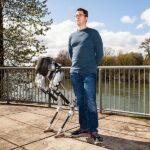

Roboticist Naomi Fitter performs stand-up comedy with a small humanoid robot to gather data on human-machine interactions.
In a typical black-box performance space, a 2-foot humanoid robot stands on a square IKEA end table. In this YouTube video, a human arm from the edge of the frame holds a microphone to the robot’s smooth shiny head.
“Hello, I am Jon,” he says and waves his small plastic arm, the joints at his shoulder and elbow whirring. “Of course, that is not my real name, but humans have trouble pronouncing: [the sound of mid-’90s dial-up internet].” The off-screen audience erupts into delighted giggles.
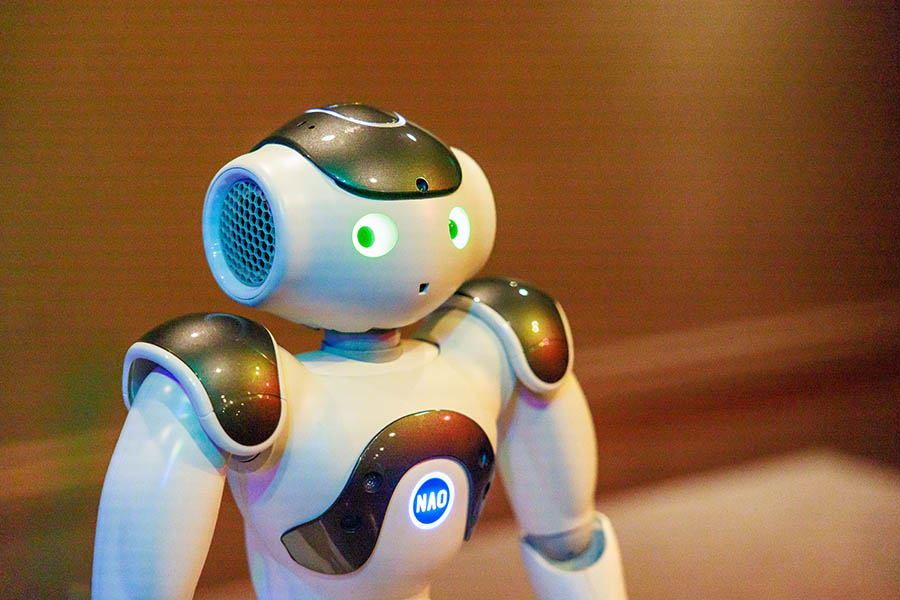
This is just one of many zingers performed by stand-up comedian and research tool Jon the Robot, a creation of assistant professor Naomi Fitter in the School of Mechanical, Industrial and Manufacturing Engineering at Oregon State University.
Having graced many stages up and down the West Coast, Jon’s origin story begins some eight years earlier in Los Angeles, a city where anyone (even an android) might dream of making it big. At the time, Fitter was a postdoctoral scholar at the University of Southern California but had already been performing stand-up for years. Living in the epicenter of the entertainment world was an opportunity to fuse her passion for comedy with the research she was already conducting in social robotics and human-robot interactions.
At a time when Hollywood and its talent pool are fiercely fighting the rise of AI in creativity, researchers like Fitter see humor as a means to connect robots with humans in ways beyond pure amusement.
“Robots with a good sense of humor represent a pathway to helping technology successfully ‘read the room,’ in a wide range of scenarios,” Fitter tells Oregon Business. “This ability can allow new technologies to better understand their users and perhaps even better connect with them.”
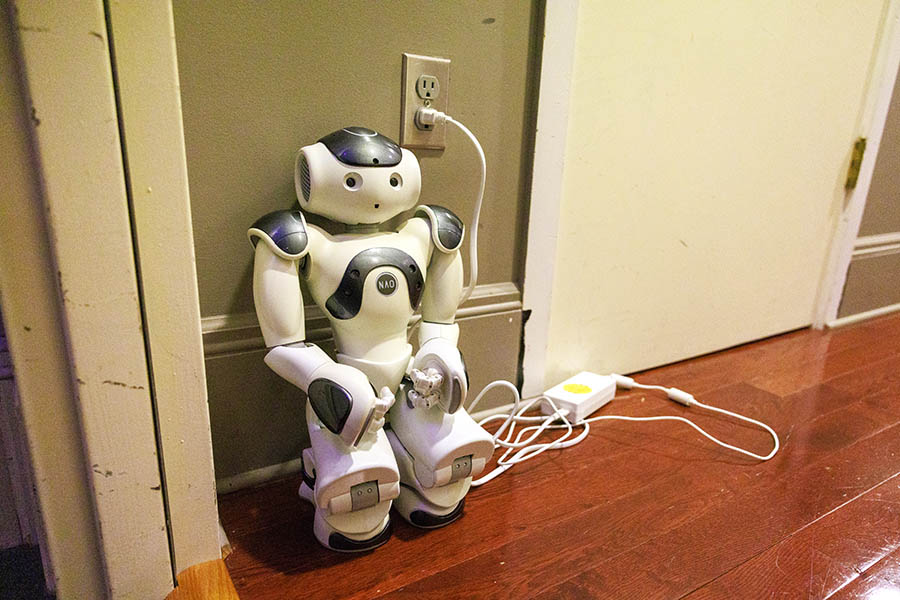
Jon, however, is not the first robot comedian to grace the public stage. Heather Knight, Fitter’s colleague at Oregon State and an assistant professor in the School of Electrical Engineering and Computer Science, had been working at the intersection of robot and comedy some years before Fitter dived in. These days Knight leads a robot theater company called Marilyn Monrobot, which features performances by her invention Ginger the Robot.
While both Ginger and Jon are NAO robots — which are humanoid and programmable —Fitter identified some unchartered territory in how technology might be harnessed in robot comedy, which differs from her predecessors.
“I’d say that with my system setup, I focused more on giving the robot the ability to sense things and make decisions in the way I do,” Fitter explains. “I was shooting more for a robot comedy performance that could almost parallel or contend with expert human comedians.”
So in 2018, Jon the Robot made his stand-up comedy debut at an outdoor open mic in Los Angeles. Two years later, Jon and Fitter performed 22 shows in the greater L.A. area to gather data on how the comedic timing of a robot can impact its success among audiences. It turns out robots are funnier when they let the audience react to a joke.
Although Jon’s jokes are written by Fitter and preprogrammed in a particular order to maximize comedic effect — punctuated by the small gesticulations he makes with his arms and hands — the small robot is considered autonomous because he makes use of adaptive timing. In other words, he can “read the room” by listening to the audience’s response, whether it’s applause or laughter, before he moves on to the next joke.
He can also deploy machine-learning tactics in decision making, which involves adding a programmed “tag” following a joke, based on whether he gauges a negative or positive response from the audience. For instance, if Jon senses that a joke was successful, he might offer the quip: “Don’t you hate it when you’re trying to solve inverse kinematics equations to pick up a cup and then you get ‘Error 453, no solution found’? Don’t you hate that?” It means he’s got the audience on his side. Conversely, he might add: “Not a lot of robots in the crowd, I guess. That joke kills at Best Buy” if the crowd falls flat.

As a stand-up comedian herself, Fitter says she’s been fascinated by how objective she can be when assessing the robot’s comedy wins and fails.
“When I try to do this with my human comedy, like look at if a particular joke or different styles of jokes succeed or fail, it’s kind of excruciating,” says Fitter. “But with the robot, you can cue up [the performance]and it’s less risky than in the moment. Then you can get some full objective data on what tactics or what material is making what kind of impact, for better or worse.”
Kory Mathewson agrees. He’s a senior research scientist with Google DeepMind, whose work focuses on human and machine creative collaborations. “Artificial intelligence can help us decode, analyze and understand humor,” says Mathewson. “This can lead to more sophisticated and personalized comedic experiences.”
So what, exactly, goes into writing from a robot’s comedic perspective? As someone with comedy training and stand-up experience, Fitter says character and world-building exercises were really the launching point.
“What is romance for a robot? What’s grief for a robot? What’s drugs for a robot?” Fitter asked herself. “So when I was starting to write, I tried to think about what are the most hack jokes that humans tell, and then I kind of mapped them to the robot’s perspective.”
As gender disparity in professional comedy is still a weighted issue, Fitter explains that her choice to make Jon male-presenting was intentional but not without careful consideration.
The robot was modeled after a typical Silicon Valley engineer, in regard to his monotone humanoid voice and commonplace name. While she did run tests with a female-presenting voice, Fitter found that it sounded almost “too human-like” and wanted to retain the robotic quality of the small performer.
Moreover, in a study with university students, Fitter was relieved to conclude that “when you do modulate the gender presentation of the voice, there wasn’t a significant decline [in enthusiasm] that we could identify.”
While Jon the Robot has settled into his identity, his technological developments are still ongoing.
For instance, Fitter is considering upping Jon’s “snarkiness” levels in an experiment to win back the audience if they respond more negatively to a joke, or perhaps when the reaction from the crowd is lukewarm. She’s curious if maybe a playful tease or chide can bring them onboard.
Fitter is also looking at what’s called “computer vision,” which would involve the robot reading facial expressions after the delivery of a joke. While technologies like that do exist, they’re often not yet mature enough to be tested in the wild (i.e., the comedy club).
“We haven’t hit the nail on the head yet for how to adapt it without it being sort of equal parts creepy and entertaining,” says Fitter.
The roboticist is also curious about larger language models. For example, could Jon
ad- lib a joke about Chicago while performing in Chicago? “The overall processing takes quite some amount of time. So using that in comedy performance in split seconds could be really impactful,” she explains. “We haven’t quite figured it out, but we’re looking into it.”
For now, Jon and Fitter have been busy playing the comedy circuit, to a generally positive reception. Fitter does recall one performance, however, in Riverside, California, where the little one was met with slight hostility.
“The robot made a joke about taking people’s jobs in a setting where that’s more of a sensitive topic, so I was a little nervous for that one,” says Fitter. In the end, “the repertoire banter actually won the crowd over. So that’s one of my crowning achievements.”
“Comedy can be can be tough,” she continues. “It’s not guaranteed that, even in the ideal setting, people will respond to your performance. So I usually like to say the robot performs at a similar level to its human counterparts in any given show, and that makes me pretty proud of the little guy.”
For Mathewson, Fitter’s work is making a difference in its own way.
“Naomi and Jon are bridging the gap between human and machine intelligence through humor, which creates engaging and enjoyable interactions in their performance,” he says. “Laughter is powerful…. Robots that can make us laugh open new possibilities for connection and interaction.”
Last summer the human-robot duo tied for fourth place at Portland’s first annual Comedy Pageant, winning a special prize awarded by the judge. They also performed at the Crow in Los Angeles, sharing the bill with comedian Aparna Nancherla, and headlined at the Comedy Loft in Washington, D.C.
Click here to subscribe to Oregon Business.