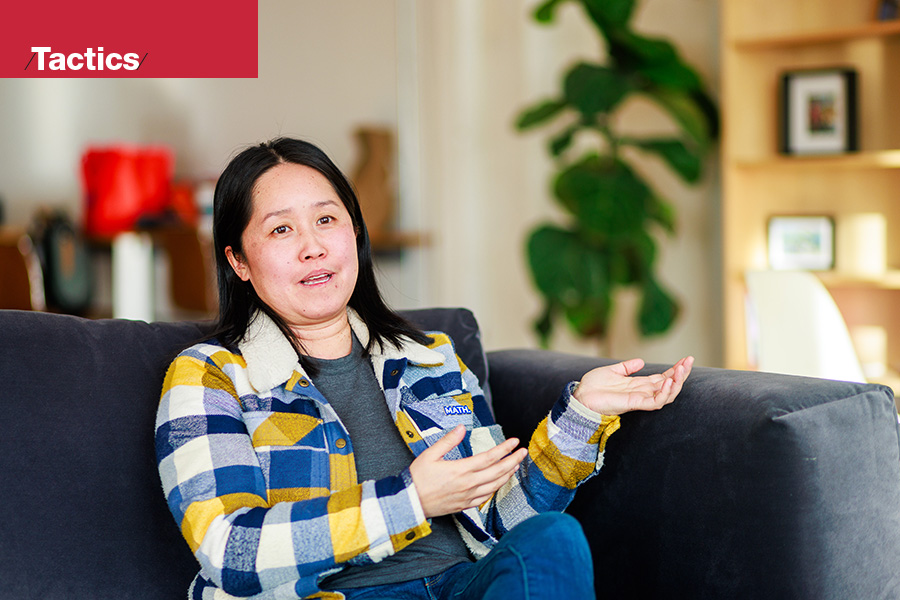
In the thick of the Great Recession, Tsang left her job as an engineer to take wedding videos, beginning a journey that took her to the Super Bowl preshow and beyond.
In 2009 Joyce Tsang was working as an engineer at 3M, designing orthodontic products. It was the work she trained to do in college, and she was successful — she holds a couple of patents from that period. “The science part of it was great,” she says, but she never felt comfortable in the corporate work environment. She’d also always had a creative side, and working as an engineer wasn’t feeding it.
So she pivoted to video, founding a production company, Only Today, with her husband, Ray. At first they shot on tape, but in the late 2000s, digital single-lens reflex cameras became able to shoot video, greatly improving the quality of digital video — and the cost and speed of producing it. Joyce says Ray, who worked in finance at the time, “kind of dared me” to quit her job to pursue a creative career. He followed suit, reasoning that if the company failed, they could go back to their old careers.
The Tsangs started out shooting wedding videos for friends, then expanded to sports work, commercials and branded content, as well as some documentary work — including a short film that showed during the 2024 Super Bowl, and one of the pre-game teasers.
Though it’s been more than 10 years since the Tsangs were asking friends if they could shoot their weddings for free, Joyce says they still get most of their work through word of mouth. Commercial work isn’t off the table, but “it’s the human stories that really excite us,” she says.
In January Oregon Business spoke with Joyce about her start in the business and how video production has evolved in recent years, as well as what’s next for the company.
This interview has been edited for length and clarity.
You quit your corporate job in 2009. It seems like that was not a time to be doing that; not a lot of businesses were being launched at that time.
We were young, and I don’t know if I would do it the same way now, but I don’t regret how we did it. I mean, 2008 was a bad year for the economy as a whole. To leave my very stable job that had a 401(k) and health insurance and a pension — you know, that word doesn’t even exist anymore, but it existed back then — to go quote-unquote be an artist was scary. It was scary and risky. But I think the way that I looked at it was, “You know what? What is riskier: staying in something that doesn’t make my soul feel alive, or trying something and seeing where that goes?” I felt like I would regret not trying. I would kick myself if, 30 years later, I was doing this thing, and I was like, “I wonder what would have happened if I just tried my hand at telling stories versus designing braces.” I decided to take a risk; invest in myself, in what I thought was possible; and I’m very thankful, very grateful that things worked out for us. I would have really, really regretted if I didn’t try.
When you launched the business, were you in Portland?
No, we were in L.A. My husband and I both grew up in the suburbs of L.A. And despite L.A. being, obviously, a huge mecca for video and whatnot, we gravitated elsewhere. We’ve been in Portland now for a long time. I love it here. People are always like, “When are you moving back?” And I’m like, “I’m not moving. We’ll come back and visit.” But yeah, I think the Pacific Northwest is home.
Tell me about some of those first jobs that you were doing, wedding jobs. How did you market yourself? How did you find people?
We were at that age when we had just gotten married, and we knew a lot of other people who were getting married. So it wasn’t terribly difficult to convince a friend or a friend of a friend, to be like, “Hey, you know, I really want to try this thing,” to do it for free or for $500 and just kind of get our foot in the door. I’d never had to do sales before; I was an engineer. It was subscribing to this whole 10,000-hours thing, like you’ve got to get enough reps to know what you’re doing and just keep shooting and keep refining that. I taught myself how to edit using Final Cut 7 off YouTube, back when YouTube didn’t have what it has now. We both took workshops and we talked to people who were doing things that we wanted to do. When we started off, it was a free wedding, and then it was a $500 wedding, and then a $2,000 wedding, and then in about a year — a year and three months, I think — we got up to a $10 or $12,000 wedding, doing photo and video very early on. I look back sometimes on convincing people to give us [an opportunity] so we would have 10 weddings under our belt. But we just love making images and telling stories with those images. And I just can’t see myself not doing that now. If you told me, “Why don’t you go back to being an engineer?” I’m just not even thinking about that.
What are some of the things that you’ve worked on more recently? I know you had a couple of short films that were shown around the Super Bowl.?
For the 2024 Super Bowl, we did a couple of big things: We did the opening tease, which plays right before kickoff, with players and families. It wasn’t just us; it was a large team from the network and other shooters. Then we also did a short film that was kind of like a biopic narrative, but based on the true story of the Oakland Raiders. So we still do some sports stuff here and there. We mostly do branded content now. We’ve done full-blown commercial work, but a lot of it is kind of what I call human-centric, documentary-style storytelling that has a brand wrapped around it. We’ll often do things about a person who uses a product, but in a way where there’s a personal story behind that, and we leverage our event and documentary background to work with them where we’re telling their story authentically and beautifully, in a way that’s true to them. It’s different from a commercial, where you have actors and a script; what we do is kind of interview-based storytelling and day-in-the-life coverage of what they do, how they do it and why they do it. That’s probably one of my favorite parts about what we do, just being able to meet people, learn from them, learn about them, learn about their cultures. It feels silly sometimes to call it a job. I’m grateful that that’s what we get to do so often, just to get a glimpse of people’s lives and be able to share that more widely with the world through storytelling, through video.
What are your thoughts moving into 2025?
I don’t know. It’s still early. Hopefully we refocus on our company and our clients, like, what are the stories that we want to tell? What are the stories that are interesting to people? There are things that we naturally gravitate toward, but it’s kind of an unknown right now. 2025 feels a little less defined than some other years. I don’t know if you’re getting that sense from other businesses too, but it feels like it’s a little nebulous. I’m hearing that there’s some anxiety in ad and marketing spaces, in particular; people don’t know how much they want to spend because they don’t know what the economy is going to look like.
There’s also just conflicting and confusing feedback from clients. There’s one train where everybody wants TikTok-style, short-form stuff. Then some people will be like, “Now it’s the long-form YouTube stuff; everybody wants more in-depth storytelling.” In recent years it feels like long-form documentary storytelling has made its way into streaming and all that.
It’s really about trying to understand, where does the market want to go now? Do you want the short-form stuff or the long-form stuff? We’ve done plenty of both; we’re trying to kind of understand what the market needs are. It’s an ever-changing thing.
Click here to subscribe to Oregon Business.