
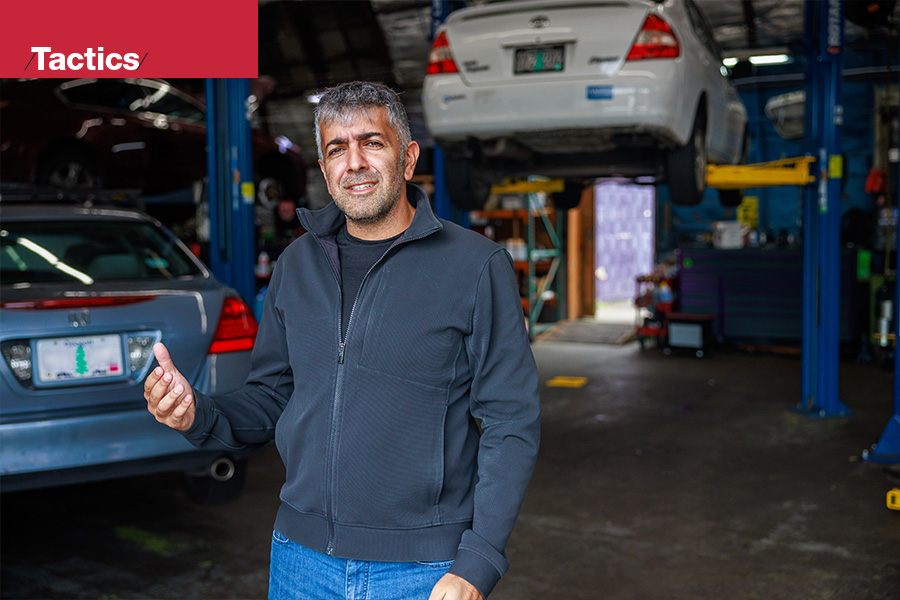
Ghafarzade started Green Drop Garage to convert diesel engines to run on vegetable oil. Now focused on general car repair, the company just opened its fifth location.
In the mid-2000s, Farhad Ghafarzade was studying biology at UC Santa Cruz (and repping the school at sporting events as its mascot, the Banana Slug). He planned at first to go to medical or dental school.
But in college, he learned how to convert diesel engines to run on vegetable oil. “I just wanted to go surfing and I couldn’t afford gas,” he tells Oregon Business. So purchased a diesel car, converted it to run on vegetable oil and started fueling it with oil he found behind the school dining hall. After college he moved to Portland, where he worked as a bartender and started converting friends’ cars to run on vegetable oil in an effort to pay down his student loans. Over time, Ghafarzade learned to fix cars and in 2009, opened Green Drop Garage.
At first Green Drop was focused on biodiesel conversions, though the first garage — situated in Southeast Portland — also did some basic maintenance and repair. Over time the business model has flipped, with maintenance and repair making up more than 99% of Green Drop’s workload. That decision was necessary in order to scale, says Ghafarzade, and it has paid off: In July Green Drop opened a shop in Vancouver, adding a fifth location to its portfolio. (All four other stores are in Portland.)
OB spoke with Ghafarzade about the early days of the business, Green Drop’s hopes for the future — and how he goes about running an environmentally friendly mechanic shop.
This interview has been edited for length and clarity.
When you started Green Drop in 2009, were you focused on biodiesel vehicles or were you kind of open to everything? You work on all kinds of cars now.
When we started, I thought it would be a 70/30 split. I thought it would be 70% repair, 30% vegetable-oil conversions. Now we’re at 99.9% repairs. We only see one or two conversions per year, but we do about 60,000 other invoices that are just regular repair and maintenance. As I started the business, I realized I could hit a bigger cross-section of the market with maintenance and repair with a new model. We meet people where they are; the products we use are a bit more eco-friendly, environmentally better. That’s the way we’ve approached it.
With the number of conversions being a lot lower than you thought, is that just because demand is for conversions is lower now, or lower than you anticipated?
It’s only 5% of car drivers who drive a diesel car. Maybe only a few percent of them want to spend a lot of money for a conversion to run on vegetable oil. We are the oldest actual businesses doing vegetable-oil conversions in the area. So it’s not so much that the market got smaller as it is that I realized other services are more scalable. A vegetable-oil conversion still requires a high degree of engagement from me and engineering; it’s not like a brake job. We started doing the other services more frequently, as a higher percentage, just because we wanted to grow the company and to get out of the onesie, twosie, where I’m involved with each job. We got to scale and serve more people by focusing more on just regular maintenance repair rather than a specialty of vegetable-oil conversion.
How many employees did you have at first?
When we started, it was me and one other employee. We slowly grew, and now we have about 40.
You talked about using products that are a little bit more eco-friendly. Can you tell me a little bit more about that?
It’s not like we were innovative or we invented something; it’s kind of like the New Seasons or Whole Foods type of model, where we’re bringing in products that are already more conscious. So the motor oil we use is a recycled oil that is 85% less energy-intensive to produce than oil from virgin petroleum. And it costs more to purchase, so what we have to do is promote the value of it and make sure that we also inform the customers why it costs more.
We offer whatever we can reduce or eliminate in terms of carbon credits. We buy wind power. We also, where we can, use enzyme-based cleaners — stacking all those little things on top of a better place to work and better employee benefits. We’re also a certified B Corp, and we recertify every two years.
So as you scale up, what sorts of things are you looking at in terms of sticking to the triple-bottom-line idea?
As we open new locations, we just keep getting better and faster. At our older locations, we adopted different practices after they opened rather than at the beginning. So it’s getting actually easier to keep the triple-bottom-line mentality and its application to a new location.
What I’m excited about is that as we open locations, it gives our staff ability or an opportunity to lead. So we have grown our staff again, not only in size but also in skill. And those who want leadership positions have an opportunity to do so without having to wait — you know, “Wait your turn, wait ’til he retires.”
Where do you see this industry heading? There’s more support for electric than there’s ever been. Does that require a different skill set?
We have our staff that are certified on electric vehicles; we work regularly on hybrid and electric vehicles. Electric is, I think, good for car repair; I don’t see maintenance and repairs going anywhere. And the beauty of it is that car repair as a trade isn’t going anywhere because you can’t outsource it like many other jobs — like copywriting, which is being heavily affected by AI, and like many other jobs, which have been affected by offshoring. The beauty of a trade is that you can still produce jobs worth having and jobs that support families and that are stable. So that’s one really exciting thing we want to do as a company in the coming years, is to become extended regionally. Our goal is to double our footprint in three years. That’s our modest goal right now for what we want to do.
A lot of industries — including skilled trades — are facing challenges with a tight labor market. Is that a challenge you’ve had in your business as well?
Yeah, we have, but it’s opening up. And honestly, the challenge is I think that, as employers, we have to up our game and attract the right talent. It’s an opportunity to show how people are treated by the company and what do we provide for technicians to be attracted to us. But it’s opened up a little bit. People are easier to find.
Where are you finding people? Are you hiring from community colleges, like Mt. Hood, or people who’ve apprenticed at other shops?
We do look to hire from Mt. Hood Community College. We do like people coming in earlier in the career, and we can train them up. But we also do hire professional technicians who want a better place to work. We pull from some dealerships, some larger repair organizations. We like to bring in newer [talent], but we also have done well with technicians who just want a better place to work.
What do you do when you’re not at work?
I’ve got a family; I have two small kids, 7 and 9. In the winter I like to ski. In the summer, a good road trip is always great.
Click here to subscribe to Oregon Business.