
A judge has temporarily blocked cuts to research funding in the 22 states that sued.
Leaders in Oregon say proposed cuts by the Trump Administration to the National Institutes of Health would ravage funding to develop urgently needed treatments for fatal conditions like cancer and heart and neurodegenerative disease.
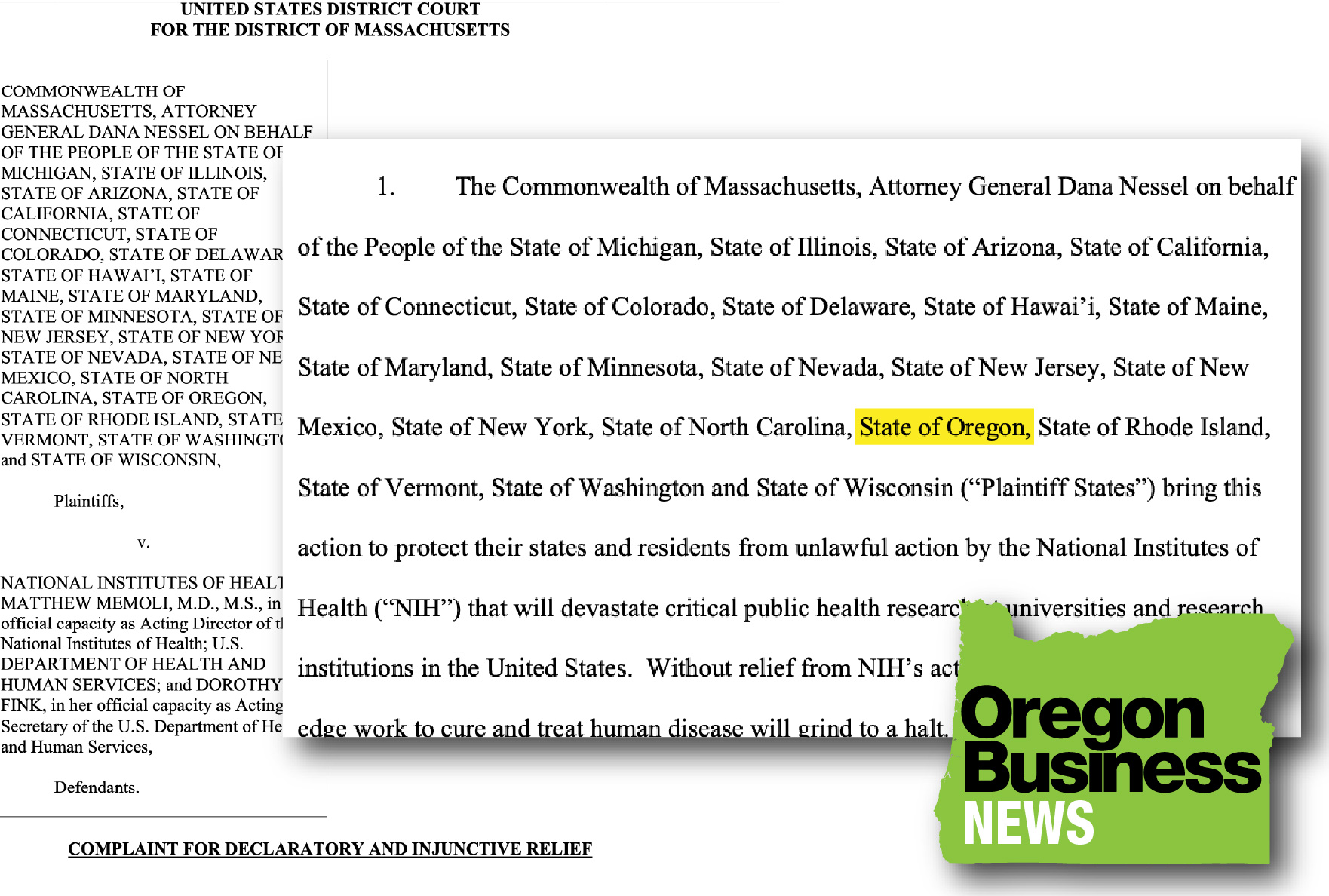
Earlier this week, Oregon’s Dan Rayfield joined 21 fellow state attorneys general in a lawsuit to stop the Trump Administration’s plan to cut overhead costs, also known as indirect costs, that add up to $4 billion nationwide. The states allege the administration violated the Administrative Protection Act when it cut funds that support innovative medical and public health research.
“President Trump’s disdain for science has been long evident, but these cuts represent a dangerous culmination of years of undermining trusted public health expertise,” Rayfield writes in a statement. “It is clear this administration has no concern for the well-being of Americans, especially those who rely on this research to improve their quality of life and protect their health.”
In response, a judge temporarily blocked the cuts in the 22 states represented in the lawsuit. The cuts were to take effect Monday.
The NIH is the country’s largest source of federal funding for medical research. Throughout the years, it has led to numerous scientific breakthroughs, according to the lawsuit. They include treatment of all types of cancer, the sequencing of DNA and the development of MRI.

Institutions in Oregon received around $388 million from the NIH. Oregon Health and Science University received around $295 million of that, the most of any source in Oregon. After OHSU, the largest NIH grant recipients are the University of Oregon ($44 million), Oregon State University ($34 million), Kaiser Permanente Center for Public Health Research ($11 million) and Portland State University ($6 million).
OHSU interim President Steve Stadum said in an email to staff the cuts were potentially devastating to OHSU and other universities, hospitals and research institutes across the U.S. Without reimbursement for indirect costs, lifesaving medical research could be compromised.
“The consequences of the new guidance are scary for all of us who take pride in our tripartite mission of research, education and patient care, but particularly so for those directly involved in research,” Stadum writes.
The cuts were announced Feb. 7 and were to take effect the next day.
In light of the flurry of action in the first days of Trump’s second term, OHSU has set up an incident command system to evaluate and respond to federal policy changes, the Portland Business Journal reported.
The lawsuit was filed in U.S. District Court in Massachusetts. The states represented are Arizona, California, Connecticut, Colorado, Delaware, Hawaii, Illinois, Maine, Maryland, Massachusetts, Michigan, Minnesota, Nevada, New Jersey, New Mexico, New York, North Carolina, Oregon, Rhode Island, Vermont, Washington, and Wisconsin.
The proposed cuts drew opposition from some Republicans including Sen. Susan Collins of Maine, the New York Times reports. In the end, Collins supported the appointment of Robert F. Kennedy Jr. as health secretary. He was confirmed by the Senate on Thursday.
Click here to subscribe to Oregon Business.