
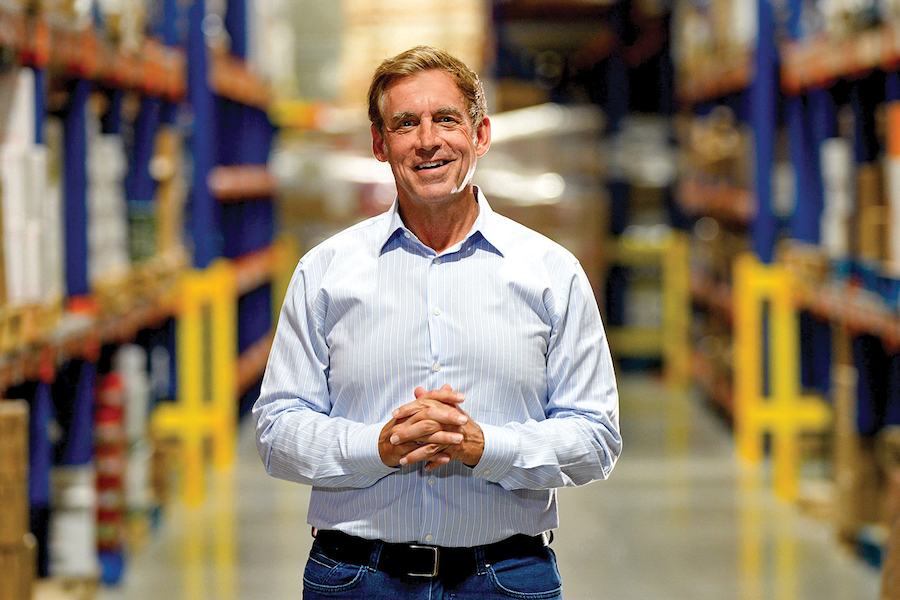
Wright talks about how the Eugene-based grocery chain’s model has helped it thrive in the face of disruption — including a cyberattack that knocked out systems for one of the industry’s big suppliers.
Rick Wright grew up in the grocery industry.
Wright’s father, Richard Wright, Sr., worked in the industry, and in 1979, Wright took the reins of his father’s business, which included a number of Thriftway and Price Choppers locations, eventually rebranding as Market of Choice. Based in Eugene, Market of Choice now operates 12 stores throughout the state, with Wright serving as CEO.
When Wright spoke with Oregon Business in 2015, the company had just announced plans for a fourth Portland-area location, on southeast Belmont, as well as a store in Bend.
Last week Wright spoke with OB about how the company has diversified its supply chain to resist disruptions like the cyberattack that targeted Unified Natural Foods — a major supplier to Market of Choice as well as larger competitors like Whole Foods — earlier this month, how consolidation among suppliers is hurting the industry, and why building relationships with local vendors helps stores stay stocked.
This conversation has been edited for space and clarity.
Supply chain disruptions have been a big topic in in pretty much every industry in the last few years. We’re anticipating, or kind of in the middle of another big supply chain disruption, but it seems like this is just sort of something that has happened a number of times in the last few years, starting with COVID. Can you talk about kind of what trends you were seeing in the grocery industry?
I actually think it started about 25 years ago. We used to have a member-owned co-op called United Grocers, which was based in Portland, and their facilities were out in Milwaukie. They served the Northwest independent retailers, and they started seeing some financial troubles. So United Grocers and Certified Grocers of California and Associated Grocers of the State of Washington all decided to merge to create one larger cooperative called Unified Grocers. There was some disruption when these companies started to have some financial stress. We first started building our first little distribution center so that we could backstop whenever there was a period of time when they couldn’t make some deliveries to us. Certified Grocers, as a member of the co-op, did survive and ended up being forced to sell to Super Value, which was based out of Eden Prairie, Minnesota, which at the time, was the largest food distributor in the United States. It was another signal that, man, it’s we’re just becoming a smaller piece of a very large pie, and when, when there’s going to be problems, nobody’s going to care about us.
In about 2008, we started building a larger distribution center, and we actually put in a central kitchen where we produce about 50% of the foods we sell in our kitchens and our bakeries, in our stores, and we built that in down in Eugene. Then COVID hit, and this disruption got to the next level that we’ve never seen before. So we doubled the size of our distribution center. We’d already had plans drawn up for a larger for an addition, and we went ahead and started construction on that double the size of our facility. Coming out of COVID, it was like, “Well, I’m not sure that was the smartest thing to do, because did we really need to double the size of the facility?” But we had it at that point, and so we really worked on finding ways to keep the facility full and to keep product moving to our stores. For a 12-store chain, we have 100,000 square feet of distribution.
Sometimes you question those decisions, but just last week our largest supplier had to shut down their entire system and their entire operation over some sort of a virus that infected their [computer] systems. We literally got our first deliveries from this large supplier yesterday, for the first time in one week, but we received about 25% of what we ordered. We didn’t see anywhere near the size orders that we in place with them. So disruption continues, and will probably continue.
There’s a lot of uncertainty around tariffs, but I but I don’t know how that I don’t know how that affects grocery at this point, or your particular model.
We actually haven’t seen a lot of disruptions because of the tariffs at all. Tariffs already exist on tomatoes, avocadoes, all kinds of things to protect the ability of farmers in the U.S., to have a competitive environment.
The key for us has been to stay diversified. Not only do we have our own distribution center, which is incredibly helpful, we have also diversified to the point where we use a lot of local and smaller distributors to help us keep our stores full in times of disruptions, especially if it’s weather-related. The small folks seem to be able to serve us in a way that these large suppliers can’t, and it just kind of keeps our stores in a better situation. We don’t buy produce from our large wholesaler. We don’t buy meat or seafood from them, or a lot of our ingredients for our kitchens or our bakeries. We buy those from smaller distributors that are based throughout Oregon, and they’re great partners, and that unique way that we have built relationships with them just kind of kind of magnifies anytime there’s a disruption, because they step up us help us in ways like our produce supplier has been helping us get frozen products and refrigerated products to our stores over the last week. That’s not the business they’re in, but they’re helping us pick up product from some other distributor or from other manufacturers throughout Oregon, and helping to get it to us. It’s just a much better system when we haven’t sold ourselves to one supplier who decides it has disruptions in It can’t get us product. We don’t buy any more than 35% of our total products from any one supplier. And that’s kind of unique in our history. A lot of folks are buying anywhere from 60 to 70% of their total products from one supplier, and so when that disruption occurs, you know, it’s much more difficult for them.
Are there other disruptions to the supply chain that you are anticipating, or are you just sort of anticipating that there will be continued disruptions that we can’t necessarily predict?
One of the disruptions is the fact that the number of large suppliers keeps getting smaller. I mean, right now there’s really only a couple. There’s only two choices for me to buy, promote on a large supply chain. They’ve all merged. The big guy buys out smaller guy in the in the case of United Natural Foods, who is our largest supplier, they actually were a smaller supplier who bought Super Value.
What do you think might help in terms of making the supply chain a little bit more diverse?
That’s a very good question, because as there’s consolidation, the location of our distribution center seems to get further and further away from us. Our distribution center used to be in Portland. Now they’ve moved all the way up to Centralia and Ridgefield, Washington, and if there’s another consolidation, they’ll move it even further away from us. So it basically is locality. Are we going to have local food distribution, or are we going to have regional food distribution? During COVID, I actually had a number of calls with Sen. Wyden about this. I voiced my concern about how we’re allowing our food to be distributed from long distances away, and anytime we have any type of test, catastrophic event is going to cause delays in giving product to us. I don’t really know where it goes from, but as there’s consolidation in any industry, if there’s more consolidation on the retail side of our industry, it’s just going to be further and further away that our food comes from. And there just aren’t a lot of companies like Market of Choice that’s willing to invest the money that it takes to keep it local and build local.
I don’t really know. I’m not sure that the government can play a part in this or not, but it just it takes people that are willing to realize that that, “I live in this community, I live in this state, and the state needs to be taken care of whenever there’s a time of need.” I’m not saying that building a distribution center or central kitchen is a super profitable endeavor to get into. It’s not the most profitable thing; it’s not the best use of my funds as far as if I was going to look for return on investment, but it’s something I chose to do, something I feel proud of.
We have this program called MOJO and we have 125 vendors in the state of Oregon, and some of them are actually in Washington as well, but these are vendors that are small — introducing their brands and their product to the market — but they have no way of distributing throughout the state of Oregon. We actually allow them to deliver their entire order to just one of my stores. Then we’ll pick it up, take it back to our distribution center, and we’ll distribute it to all 12 of my stores for them for free. We have like 535 products on the shelf that we are distributing for small, little cottage-industry startups. Nobody else is doing that, and certainly not profitable — I’m not making any money by the time I touch that product as many times as I’m touching it to get it out to my stores — but it’s a way to help those folks, but also to keep the industry driving in Oregon, because there is a really good cottage industry of food.
Do you have any other thoughts on either, you know, developments in the industry, whether it has to do with the supply chain or anything else coming down the pike?
Oh gosh. In my industry, every day, I get some push notifications from our industry telling me about how important AI is to all of this, that AI is going to be doing everything, and it just scares the heck out of me. You look at how reliant our food suppliers are on their computer systems, and their computer system gets a virus, and all of a sudden have to shut the entire system down: they can’t take orders, they can’t receive product, they can’t ship out product. They feel like we’re going to become more reliant on our computers and artificial intelligence. Is kind of scary to be honest.
It kind of breaks your brain to think about a computer system being the reason that you might not be able to buy fresh produce. Lifting a crate of tomatoes off a truck, that’s not a computer’s job.
In my company, we 100% have humans write our orders every day. I don’t know how a computer is going to know whether or not the consumer is going to be ready for strawberries in the next few days — because they’re looking beautiful, and they’ll make sure we bring in a lot more strawberries because it’s going to be a nice weather, and the strawberries are looking perfect and all that stuff. There’s just so many aspects to it. And there are a lot of retailers out there that are using some sort of artificial intelligence to help with their order writing. But you go into their stores and you’ll see there’s a lot of out of stocks or overstocks — you’re out of stock or overstocked because you didn’t anticipate something that hopefully a human that has some good knowledge and history can.
Click here to subscribe to Oregon Business.