
Ryan Krabill discusses tariffs, trade deficits and what makes Oregon ag unique
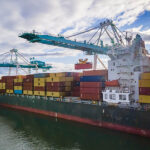
Over the past four years, the U.S. has imported far more in agricultural commodities than it exported with last year’s trade deficit setting a record at $32 billion.
That’s a scenario far from ideal for Ryan Krabill, the Oregon Farm Bureau’s government affairs manager, which represents 6,500 farms across the state and advocates for legislation in Salem and Washington D.C.
Some of the group’s top priorities at the moment are water and labor policies. That involves fighting SB 1153, which would limit water rights transfers and Democrat-supported proposals to improve worker conditions, which ag insiders say could have unintended consequences for an industry heavily reliant on undocumented labor. And with a record number of bills introduced this legislative session — more than 4,000 — other priorities are in danger of being drowned out.
Krabill is a veteran of the public and private spheres at the state and national levels. He’s been particularly active in the field of potato growing with recent stints with the National Potato Production Board and National Potato Council.
He met with Oregon Business this month to discuss tariffs, trade deficits and climate change.
This interview has been edited for length and clarity.
Tell me about your group’s membership.
We represent 6,500 farm families across the country or across the state and of all sizes. That’s mom-and-pop outfits that are supplying your local farm stand, all the way up to larger production facilities typically seen on the eastern side of the state. It runs the gamut — everything from cranberries on the coast to cattle and beef and wheat and everything in between.
So I’ve heard Oregon is more diverse agriculturally than, say, a plains state, which is maybe more monolithic. Is that right?
You’re exactly right, and you used my favorite word when describing what Oregon is not and that is “monolithic.”
We have over 220 commercialized crops in this state. You go to the Corn Belt and it looks very, very different. So that makes us a lot more unique in terms of what we offer the global marketplace both in terms of production but also, inputs, as well.
I want to talk about tariffs and about how they impact the ag sector. How did the sector in Oregon fare during the first Trump administration? Did your members end up losing money?
That’s a big question. For the farm economy across the board, the past few years have not been great. And I would say that spans presidents. That spans different sessions of Congress. There’s a whole lot of larger issues that are wrapped up in that.
It’s not been great in farm country from an economic standpoint, but I think there are a bunch of different factors that go into that.
One thing about a trade war is, it’s not about the tariff so much as the retaliatory tariff. When we impose high tariffs on China, for example, you have to worry about the effect, right?
Well, I will say, the whole tariff policy is something that introduces a level of uncertainty that’s not helpful to any market, whether it’s financial or agricultural or whatever. And I’ll say, the dynamics here that I’ve observed are unique in the sense that the policy is not all that unexpected. It was known that this was going to happen at the federal level, with an electoral outcome that we had. So there is still support for it at a personal level.
I was surprised when I had a conversation with one of our members the other day and I asked what their perspective was on the tariffs. The response I got was, well, you know, it’s one of several things that’s impacting the market.
So we would prefer them to not be there, but at the same time, I think the evidence has borne out that tariffs have been used as a negotiating tactic and tool. Not that we’re endorsing using them in that way, because that does introduce that level of uncertainty. But there’s kind of a wait-and-see approach many of our members are taking.
I know some agricultural groups are opposed to cuts to SNAP in the Farm Bill. Why is supplemental nutrition — food stamps — important to farmers?
Well, the full Farm Bill is always on our radar. And it needs to stay together.
The Farm Bill is a unique coalition, both on the production and the consumer-driven side. And I think it’s worth talking about the food stamp program or SNAP. It represents about 80% of what the quote-unquote Farm Bill is. And I think that gets lost a lot of times in conversations about how we find savings in a USDA budget.
I mean, if you’re trying to identify savings in a program, and there’s a specific slice of that pie that takes up 80% of it. That realistically has to be a part of the conversation. It’s certainly an important piece of what we do, and there are a lot of downstream effects that need to be taken into account as those kinds of policies are being pursued.
What about the issue of climate change — is this an area where agriculturalists can find common ground with environmentalists?
I think by and large, in the agricultural industry, folks will say, yes, growing conditions and the overall climate drivers are different than they were a generation ago. Just from my prior experience, there’s a ton of work being done on the research side, developing new cultivars that are more drought resistant or that pack an additional nutritional punch.
But from the agricultural production side of things —the day-in, day-out —our members are more committed to the land than anybody. And they’re doing everything they can, not just to take care of the land they have, but to leave it in a better place than they found it. Because in most cases, they have future generations coming behind them who want to carry on the family legacy. It’s all very much tied to the responsible cultivation of agricultural crops throughout the state.
Where does the Farm Bureau come down on some of the deportation measures of the Trump administration and Trump’s targeting of sanctuary states and cities?
Well, agriculture is hard pressed for labor to begin with. There’s a high demand and we certainly rely on good, reliable agricultural labor all the time. And we have some of the strongest labor protections of any state in the country, which means that we have some of the strongest protections of any place in the world. I mean, just look at the H2A, for example. The wages associated with that program you’re looking at, I think Oregon has the second highest rate right now. It’s almost $20 per hour. And then you look at the labor costs of Mexico and some other place, and it’s like $4.12, something like that.
So, labor is an incredibly important piece of the puzzle. And I think Oregon is definitely unique in a sense because it’s a specialty crop state, so we don’t get the advantage of relying on the mechanical harvesting techniques to the same level that some other states enjoy.
So the real-world impact of that is, we’ve got a labor cost here in Oregon that’s about 70% higher than what it is in other states. We value our workers.
I know state colleges have been instrumental in agricultural research for a long time, and now there’ve been cuts to the Department of Education and higher ed. Is the state or the private sector going to have to pick up some of that cost in the future?
That’s a difficult question. I’m not sure about the macro drivers of where that funding might come from but I can say a lot of what you might see are collaborative efforts at research stations throughout Oregon, specifically, where you have scientists who are partially funded by industry funds as well as federal funds through USDA, and university funds. They might draw from all three of those buckets to work on behalf of a specific industry.
I know those are the types of potential cuts that would be of the most immediate concern and consequence to our members, because that kind of applied research is so incredibly valuable. You have emerging pests and disease, and production practices that are constantly being re-evaluated and adapted to create additional efficiencies and fewer inputs.
And this is an incredibly drawn-out process that takes years to complete. From the initial cross (pollination) to when a product is ultimately commercialized, that can be like a 20-year process.
And if you cut some of those projects where it disrupts that development chain, or you have folks leave a project at a specific time in the calendar year, you could lose a year of work, maybe more depending how long those cuts are in effect and whether or not you can salvage the field trials.
So those cuts have meaningful impacts that we really need to be careful about.
What’s one of the biggest misconceptions about the ag industry?
Well, let’s go back to the monolithic thing. There are a number of times when we’re invited to speak from the perspective of “ag,” but there are a number of different types of ag. It looks different by county, and by grower.
There’s a lot of interest in, say, diversification of revenue, because some of our fundamental agricultural markets are shifting, for a multitude of reasons that require folks to look to diversification strategies that might look like farm stands and in other places that might look like renewable energy.
If I could boil it down to one thing it’s that a one-size-fits-all approach doesn’t really do justice to Oregon agriculture.
Click here to subscribe to Oregon Business.