Taxes on imports could undermine trade and slow construction, observers say.
Though much remains uncertain about President Donald Trump’s plan to impose sweeping tariffs on U.S. trade partners, business sectors around trade-dependent Oregon are readying for impact.
After announcing 25% tariffs on goods from Canada and Mexico, Trump cut last-minute agreements with those countries to delay tariffs by a month, and allowed a carve-out for Canadian oil. But a 10% tariff on goods from China — America’s largest trade rival — is now in effect. (Trump is — at least temporarily — allowing a loophole on Chinese goods under $800.) China responded with retaliatory tariffs on energy and agricultural tools.
And over the weekend, Trump announced 25% tariffs on all foreign steel and aluminum imports to the U.S.
“Any steel coming into the U.S. is going to have a 25% tariff,” he said from Air Force One Sunday. “Aluminum too.”
The proposals could have major impacts at the Port of Portland, according to Kara Hansen, port spokeswoman.
“An escalation of tariffs on goods imported from China, Canada and Mexico, and potential retaliatory tariffs on our exports, could undermine trade with some of Oregon’s most significant trading partners, and we’re keeping a close eye on this situation as it evolves,” Hansen writes to Oregon Business.
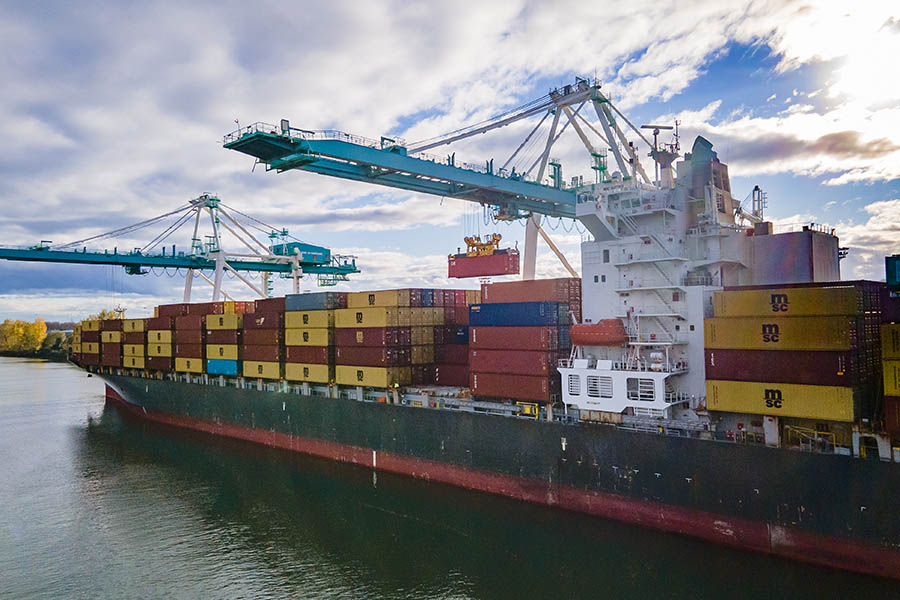
The Port of Portland’s marine terminals represent an important hub for global trade and supply chains. Much of the Port’s activity is conducted through its Terminal 6 on the Columbia River, which handles cargo from consumer goods to agricultural products to machinery to building products like plywood and steel.
Terminal 6 currently receives no container trade from Canada or Mexico, but about two-thirds of container cargo imports received at the terminal are from China. The biggest impact of tariffs on imports would likely be on autos and consumer goods from China.
The top imports are — in order — furniture, tires, footwear, glass articles like beverage bottles and toys.
Oregon exports a fair amount to China, as well. About 6% of containers leaving Terminal 6 are bound for China. The most popular Oregon exports include cars grass seed, hazelnuts, paper products, hay, animal feed and empty containers. The Port also exports bulk shipments including corn and soybeans to China and South Korea, and it imports bulk shipments such as potash from Canada and some autos from Mexico.
The proposed tariffs are not expected to have a significant impact on air cargo flights at Portland International Airport. Air exports from Canada represent just 1.5% of operations by volume, and from China, just over 10%. There are no air cargo flights from Mexico.
Trump has long been a fan of tariffs. In his first term, he used them more aggressively than any president in the post-World War II, free-trade era, according to state economist Carl Riccadonna. But Trump’s targets this time around have puzzled economists and even the right-leaning Wall Street Journal editorial board which last week released an editorial titled “The Dumbest Trade War in History: Trump Will Impose 25% Tariffs on Canada and Mexico For No Good Reason.”
Trump’s stated rationale is that tariffs would hold countries accountable for illegal immigration and trafficking of the deadly drug fentanyl.
According to the Federal Reserve, the share of the U.S. GDP that derives from imports is around 14%, which is low by international standards. But around half of that comes from the three countries targeted by Trump for tariffs: China, Mexico and Canada.
The Oregonian reports the tariffs could further hamper the construction industry and deepen the state’s housing affordability crisis. Homebuilding and other construction would be hit by price increases in materials like softwood lumber — a major export of Canada — gypsum board for drywall, electric transformers and kitchen appliances. The threat of tariffs has already impacted housing production in Portland, which currently has the fewest homes under construction since 2011.
Riccadonna recently told the state House Committee on Housing and Homelessness the state needs to double current production of new housing to 30,000 units to keep up with population growth.
On the commercial building side, industry group Associated General Contractors of Oregon has lobbied Trump administration officials to avoid tariffs that could hurt the industry, reports the Daily Journal of Commerce. They’ve also pressed for the new administration to roll back Biden era rules requiring union-friendly project labor agreements on major federal projects.
Estimates vary for how much tariffs will affect average households. According to some, costs could climb around $4,000 annually.
Angela Wilhelms, president and CEO of Oregon Business and Industry, says though impacts are difficult to predict, she’s most concerned about jobs, rising costs for consumers and rising state and local taxes.
“We are concerned about any steps that could further erode Oregon’s competitiveness or deepen its manufacturing recession,” Wilhelms writes to Oregon Business.
“Tariffs are of heightened interest to businesses in Oregon, which is a trade-dependent state with a significant manufacturing presence. We are concerned not only about higher costs of goods coming into Oregon’s supply chain, including as inputs or equipment in manufacturing, but also about retaliatory tariffs Oregon-made and Oregon-grown products could face.”
Tariffs are usually passed along to consumers in the form of higher prices. In Trump’s first term, tariffs are thought to cost households hundreds more each year in increased expenses. Costs weren’t shared equally across the board, with income reduced at a greater rate for lower-earning households.
Tariffs can also affect all manner of businesses through disruptions in supply chains that shift where goods are sourced. And over the long term, tariffs can lead to higher prices, inflation and economic uncertainty, which can reduce consumer spending, which in turn can affect travel and tourism.
Riccadonna says Oregon, with a larger export sector relative to the national average, will likely be more impacted by trade tensions compared to other states. That’s partly because Pacific trading partners like India, China, Japan and Korea look to face a greater tariff burden than partners across the Atlantic Ocean.
“What we’ve seen in the past is West Coast states are impacted more by tariffs on Pacific trading partners,” Riccadonna says.
The ag and automotive industry will likely be significantly impacted. Whatever happens, there will likely be positives and negatives, says Riccadonna.
“There are tradeoffs when we change the rules of the game,” Riccadonna says. “So if you’re taxing foreign produced items, then to the extent possible, businesses will readjust their supply chains. And if you have a supply chain in place and you have to change it, that’s expensive. So tariffs do increase the cost of doing business, and businesses have to reorient. Some businesses might eventually say that it makes sense to manufacture a product in the U.S. compared to overseas. And so there will be net positives in terms of factory investments and job creations and those sorts of things. There are silver linings to what’s happening on the tariff front. We shouldn’t ignore that.”
Click here to subscribe to Oregon Business.