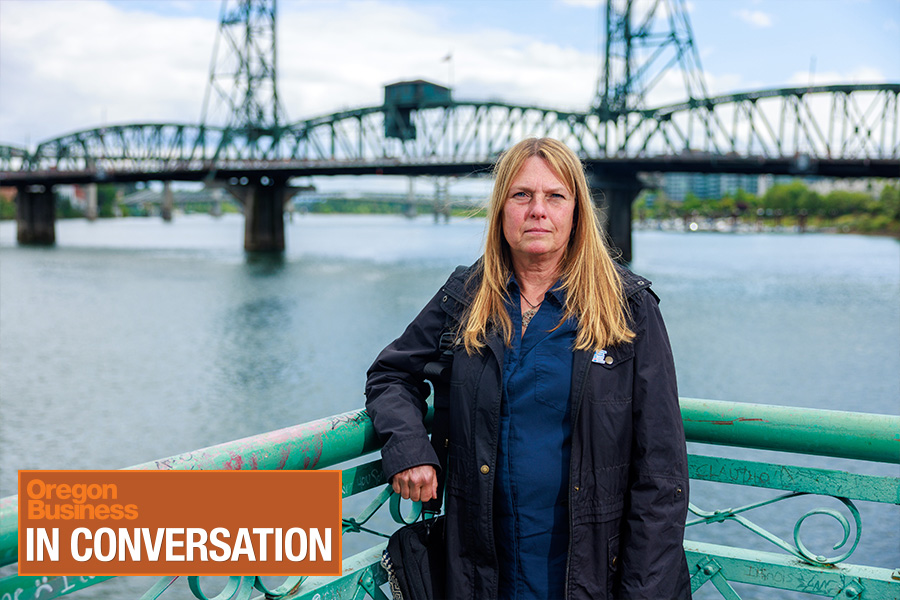
Hampton on Medicaid and other federal cuts: ‘Our mission is at stake. People’s lives are at stake’
Forty years ago, when Kari Hampton was 12, she lost her best friend to leukemia. At the time, a leukemia diagnosis was akin to a death sentence.
In 2019, she received a call at 4:30 a.m. about her daughter, a first-year college student, who’d been admitted to a hospital with multiple pulmonary embolisms. When the doctor said the word “leukemia,” Hampton’s first thought was, “I’m going to lose my daughter.”
But, as she learned, over the past four decades, medical researchers had worked to raise the survival rate for leukemia from less than 5% to greater than 90%. Hampton’s daughter, Johanna, was able to get into a clinical trial for young adults that saved her life.
When Johanna finished treatment in 2022, her mother decided to do more to help families like hers. Since then, she’s been in her current role as grassroots manager for the advocacy arm of the Oregon chapter of the nationwide American Cancer Society, a 112-year-old organization whose core services includes patient support and medical research. With one other staff member, Hampton wrangles hundreds of volunteers for fundraisers and other events.
Hampton has had a varied career including stints as a firefighter-EMT and director of operations for a large international exchange student program. Like every family, cancer has left its mark on Hampton’s. The year before her daughter’s diagnosis, her mother, father, uncle, mother-in-law and four friends were each diagnosed with the disease.
“It was one of those things that it was either, go crawl under a rock, take up some really bad habits, or fight back. And I chose to fight back,” Hampton tells OB.
Hampton met last week to discuss how expected deep cuts to federal social programs will affect ACS.
This conversation has been edited for length and clarity.
Usually when I talk to people with the American Cancer Society, it’s about a Relay for Life or some other kind of fundraiser. I can’t think of a time it was involved in a contentious political discussion. Why did you choose to go public like this?
I mean, it’s what we have to do. Our mission is at stake. People’s lives are at stake. I always say, don’t hire someone as an advocate if you don’t expect them to advocate.
When the pressure comes, you just amp it up. That’s what we have to do. (We) are a nonpartisan organization; cancer is nonpartisan. But this is becoming more of a partisan issue because of the funding. And we need to basically bring it back to what matters, and that is saving lives.
How much of your budget comes from the federal government?
So ACS-CAN, we get a lot of our funding from ACS grants. And we also have our signature fundraiser called Lights of Hope, which is similar to a Relay for Life, with the luminaria bags people can purchase for $10. We have a big leadership summit in D.C. and an Oregon-specific Lights of Hope display on Aug. 27 in Salem.
How would the president’s budget proposal affect ACS?
Right now, the Congressional Budget Office, which is a nonpartisan entity, has basically come out and said that what they’re proposing would amount to a $715 billion cut to Medicaid. And what that means is 8.6 million people are at risk of losing their health care. That’s an immediate concern.
And that impacts ACS directly?
Our mission at ACS is to end cancer as we know it, for everyone. So obviously, right now, our mission is at stake. Because if people don’t have access to health care, they don’t have access to their regular screenings, their diagnostic testings. That’s not even looking at the cost of their cancer treatments, and looking forward to having a life after cancer.
Trump supporters might say, well, what you’re saying isn’t going to happen. It’s just speculation; people won’t actually lose health coverage. What do you say to that?
You can’t cut $715 billion from Medicaid and expect that it’s not going to have consequences. So the idea that this is not going to happen, or that this is hypothetical, is completely untrue.
Like I said, 8.6 million people are at risk of losing their health care coverage. In Oregon, 1.4 million people are on the Oregon Health Plan, which is Medicaid — and people don’t realize that, because it’s called the “Oregon Health Plan.”
One in three children who are diagnosed with cancer are covered by Medicaid or another federally funded program such as CHIP. And one in 10 adults that have had a cancer diagnosis or are currently living with or being treated for cancer, have Medicaid as their primary insurance coverage.
Do you encounter much misunderstanding about how our system of government works and how groups like yours are funded? How do you help people understand what you’re trying to tell them?
There’s a lot of public misunderstanding right now. I think the attack on research funding and biomedical research funding is pretty relevant. Right now they’re talking about the cuts to [the National Institute of Health] and [the National Cancer Institute], and if the proposed cuts go through, it’s cutting back the funding of those agencies to about what it was in 2003.
There was just a survey last week of NIH and NCI researchers and they asked, if your funding continues to be cut, would you look at going elsewhere to do your research? And 75% of the researchers said, yes they would go out of the country. (Editor’s Note: In March the scientific journal Nature published a survey of 1,600 scientists regarding cuts to scientific research; 1,200 said they were looking for work in Europe or Canada.)
We were once — and could still be — the number one country for biomedical research and advancements. But without the necessary funding, we’re not going to see those advancements, and we’re actually going to lose the brightest minds out there to other countries that are able to afford to fund the research.
What’s the financial argument for funding biomedical research?
We’re losing our greatest minds to different countries. That’s the main thing to think about. If 75% of our current researchers are willing to go elsewhere, that’s going to affect our colleges and research campuses.
I know there’s a bill in Salem concerning medical debt. Why is that bill important?
The medical debt bill is basically saying that certain types of medical debt can’t be used against an individual for their credit report. So it wouldn’t affect their ability to rent an apartment or buy a car.
Medical debt is not a choice. It’s something that happens to someone because they’ve gotten a diagnosis and they go into medical debt. They shouldn’t be penalized because they got sick.
This is something that always comes up: people who choose to not treat their cancer if their cancer comes back.
One of my former coworkers, his mother’s cancer came back, and she chose not to treat it because they’d used up all their savings during her first round of cancer. And she didn’t want to leave her family with debt.
I just heard another story of a young woman who was diagnosed with breast cancer in her twenties. She’s now in her thirties and has over $100,000 worth of medical debt. And you take a young person in their 30s, and you burden them under that type of debt — we should have safety systems in place to make sure that doesn’t happen.
Are there other efforts in Oregon that you’re excited about?
We’ve always done a really good job with our health care. Compared to other states, we expanded Medicaid, we expanded the ACA tax credits. In 2023, we passed a breast screening bill that basically says that anybody who has an abnormal mammogram, that their secondary diagnostic testing is covered at no cost-share to the patient.
We are the first state and the only state right now that has introduced a bill to basically do the same thing for cervical cancer. So anybody who has an abnormal pap smear, any further diagnostic testing is covered at no cost-share to the patient.
Is there anything else giving you hope these days?
I was just in Houston. We do a conference every year where we bring in our top two volunteers from every state, Puerto Rico and Guam and D.C. And these are probably the most inspirational, dedicated volunteers from all 50 states. We flew there just as the first numbers were coming out. And I was really worried about what this conference was going to be like. Normally, it’s one of my favorite days because these are such inspirational people that are doing such good work across the board.
I was worried that this was going to be a pity party and we weren’t going to get anything done. And it was exactly the opposite. People were fired up. It was like,“Our mission is on the line. We’re here to save lives, and we mean all lives.”
Back when I was a firefighter, you trained and trained, and then you were ready to go. Now we’re ready to go, and we’re ready to fight.
Click here to subscribe to Oregon Business.