
Revenue chief on tariff challenges: ‘We’re turning over every rock’
Most brands are lucky to have just one cultural touchpoint.
Oregon’s Pendleton Woolen Mills has a few — from the Chief Joseph blanket to the board shirt worn by the Beach Boys to the Dude’s Westerly sweater to the flannels favored by Chicanos in Southern California.
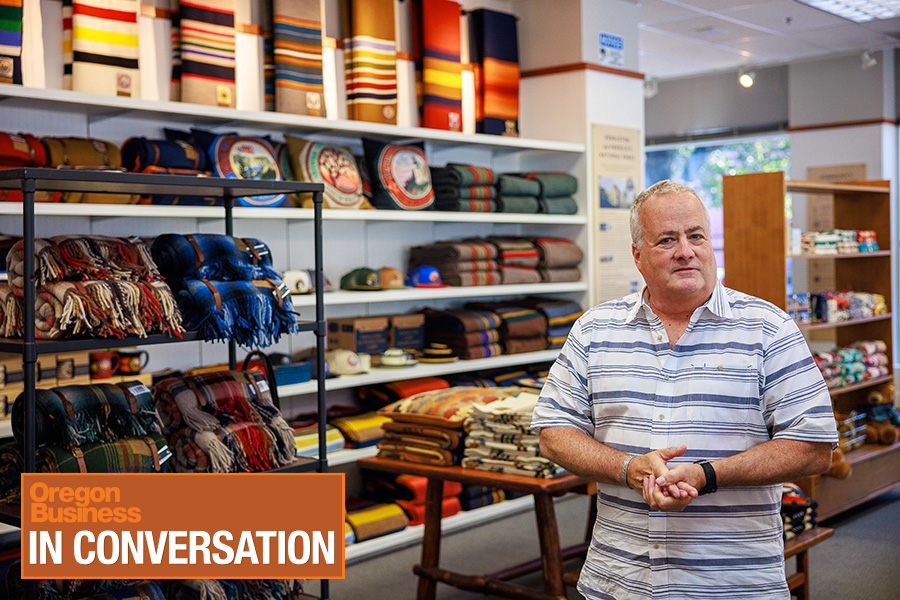
These high-profile brand interactions accent the company’s Heritage Hallway in its Old Town headquarters off NW Broadway. In operation in one form or another for more than 150 years, Pendleton has proven an enduring symbol of US manufacturing. Only now, the company is challenged like never before, according to Bob Christnacht, Pendleton’s executive vice president of sales and marketing.
Christnacht, a 25-year Pendleton vet, has lately been dotting the globe meeting with factory partners, customers, suppliers and distributors. He gets many more questions than he has answers for.
Known as a model of vertical manufacturing in the U.S., Pendleton remains deeply tied to the global economy. Tariffs will mean the company will have to raise prices on its premium products, Christnacht says. But it’s also uniquely positioned to capitalize in the emerging economy.
Since February, Pendleton has closed several retail locations and reduced its mill workforce from more than 700 to around 600 today and 34 retail stores. One major revenue stream is the result of good foresight decades ago; Pendleton Woolen Mills holds the copyright for the successful Pendleton Whisky.
Christnacht discussed the impact of tariffs and the company’s efforts to mitigate costs and where Pendleton is looking to expand (hint: look for it at the beach).
Amid the garboil, Pendleton is planning a leadership transfer. Fifth-generation leader John Bishop announced in February that he planned to retire. Shortly after our conversation with Christnacht, the company announced that Jennifer Ingraffea, who most recently served as chief product and merchandising officer at The North Face and whose resumé also includes 19 years at Nike, most recently as global vice president of kids footwear.
This interview has been edited for length and clarity.
How’s business?
Business has been a challenge. The consumer has been impacted. In Q3-Q4 last year, and this year, we’re seeing a fall-off in some areas of our business, especially in the resort areas — areas that normally do very, very well for us. Our beach stores are down; no one’s going to the beach. Our mountain locations are down. Really, really challenging.
Any retail store that had any Canadian business is down. So our North Seattle outlet up on the Tulalip reservation — that one’s been just decimated by the lack of Canadian tours coming down. We see that also in Minneapolis, at the Eagan Outlets, as well. And we see that up in New Hampshire. We’re definitely feeling the pullback from Canadians.
Pendleton is somewhat unique in that it manufactures in the U.S. and it has its own supply chains. But you also make products in other countries. Which ones and how much?
We’re still 60% mill-based product. So that does give us some insulation from tariffs. But raw materials that go into our supply chain — everything from plastic bags to labels — are sourced from around the world. So, we’re seeing cost impacts.
We import a lot of wool from Australia and New Zealand besides the wool we buy here in America. We’re seeing the tariff on that, as well, although wool prices right now are down, which kind of offsets the tariff impacts. But that’ll change shortly, because there’s a limited number of sheep out there in the world. And there’s a limited number of people who want to raise sheep. It’s really not a growth industry for the growers.
That’s all new this year?
Wool prices have been trending down over the past six months, and I think that’s kind of an indication of what the economy’s going to do. I think people are dialing back. The
Chinese are big buyers of wool, and their buying’s been down.
You also sell abroad.
Yes, and selling abroad has really been a challenge for us, with the strength of the US dollar. I was just in Japan this past week and we were discussing the price increases for our iconic men’s wool shirt, and they were comparing the 2020 versus 2025 price. Our wholesale price in the United States has gone up 34% in those five years. In the same timeframe, the equivalent value of the shirt has gone up 80% in Japan. The difference is the price increase we took on the shirt, and the impact the exchange rate has had on the value of the shirt in the Japanese market. And we struggle with the Canadian exchange rate, and the European exchange rate. I’m kind of hitting all three of those. There’s been some improvement with the US dollar in the last three months. But it’s a long way from where it was five years ago.
Tariff-wise, the big challenge that we’re facing right now is really with our Canadian business. Our largest category of products that we ship in Canada is our blankets made in the United States. And right now, Canada is putting a 25% tariff on top of our wholesale price, because of the tariff fight that we’re in. So the Canadian business is very challenged as far as the opportunity for our blankets going forward.

Will you continue to sell in Canada and just make less money?
We have to sell in Canada. Just as we have the Native American consumer down here, we have the First Nations customer up there. We’re part of the customer culture, and that’s such an important part of our business. We’ll do whatever it takes to continue to supply product to the Canadian market for our customers.
We can potentially reduce margins. I don’t see us changing the quality of the product. We’re not going to take something out of the make of the blankets — that’s just not who Pendleton is. But we’ll work with our distributor, and look for other ways to reduce costs. Can we reduce styles to garner some efficiencies? Can we cut something in the supply chain? We’re looking under every rock right now. I’m hopeful that the new Canadian government, negotiating with the U.S. government, is going to reduce that retaliatory tariff.
Sounds like you’re delivering a lot of bad news these days.
Well, there’s good news, too. Obviously, 60% of my products are made in America — tariff-free, right? So there is an opportunity for us to replace some goods, especially in the trade side of the world. You know, if someone was importing something like wool blankets from China or Vietnam. There’s an opportunity for Pendleton to be more price competitive than they have been to the past. We’ve always been on the premium side of the business. But I think with the tariffs on some of these categories, it might make the U.S.A. supply chain a little bit exciting.
Will you have to bring on more people for that?
We have excess capacity with the labor force we have right now. What we lack at Pendleton is: we’re not in the cut-and-sew business anymore. We used to have four sewing plants down there in the Sellwood area. We don’t have any sewing here in the States anymore.
For example, our classic men’s wool shirts — we weave the fabric here in America and then ship the fabric down across the border to Mexico and Central America for the sewing of the apparel, and we bring it back across the border. So ramping that up isn’t something Pendleton would do. It would be up to our suppliers.
Do you envision that ever changing, where we sew more apparel here?
Boy, I’d like to say yes. But then you think about what that would require as far as skillsets and people who want to do that work. I mean, we’re challenged enough just to hire folks who want to work in the mills, let alone the sewing side of this business. There’s a great history of sewing craftsmanship in this country, and there’s a group of folks here who like to sew. But I don’t think there’s a group of folks here who like to sew for eight hours a day, five days a week.
That being said, there are people looking to expand sewing factories. California’s got some sewing going on, and we’re constantly looking for onshore suppliers that can make stuff for us.
So is Pendleton going to raise prices?
Yes. But that being said, we’re looking at spring ‘26. We are holding prices for fall ‘25 in our direct-to-consumer and trade channels. We’ve been able to work with our suppliers as well as a large percentage of our US main environments, and that’s allowed us to keep that dollar-cost average. We will have price increases in spring ‘26, which ships starting in January. But for fall ‘25 products, we will not have any price increases.
And to be clear, that’s a result of tariffs?
The price increases are directly related to the impact of tariffs, and in a couple cases, we’ve had to move suppliers from one country to another. Because, you know, now one country is more expensive than another.
Did you have any warning or guidance from the government ahead of these changes?
There was no warning at all. This has been very challenging for us to navigate. There’s a major difference between what I think is going to happen on Monday versus what happens on Wednesday. And at least from our standpoint, we see last-minute decisions happening that don’t allow us to plan accordingly like we like to.
Click here to subscribe to Oregon Business.