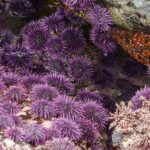

Lacking natural predators and able to survive long after food sources are diminished, purple sea urchins are devastating kelp forests, an important carbon sink. The founders of a Newport startup have a plan to turn the tides for these spiky pests.
Purple sea urchins are carpeting the ocean floor off the coast of Oregon — their round, spiky bodies clinging to rocks and reef. For sea urchin divers who harvest them as premium shellfish, most often served in sushi restaurants as uni, this could look like a fortune.
But instead of dollar signs, divers see devastation. That’s because these particular urchins are practically empty, starved and worthless. They’re also wreaking havoc on the local ecosystem.
According to a recent count by the Oregon Department of Fish and Wildlife, there’s been a 10,000% increase in purple sea urchins since 2014. There are many ongoing factors at play here, including warming waters from climate change. But 2013 marked a major, catastrophic shift in two parts. That’s when sea star wasting disease swept up the coast, killing sunflower sea stars to near extinction. Around the same time, a marine heat wave arrived and warmed the water for years, stunting kelp growth and reproduction. Sunflower sea stars — the giants of sea stars, with up to 21 limbs — eat sea urchins. In their absence, the sea urchin population proliferated. Sea urchins eat kelp, and the explosion in their population greatly diminished kelp forests, which provide critical habitat and nutrition for countless marine species. Kelp forests also soak up carbon — just like land-based forests. Without kelp off the coast of Oregon, we lose a critical carbon sink.
Apart from their overwhelming numbers, there’s another problem with purples: They’re survivors. Normally, when a species loses its primary food source, its numbers begin to decline, even if that species has also lost a key predator. But purple sea urchins are different. Even after they’ve completely wiped out a kelp forest and there’s nothing left to eat, these strange little ocean creatures don’t die. Instead, they go into a zombie-like state in which they can survive without food for years. As soon as new kelp buds, the zombie urchins smell the food, wake up, and start munching. Kelp doesn’t stand a chance, and there’s really no tipping point at which the urchins die off on their own.
Aaron Huang had been circling the Pacific Coast kelp issue for years. After more than a decade in the Seattle and San Francisco tech scenes, Huang was looking for a new professional project. He started studying permaculture, which he felt aligned with his 15 years of studying Buddhism. On multiple weeklong silent retreats, he filled a thick journal with what he calls “Socratic inquiry” into what he might focus on; it had to be something that would have a positive impact on the planet, something he could feel good about. Eventually, this thought experiment led Huang to a regenerative ocean-farming community called GreenWave, where he met Brad Bailey, a longtime sea urchin diver and commercial fisherman. Huang and Bailey got to talking about sea urchin harvesting and the urgent need to reduce purple sea urchin numbers in Oregon.
If only these prolific creatures had value that would motivate a large number of divers to get them out of the water and onto our plates.
In California fish and game wardens are encouraging recreational scuba divers to bring hammers with them and smash sea urchins.
But in order to incentivize enough culling of the urchins to have any kind of impact, Huang says they need to be edible — and there needs to be a market. Sea urchins in general are valuable. Red sea urchins — which are more popular for harvesting than purples because they contain more roe (uni) — have skyrocketed in price because the purples are pushing them out. But the purples are the problem, and the purples are nearly empty and without value.

Urchin ranching is one potential solution. It’s a relatively new approach to harvesting by which urchins are pulled from barrens, kept alive and fed until they’ve grown to a marketable size. Huang and Bailey saw an opportunity to help the kelp forests while opening up a new market for uni in a state that’s hungry for more local seafood; about 90% of seafood sold and consumed on Oregon’s coast is not from here. Bailey said it would be easy. Huang, admittedly naive and optimistic, saw kismet at work. After all, uni is one of his favorite foods. If harvesting uni could help save kelp forests and bring back coastal industries that have suffered alongside kelp loss, it was a win-win-win situation.
In 2023 Huang and Bailey launched OoNee Sea Urchin Ranch. In July 2024, I visited their operation in Newport, where long white troughs or “racetracks” kept in a hagfish warehouse are now home to purple sea urchins that Bailey and his team of divers pull from the water. They’ve been experimenting with feeding them different types of seaweed; on average it’s taking them about 8 weeks to get them big enough for market.
In their first summer of operation, in 2023, Huang wanted to answer a simple question: Do people want this product? Uni is very popular in Japan; in the states, it’s a more polarizing menu item.
“People either love it or hate it,” says Huang, “but people who love it are fanatics.”

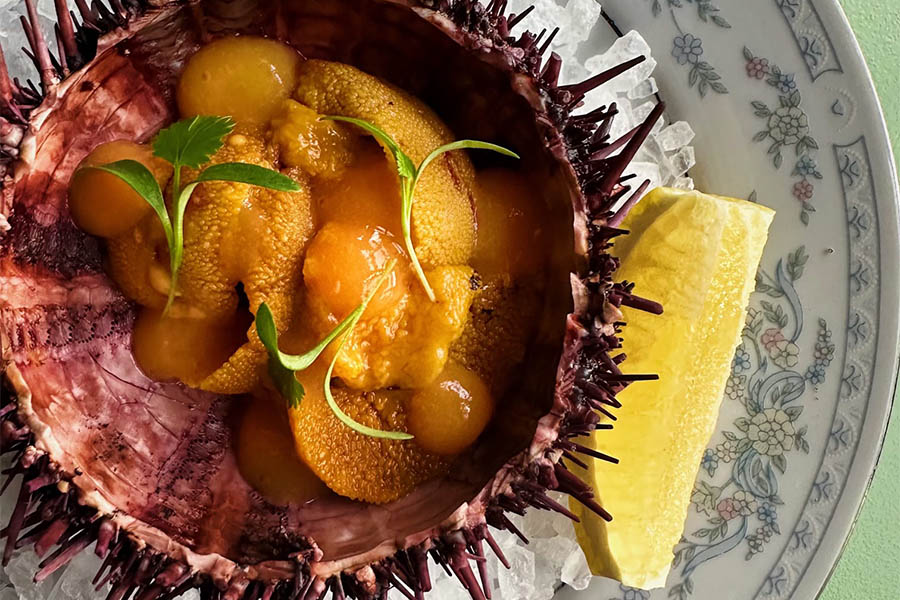
The gonads of sea urchins are revealed when you crack them open, five lobes of briny-sweet, buttery meat — the shape and texture of little orange tongues.
Bailey cracks one open for me and pulls out the uni. It glistens on a spoon. I’ve had uni before, served in a little bed of seaweed-wrapped rice, with a raw quail egg quivering on top. At the time, the combination of slimy textures overpowered the flavor for me. But this time it’s surprisingly perfect, rich in umami and fresh, like an oyster but more buttery and substantial. I love it — and apparently, the one I’m sampling is still not ready for market. They’ll get even better.
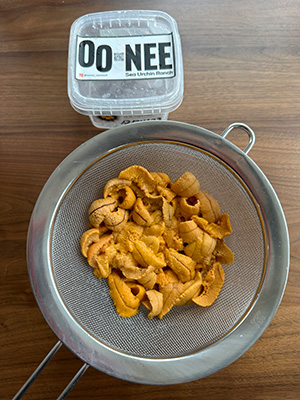
Last year OoNee sold about 10,000 pounds of sea urchin to restaurants and markets, mostly for sushi and raw bars. Diners were excited to see it — especially straight from Oregon. Typically, uni is flown in from Japan. You can’t freeze sea urchins, so you know the uni is fresh. But keeping it fresh from Japan takes a lot of energy and makes for a pretty unsustainable plate. When uni comes from Oregon’s waters, diners have the pleasure of a delicious, premium seafood that definitely hasn’t been frozen and didn’t travel far.
There’s also the unique satisfaction of eating something that’s damaging an entire ecosystem. Sea urchins aren’t invasive, but kelp forests can’t survive their current numbers. Getting them out of the water and onto a plate is one step toward restoration.
For chefs like Maylin Chavez, owner of Nácar Oysters Pop-Up & Catering, serving and eating uni is the embodiment of a culinary ethos that aligns and supports the bounty of local ecosystems. “Working with ingredients that give back rather than take away is at the forefront of my culinary stewardship,” she says. Chavez calls uni a “magical ingredient” that can be served as the centerpiece on the half-shell or more subtly included in pastas, soups and butter. Since many diners are unfamiliar with the menu item, Chavez says it’s up to chefs to present it in a beautiful way and share the story that’s on their plate.
“We’re seeing a growing number of restaurants that are embracing local seafood. Uni has a special place in that,” she says.
Chavez emphasizes how important it is for chefs to have close relationships with their suppliers when they’re serving local items like sea urchins, which are seasonable and variable in availability.

Sea urchin season really gets going in November. That’s when Bailey and his team are out on the water about twice a week, long days on choppy, Pacific swells. “It throws you around like a washing machine,” Bailey says.
Despite the harsh conditions, Bailey loves it.
“Diving, you’re all by yourself down there—it’s a whole ’nother world,” he says. “It’s really fun and beautiful.”
Unfortunately, the diving season is short. By January or February, the water is just too rough for diving over the shallow reefs. This year rough waters made it difficult to harvest in late October, too, and delayed the arrival of OoNee’s uni on restaurant menus.
Bailey’s intimate knowledge of the ocean is valuable to this project. It’s a type of knowledge that’s fading, just as it’s becoming so urgently important. As ecosystems like this one tip out of balance, people like Bailey are the ones who notice first.
The collapse of kelp forests is already severely impacting marine species and coastal communities. And it’s getting worse. Abalone — large sea snails that feed on kelp — have drastically reduced in numbers, to the point that recreational harvest of red abalone has closed indefinitely and flat abalone are at risk of extinction. Kelp is critical habitat for zooplankton, tiny organisms that whales rely on for food, and as such, gray whales are spending less time foraging in Oregon’s near-shore waters.
In 2019 the concerns raised by sea urchin divers prompted the creation of the Oregon Kelp Alliance (ORKA), to assess kelp conditions. Throughout 2023 it collected data through scuba surveys and combined that with plane-based and satellite surveys to better understand the state of Oregon’s kelp forests. Before this kelp forests in Oregon were significantly understudied. And it’s just hard to get the general population—those who don’t spend their days on boats or underwater—to pay attention to this kind of thing.
“We can’t see the forest fire that’s happening underwater,” Bailey says.
ORKA released its findings in October of 2024, and its conclusions are troubling: From 2010 to 2022, Oregon’s kelp forests declined by as much as 73%, a loss they estimate — based on the value of kelp forests in other systems — is costing the state between $23 million and $53 million each year.
“The major problem is the sea urchins,” says Dr. Sarah Gravem, a co-author of the 2024 Oregon Kelp Forest Status Report.
Taking urchins out of the water is a necessary step in rehabilitating kelp forests and preventing further damage up and down the Oregon Coast. In 2025 and 2026, ORKA will use funding from a NOAA grant to carry out restoration and protection work that includes harvesting and culling purple sea urchins. The other two pillars are kelp seeding and sea star recovery work.
When it comes to urchin harvesting, no matter how many restaurants and sushi fans get on board with locally harvested uni, there are too many urchins out there for Huang, Bailey and their team to make much of a dent. But even a small dent in urchin numbers could have rippling effects.
“There are places where it’s not all doom and gloom,” says Gravem, “and we’re trying to learn what is going on in those places.”
The California Ocean Protection Council found the most effective way to address the urchin problem is not going into the urchin barrens, those carpets of urchins where no kelp has survived. Divers can’t possibly gather enough of them in those barrens to make a difference. Instead, researchers found it’s more effective to focus on relatively healthy kelp forests, at the edge of urchin barrens, and reduce numbers there.
“We can try to hold the line,” says Huang.
By harvesting urchins in this liminal space between barrens and forests, OoNee becomes part of an ecosystem of efforts to solve a very complicated and urgent problem.
“We’re not kidding ourselves in thinking we can recover kelp along the entire coastline,” says Gravem. “But if we can target certain places to bring the urchins down, seed some kelp, and release some sea stars, we can use this three-pronged approach and that spot will have healthy kelp forests that can hopefully reseed nearby places.”
Bailey chose Cape Arago — situated on the South Coast near Coos Bay — as their harvesting site, “because it’s the most consistent kelp bed in the state.” Bailey says here he can find some purple urchins that are sellable in the fall and winter, straight from the water. Selling these wild-harvested urchins to start has allowed Bailey and Huang to get a feel for the market and give buyers a taste of what’s out here. But to harvest numbers that will have a greater impact, they’ll need to harvest the smaller urchins, too, then fatten them up at the ranch.
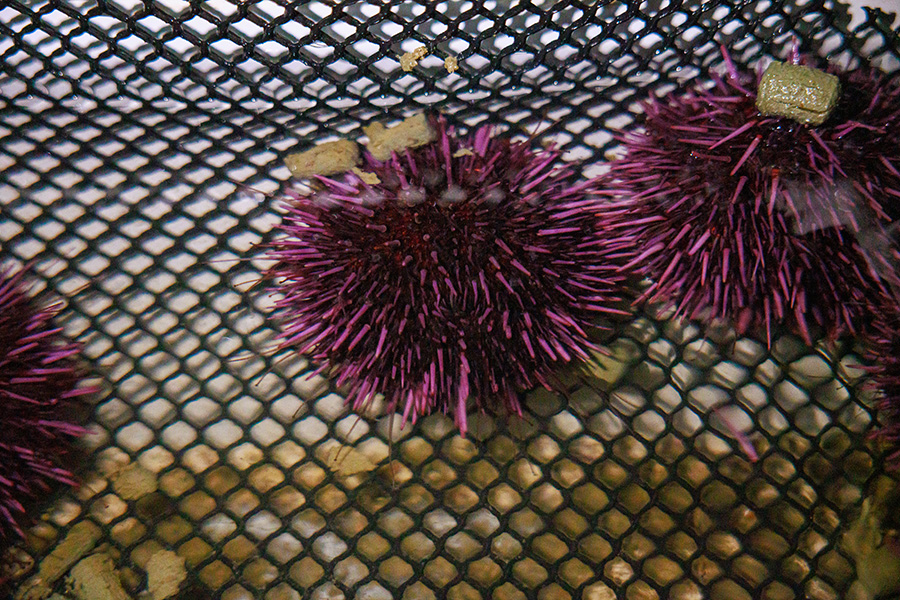
In the summer of 2024, Huang and Bailey experimented with different types of seaweed diets for the urchins. The Nature Conservancy has been working on several types of seaweed pellets for urchin farming and provided them for testing at OoNee; the goal is to make the urchins taste like they’ve been eating their natural diet of kelp, but using seaweeds that are thriving. The urchins have also been munching on fresh dulse. This is an incredibly versatile and sustainable crop—one that’s farmed on land at Oregon Seaweed—and urchin farming could be a new market for expanding its reach.
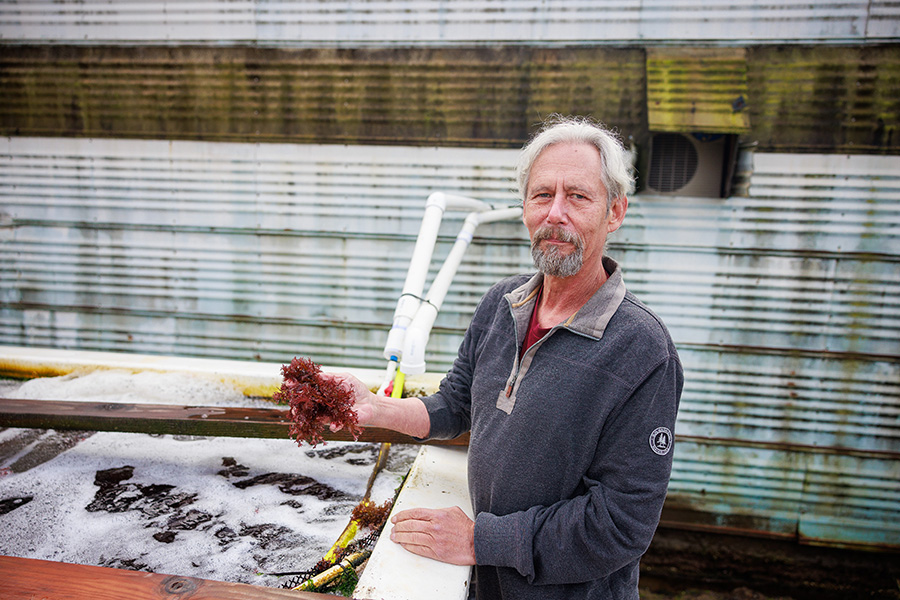
This connection to another sustainable crop highlights something that’s particularly exciting to Huang, Bailey and anyone who wants to see the restoration of coastal ecosystems and the communities that rely on them. By doing its small part to restore kelp forests, OoNee is poised to become part of a web of businesses and work that intentionally connects people to the ocean in ways that are good for everyone.
There are many obstacles on the road to making OoNee a sustainable, thriving business.
Oregon’s waters are infamously rough, and divers have a limited window in which they’re navigable.
Oregon also tends to see less funding for ocean farming projects than more commercially thriving coastlines like California and Washington. When we met this summer, Huang said he was curious about how the upcoming election would impact funding for regenerative agriculture projects like this one moving forward, a question that remained unanswered as this issue went into production in mid-November.
But Huang and Bailey seem optimistic about pushing forward.
Not only are they excited about their own project, but they want to see how other people can establish similar systems for harvesting purple sea urchins, and applying this type of work to other struggling ecosystems where certain species are causing imbalance.
More broadly, Huang would like to see more people try to align their own work with natural systems that need support, like this one.
“There’s something inherently dangerous in being disconnected from nature,” he says. Huang says it feels good to be working on something so connected to nature and to a food he loves. “If everyone tried to find something that’s a little more aligned with themselves, maybe our entire society would just shift a little bit.”
Click here to subscribe to Oregon Business.