
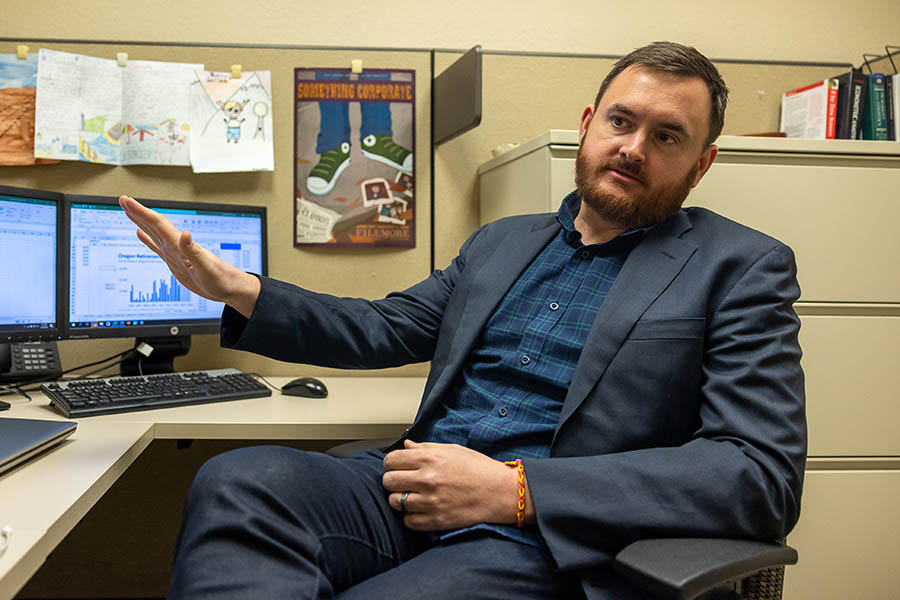
Lehner, known for making economics digestible to the masses, leaves the Office of the State Economist after 16 years.
When he arrived in Portland fresh out of college, Josh Lehner had no job and few contacts.
Now as he departs the Office of the State Economist after 16 years, he takes with him a reputation as an vital resource for lawmakers and a skilled communicator of economic data.
The state economist’s office is small but bears an outsize importance. Its projections form the basis of the biennial state budget and the size of the kicker rebate. Lehner has served the office in a number of public-facing capacities, regularly traveling the state to present economic updates and addressing lawmakers in Salem. He’s been a go-to resource for reporters and educators for his ability to compress large amounts of information and his lively presence on social media, where he opines on craft beer and his beloved Kansas City Chiefs.
Lehner has lived with his family in Bend since 2018. On Monday, he starts a new job at SGH Macro Advisors, an opportunity he says was too good to pass up. Lehner’s departure comes a few months after his supervisor, Mark McMullen, announced he would be leaving the office to join the Common Sense Institute, an Oregon-based think tank, as vice president of policy and research. Earlier this month the Department of Administrative Services announced it had hired Carl Riccadonna to replace McMullen, but the state has yet to replace Lehner.
Lehner, 41, took time during his last week as a bureaucrat to talk about Oregon’s economic strengths and weaknesses, its controversial kicker rebate and craft brew.
This interview has been edited for length and clarity.
Your final blog post reads a little bittersweet. Why are you leaving?
I’ve been offered something that’s a unique and exciting opportunity. It’s something I never expected, honestly, and I felt like it was just time to try something new.
As you head out the door, what’s the big-picture state of the Oregon economy?
If you were to take a snapshot today and look at where Oregon stands economically, we’re in a good spot in terms of high employment and high income, and gaps with the rest of the country have narrowed. We have smaller racial disparities than any other time in our recorded history. Our average per capita income relative to the rest of the country is better than it’s been in 20 years. And our average wage compared to the national average is the highest it’s ever been. So we’re in a good spot and our growth, particularly in the past decade, is better than the average state.
What I think is different is we’ve seen a slowdown in population if not an outright decline, certainly in the pandemic. That’s not something that Oregon’s used to. So you could argue the economic outcomes for Oregonians have rarely been better. But the nature of our growth has shifted and so that makes the future more uncertain, I would say.
With all the data available, it’s easy to draw different conclusions about the labor market. Would you say Oregon has a healthy job market?
The phrase we use is that the labor market is softer than it appears. Overall, the labor market has been strong if not overheated for much of the post-pandemic period. But in the past year, it’s really softened. There haven’t been a lot of layoffs. The unemployment rate’s up a little bit,but not a huge amount. But job openings are down significantly and the hiring rate is down significantly. So firms aren’t hiring much. So if you’re looking for work, it’s certainly harder than it was a year ago.
What industries should be worried?
It’s a mix and it depends what time frame we’re talking about. Right now, we’re seeing all the cyclical industries —especially the ones impacted by the higher interest rates —they’re all flat to down. You’re talking manufacturing, warehousing, those blue-collar trades and occupations and industries — hiring for them has really slowed to a crawl. Some of that will get revived with lower interest rates. That’s compared to the ones that are tied to population numbers to a certain extent. The young college-educated workers. Where do they choose to move to? That will grow more of the white-collar office-based jobs.
I think that’s a potential existential-crisis type discussion if the population growth doesn’t rebound. Versus those other industries which are all about the level of consumer spending in the economy. Those are different discussions.
Similar question: What region or regions of Oregon should be worried?
I think fundamentally, there are two things to think about. One is demographics. Where do we still see relatively high birth rates? For that, we’re talking about the Willamette Valley, maybe the Salem area. We’re talking about Northeastern Oregon. There are pockets where demographic strength is still very real. So in the long run, that should provide more workers, as long as they don’t move away.
That’s one way to view it. The other way is to look at migration trends. And again, the pandemic cycle is basically the opposite of the cycle coming out of the Great Recession. Back then it was all about the large urban areas and the urban cores. They were the first areas to turn around nationally. And Portland was one of the leaders in the entire country for growth. Obviously, that’s not the case today. That dynamic has flipped. It’s more about those smaller and medium-sized metropolitan areas and those with better housing affordability have shown the strongest growth in recent years.
And so the question is, what does it look like five, 10 years down the road from now? To what extent have these dynamics permanently flipped or is this just a temporary pandemic thing? That’s ultimately a major question we’re trying to figure out.
In Oregon, inflation is down. There’s low unemployment. Wages are rising. But I read that Oregonians remain pessimistic about the economy. Why all the bad feeling?
I don’t want to speak for Oregonians and their lived experiences; I can only speak for myself and the research. But this came up in our most recent revenue forecast. Rep. [Werner] Reschke asked something that I think gets at this discussion. It has to do with the difference between the price level and inflation. Price level is the absolute cost you pay when you go to the grocery store, when you go out to eat or you buy a computer or whatever. Then there’s inflation, which is the ongoing change in prices.
Inflation has slowed down tremendously. We’re in the 2-3% range of inflation. So prices are still going up but they’re only going up by 2-3% a year right now, which is roughly close to average. But in 2021, 2022 and early 2023, they rose by much more than that.
So the price level of everything increased more than twice as fast as expected. And even if you look at what you paid going out to eat last year versus this year, it might not be that different. But if you compare the price of going out to eat today versus pre-pandemic, it’s drastically different.
So prices are up a ton but they’re no longer growing — or at least, they’re not growing as quickly today. This also shows the difference in how people view the economy versus how an economist measures the ongoing change in prices.
What have you learned in your career about presenting complex economic information to the public?
When you do a lot of research and you have all these numbers in your head and you’re trying to figure out the most important point, it takes preparation and experience to get it across to other people. I hope I got better at it over time.
You got to stick to that main talking point or that high level summary. And when there are more questions or people want to learn more, you have all that additional detail available to use. But don’t overwhelm folks at the start. That’s the way I approach it anyway. And this goes for conversations with anybody, as well.
What is an important economic concept that’s difficult for the general public to grasp?
In terms of, like, textbook economics, I’d have to say opportunity cost. That’s just the idea that your time isn’t free. We don’t think about how much time we spend in the car driving to work. That time isn’t free even if we think, “I’m not paying anything to do this.”
And for Oregon, with the slowdown in population and our aging population, I think the concept of productivity really matters. It’s not just about the raw number of workers in the economy — it’s about how productive each worker is. It’s important to look at business investment and capital investment to make the existing workforce more productive and to grow the economy and incomes in the years ahead. That’s a key thing we need to focus on.
What’s something people worry about that’s maybe not such a big deal, in your opinion?
That’s hard for me to say. I’ll say though that in the national discourse with issues like international immigration, you see a clear difference between a lot of public opinion and the opinion of economists. Economists look at international immigration and see almost all good news. People want to live here! They want to bring their skills here! Immigrants have higher entrepreneurship rates, so they’re going to start businesses and grow our economy at a faster pace. They bring a lot of great things that we care about. But that doesn’t seem to be what public opinion polls show.
If you could wave a magic wand and change one thing at the Office of the State Economist, what would it be?
I’m leaving, so I can say this — and I only speak for myself here — but how the kicker is forecast, where it’s just a couple people — a couple unelected bureaucrats — making a forecast a couple years in advance, is a little bit tough to swallow when you’re one of those people sitting in that chair.
It is the law. It’s in the state constitution. I’m not arguing against it. But I don’t know if the general public fully understands what goes on with how it’s forecast.
You seem more comfortable on social media than your stereotypical egghead economist. Would you agree?
I guess I came of age with social media. We had Instant Messenger in high school and social media came a little bit later. Economic blogs were a thing in the mid 2000s, when I was starting my career. Blogs kind of evolved into Twitter and around that time, state offices started setting up their own accounts. Our office set up our blog and Twitter account in 2010 and it kind of evolved from there. So it’s partly because I’m a geriatric millennial but the rise of social media also coincided with the start of my career.
So what’s the best Oregon beer you’ve tried lately?
One of my favorite beers at the moment is Volatile Substance by Von Ebert Brewing. Another is the RPM IPA by Boneyard Brewing.
Click here to subscribe to Oregon Business.