

Collins steers Blount into a promising future
 Josh Collins took over as CEO of Portland-based Blount International just after the worst year in the company’s 65-year history. Business had dropped off by 20% in 2009, forcing widespread layoffs. “We were looking down into the abyss,” Collins recalls. “I was observing from the board level and we were nervous. You just didn’t know how bad it was going to get.”
 Pierce Lamb met Daniel Starling online, splattering each other with digital paintballs at the ripe age of 13. They remained digital comrades, but only met in real life last year, at Portland’s Open Government Hackathon. It was at the Hackathon where they conceived and began building their new company, BarBird.
 The film industry in Oregon has been growing steadily over the years, with film and television productions pouring into Portland and the Coast. Now Southern Oregon is getting in on the action.
 Erickson Air-Crane is hoping that a key deal to ship five helicopters made in Oregon to China will rescue its bid to become the state’s first business to go public through an initial public offering since 2004.
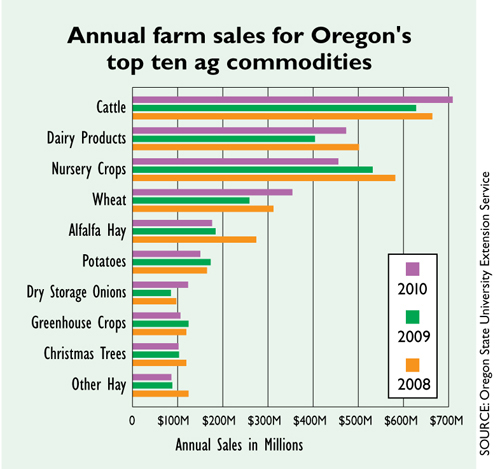 Only four of Oregon’s top 10 farm commodities increased value in 2010, yet overall state commodities increased 3.8% to $4.3 billion.
 Raw coffee beans are getting more expensive. Whether or not the price you pay at the local café or grocery story for roasted beans or coffee has increased because of it depends largely on where you buy them.
 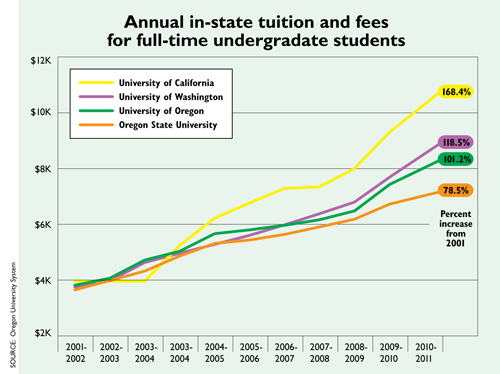 The state’s most expensive public university, University of Oregon (UO), raised tuition and fees for in-state undergrads more than 100% during the last 10 years, while the dominant science and engineering school, Oregon State University (OSU), raised them 80%.
 Jeff Katz and Noah Siegel have spent a lot of time in both Israel and Oregon, and they are of the opinion that the two places have more in common than one might imagine. Think renewable power, apparel design and specialty agriculture — not to mention Intel, which has been operating in Israel since 1974.
 The growing pains of the federal Biomass Crop Assistance Program (BCAP) may be nearing an end, presenting an opportunity for those in Oregon’s biomass industry.