The $24.6-million deal would have created the largest grocery corporation in the U.S.
A Portland-based judge on Tuesday ruled against what would have been the largest grocery store merger in U.S. history, finding that a combined Kroger-Alberstons would have stifled competition, hurt workers and raised prices for customers around the country. On Wednesday Albertsons sued Kroger, seeking a $600 million termination fee and blaming the Cincinnati grocer for the merger’s collapse.
U.S. District Judge Adrienne Nelson sided in her ruling with the Federal Trade Commission, which argued over a three-week trial in August and September that far from operating in separate spheres, the companies compete fiercely with each other.
“Evidence shows that defendants engage in substantial head-to-head competition and the proposed merger would remove that competition,” Nelson writes in the ruling.
The morning after the ruling was issued, Albertsons issued a press release saying it filed suit against Kroger in a Delaware court, bringing claims of “willful breach of contract” and “breach of the covenant of good faith and fair deal” to secure approval for the merger.
“Kroger willfully breached the Merger Agreement in several key ways, including by repeatedly refusing to divest assets necessary for antitrust approval, ignoring regulators’ feedback, rejecting stronger divestiture buyers and failing to cooperate with Albertsons,” the release says.
Kroger issued a response, reported by The Portland Business Journal, stating Albertsons’ claims were “baseless and without merit.”
“This is clearly an attempt to deflect responsibility following Kroger’s written notification of Albertsons’ multiple breaches of the agreement, and to seek payment of the merger’s break fee, to which they are not entitled,” says the statement, which goes on to say Kroger “looks forward to responding to these baseless claims in court.”
With a combined 700,000 union employees working for both companies, the deal was closely watched by organized labor. Local and national chapters of the United Food and Commercial Workers Union opposed the deal, though for several months this year, the local chapter was the only one in the country to support the merger. Local 555 rescinded its endorsement in August when 4,500 Portland-area Fred Meyer workers voted to strike.
The Kroger-Albertsons merger was announced two years ago. The $24.6 billion deal was opposed by the Biden Administration’s FTC and attorneys general from eight states, including Oregon, which sued in February to block it. A three-week trial in Portland featured testimony from more than 30 witnesses and evidence including internal emails and text messages. Expert witnesses for the FTC showed a combined Kroger-Albertsons would likely have incentive to raise prices in more than 1,400 communities around the country, according to the Portland Business Journal.
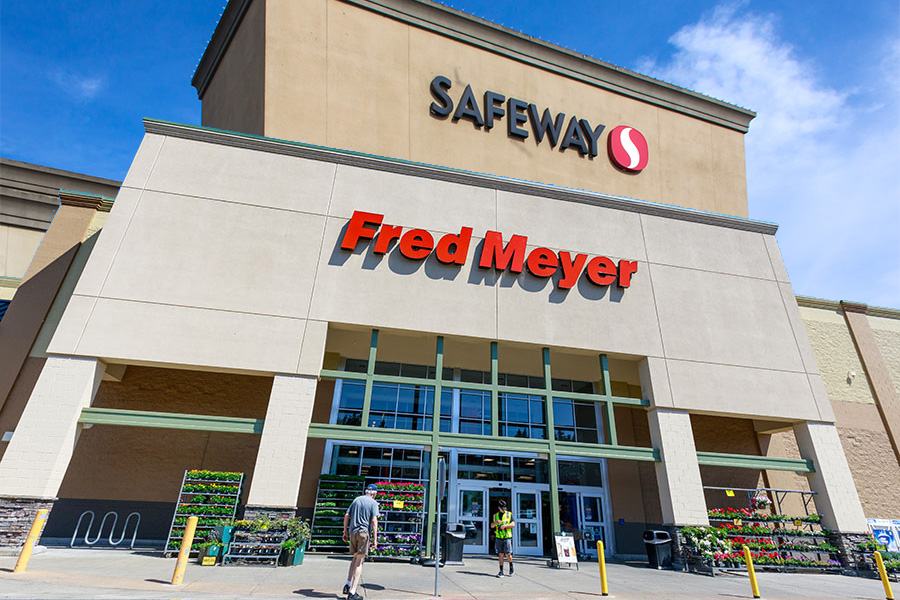
Cincinnati-based Kroger, which owns QFC and Fred Meyer, argued the merger would have benefited customers through price reductions at Albertsons stores, and would not lead to store closures. The companies argued that new competitors like Amazon and Walmart threaten the existence of traditional grocery stores. With 2,700 and 2,300 stores respectively, Kroger and Albertsons argued a merger would better position them to fend off new competitors like Amazon and wholesalers like Aldi and Lidl.
Ultimately, Judge Nelson granted the federal government’s motion for preliminary injunction.
“The FTC, along with our state partners, scored a major victory for the American people, successfully blocking Kroger’s acquisition of Albertsons,” writes Henry Liu, the FTC’s Bureau of Competition director, in a statement.
Due to a wave of consolidation that began in the 1990s, only four companies — Walmart, Costco, Albertsons and Kroger — account for around half of all U.S. grocery sales, The New York Times reported. Walmart accounts for 22% of those sales and has led the U.S. for decades. Kroger represents 9% of the market while Albertsons has a 5% share. Costco recently caught up to Kroger.
Kroger and Albertsons would have combined to create a $200 billion company with around 5,000 stores in 48 states and the District of Columbia. The Biden Administration has sought to rein in corporate consolidation across a number of industries including tech, book publishing and pharmaceuticals, the WSJ reported.
Boise-based Albertsons, which owns Safeway, is said to be in a worse financial position than its potential merger partner. Albertsons CEO Vivek Sankaran has said the company may consider layoff and store closures if the deal fails. The FTC, however, argued at trial the company is not in financial danger.
On the news of the ruling, Kroger shares rose 5.1% while Albertsons shares dropped $2.3%.
Click here to subscribe to Oregon Business.