
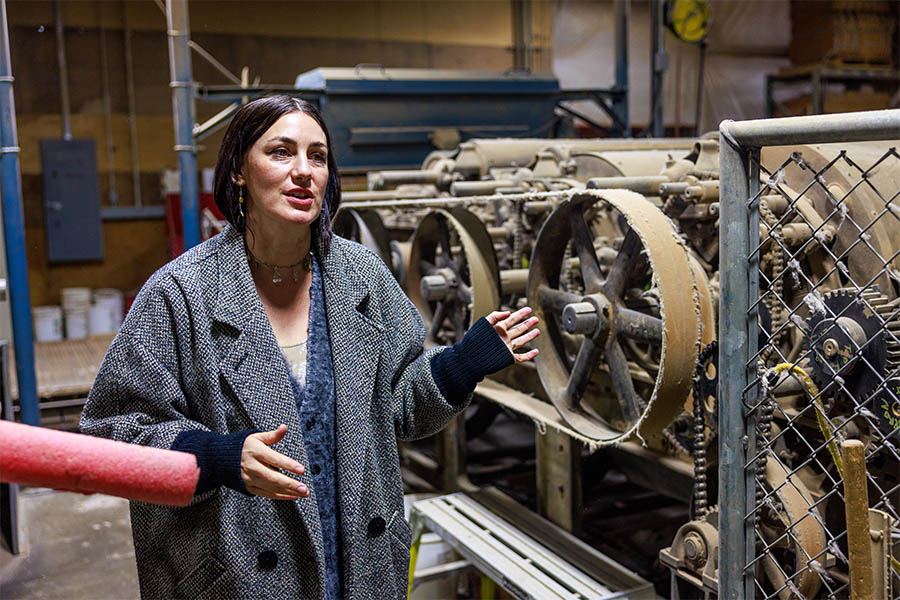
Three years after her Portland Garment Factory burned down, Britt Howard tackles a new next challenge with an organic fiber mill in Slab Town.
Textile waste is among the greatest sources of environmental pollution, accounting for a major portion of the world’s landfill space, greenhouse emissions, harmful microplastics and toxic chemicals.
Portland Garment Factory’s Britt Howard hopes a new business venture can lead innovation in sustainable manufacturing and waste management.
“I’m in deep, money-wise, and, like, I’ve never been so stressed. My whole business burned down, and I’m more stressed now than I was then,” says Howard, 42. “But at the same time, I really believe in this and I really think we can make it work.”
Three years ago, the Portland Garment Factory burned in a devastating fire. Insurance covered most of the damage and Howard built back the business piece by piece, keeping her staff of around 20 people.
In April, Howard acquired the assets of Cotton Cloud Futons, which include turn-of-the-19th century cotton and wool milling equipment that produces the “puffy stuff” for pillows and mattresses. Howard has rebranded Cotton Cloud’s Slab Town manufacturing space as “Oregon Natural Fiber Mill.” She hopes the facility will augment PGF’s operations and become a leader in sustainable textile manufacturing. To that end, she aims to retain as many of Cotton Cloud’s clients as possible while expanding its product line and exploring new business partnerships, zero-waste practices and innovative uses of textile waste.
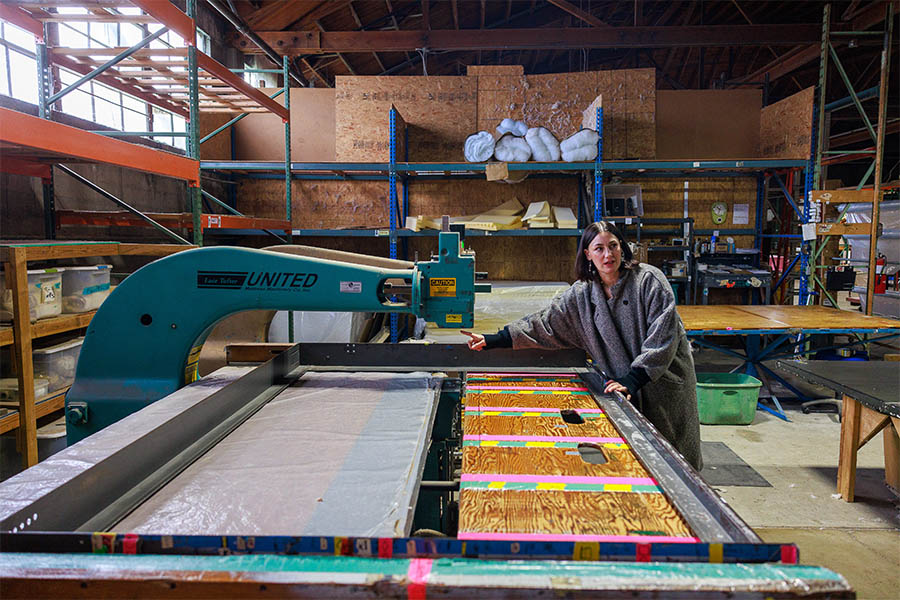
A native of Vancouver, Wash., Howard founded Portland Garment in 2008. PGF specializes in soft goods manufacturing, creative fabrication and large-scale sculptures. Operating out of a 10,000-square foot manufacturing space in the Hazelwood neighborhood, PGF today works with large brands on projects like store activations, custom curtains and giveaways.
RELATED: Scott Hamlin Comes Full Circle
Last year, Cotton Cloud founder Terri Treat approached Howard to buy the business. Howard initially declined, believing she had enough on her plate with the fire rebuild and challenges associated with the COVID pandemic. But she had a change of heart a year later when she toured the facility and saw potential in the old machinery and in involving her mechanically-inclined younger brother, Taylor Lindsey, in her business.
“I think I just got enchanted by the equipment,” she says. “I was like, ‘I think we can make a ton of different stuff with this equipment, and it would really augment what we do at Portland Garment Factory.’
“It was kind of an impulse but it was also something I felt I couldn’t turn away from.”
The factory mills U.S.-sourced cotton and wool into usable materials with a focus on organic cotton, regular cotton and polyester. The factory also produces springless mattresses, aka “futons,” a term Howard says has negative connotations.
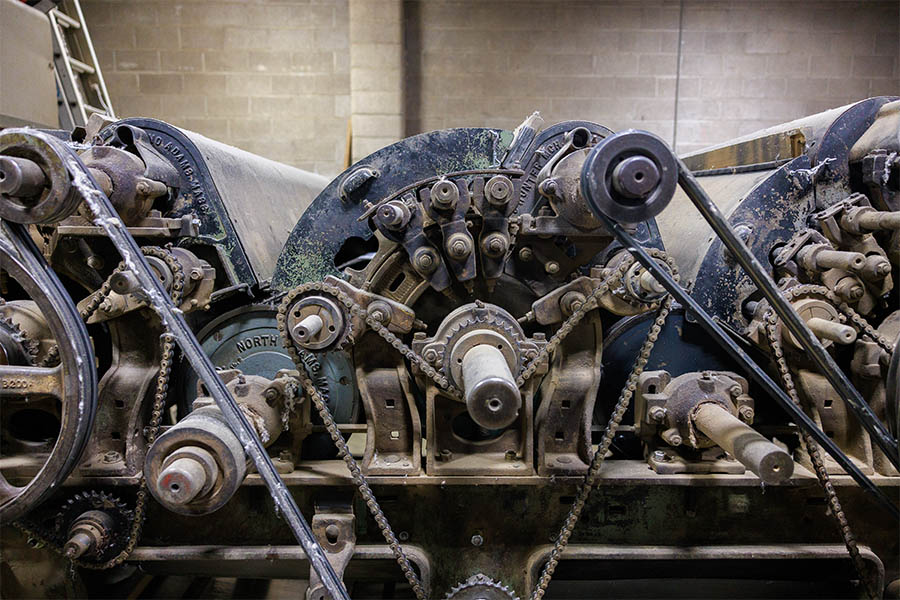
The factory’s equipment includes a 100-year-old Garnett machine, a massive textile processing mechanism that converts waste into a uniform fiber to be used in other applications. Covered in pulleys and belts, it flattens and smooths, feeding sheets of fiber onto a wooden-slat conveyor belt.
One of the first things Howard did was hire the mill’s four extant employees, one of whom is an experienced mill worker who maintained the factory’s equipment for 15 years. The man agreed to take on Lindsey, 32, as an apprentice.
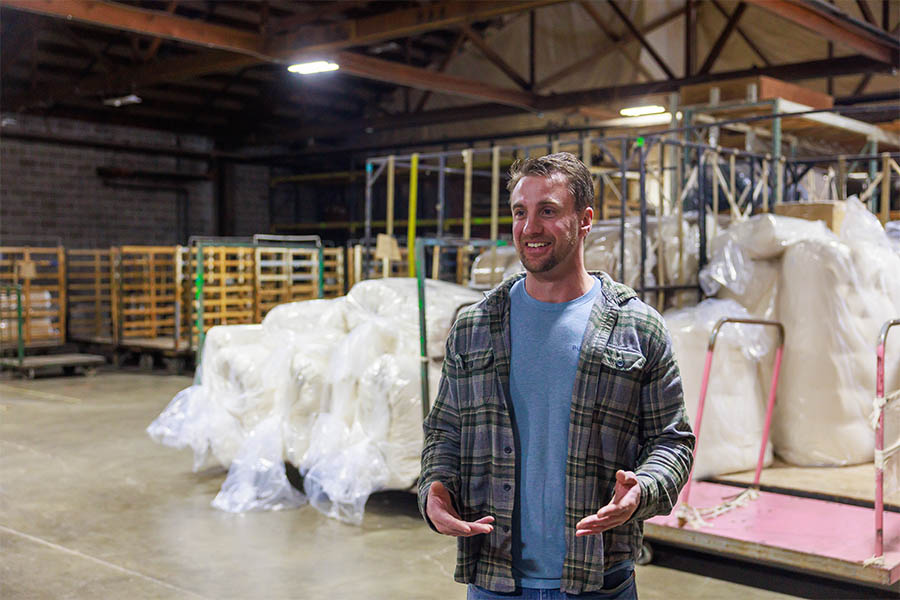
Howard believes ONFM can help create a “circular economy” where waste products are continually recycled into new products. One plan is to acquire off-cuts from textile manufacturers to pulverize and make into new felted products like dog beds and tabletop items. She envisions Ridwell-style doorstep collection boxes for discarding old clothes and soiled fabrics. Earlier this month, ONFM debuted a line of direct-to-consumer “Puffy Stuff” items.
But with the new venture have come new challenges. Howard has had to raise prices to cover increased costs. She hopes to attract new clients by improving quality but like many sustainable business owners, she knows she needs to explain to customers the reasons behind her pricing and policies. One new policy involves free return of mattresses. Howard says free-return policies are a major selling point for modern mattress companies. But with shipping being a major contributor of greenhouse gases, Howard decided to not allow mattress returns to minimize environmental impact.
Six months in and Howard remains committed to the fabric factory despite challenges and stress. Though much remains up in the air, she isn’t stressed about the availability of raw material.
“There’s plenty of waste to go around,” she says.
Click here to subscribe to Oregon Business.