

In recent months, Portland-based print readers have noticed sporadic delivery of The New York Times. What’s behind the delivery gap — and what does that say about the state of print media?
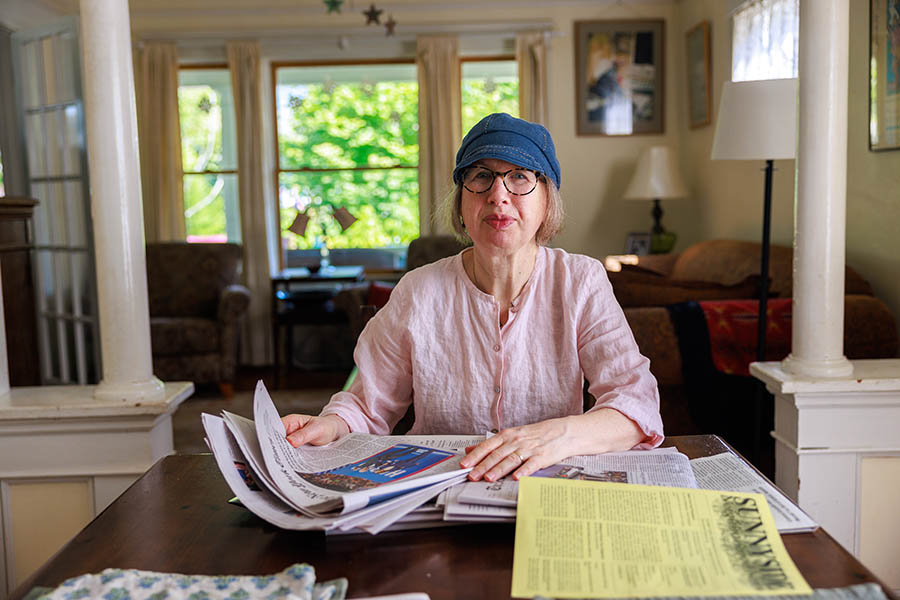
When Portland writer Kate Haas grew up on the East Coast, she got The New York Times delivered daily. “In addition to The Wall Street Journal and The Bergen Record!” she adds. “I’m a newspaper-on-the-porch type of person. And I’m not willing to give it up.”
Even though she now lives in the Southeast Portland neighborhood of Sunnyside, she still gets the physical New York Times every day. At least she did — until mid-January, when the city came to a standstill during the ice storm. And the paper didn’t come.
“I was expecting that,” she says. “But then the ice and snow melted and there was still no paper. Then it was just like weeks and weeks with no paper.”
She called the Times’ customer service line weekly; she reported her paper missing on her account, and received credit for the missing papers. Eventually, customer service asked her to fill out a questionnaire about her experience.
“I was irate at that point,” recalls Haas. “I said something like, ‘I really wish you would investigate what’s going on in Southeast Portland, because everybody I know is not getting their paper.’”
Unbeknownst to print-loving Portlanders, in January The New York Times had quietly switched carriers from the Oregonian Media Group to PCF (Publishers Circulation Fulfillment), which is a Hunt Valley, Maryland-based “delivery service provider.”
Haas did not find this out from the Times but from a community message board she belongs to called Being Neighborly. “Somebody posted that there was this new guy, Keith, who was in charge. So I texted him and he was like, ‘Yes, it’s a new carrier…they are ironing out the kinks. It’s gonna be a transition, yada yada,’” Haas recalls.
Why did The New York Times stop contracting with the Oregonian Media Group? I wrote the communications department at the Times to find out.
New York Times senior communications manager Elizabeth MacAulay Young responded, saying that in late 2023, the Times was notified by their longtime distributor, The Oregonian, that it would no longer be doing home-delivery services for “outside publications” in the Portland area as of January 2024.
“In order to maintain distribution in the Portland market, we immediately found an alternative distributor and are continuing to work with them to provide the best home- delivery service experience possible to our customers,” MacAulay Young wrote via email. In response to questions about unhappy customers who haven’t been receiving the paper, she continued: “We are reviewing any delivery issues and are reaching out to customers directly to address their needs.”
That “alternative distributor” is PCF. Keith Miller, the person Haas texted and PCF’s facility manager in Portland, would not reply to repeated requests for comment. But before I’d gotten this assignment and was just another frustrated subscriber, I had gotten his number the same way Haas did. Back then, in mid-March, I’d asked him what the issue was.
“Finding good carriers,” he texted back. “We are recruiting heavily every day, and we’re getting better in other areas. We will have this turned around very soon, and I greatly appreciate your patience.”
In early July, online job-board site Indeed’s posting to be a PCF newspaper carrier in Portland was now offering a $1,000 sign-on bonus. The posting also said the job would pay a flat $400 to $475 a week in the Portland area for a seven-day-a-week route, and that applicants need to be at least 18 and have their own vehicle as well as proof of insurance. (Gone are the days of hiring teenagers who do delivery routes on their bikes.) Perhaps the sign-on bonus is helping to attract more reliable delivery carriers.
James Cunningham, vice president of communications at PCF, declined to comment for this story, saying, “PCF serves a broad range of publishers and publications. We take a very conservative approach, managing our exposure outside of the industry, and prefer instead to maintain focus on fulfilling our commitments to the clients we serve.”
Oregonian Media Group president John Maher confirms that years ago, Oregonian Media Group entered into a distribution agreement with The New York Times, The Wall Street Journal and USA Today. “At that time, those services were complementary to our existing distribution operations and timing,” Maher wrote via email. “The ongoing coordination was complex as these printed products were produced by and for several different companies with different operational needs and requirements.” As a result, Oregonian Media Group stopped offering those services at the end of 2023, Maher says. He says this has allowed them to focus exclusively on distribution of The Oregonian, improving delivery in the process.
But this move — and PCF’s unreliable delivery service — has left many Portland-based New York Times subscribers frustrated. Many of the people I spoke to for this story said they’d given up in exasperation and cancelled their Times subscription, hastening a trend that newspapers should be working hard to reverse.
It’s no secret that newspaper circulation in the U.S. has been steadily falling since the mid-2000s. According to the Pew Research Center, weekday print circulation at U.S. newspapers decreased 13% from 2021 to 2022, the last two years for which figures are available. Because of that dramatic decline in print readership, many newspaper publishers are reducing investment in the physical paper, says Damian Radcliffe, a professor at the University of Oregon’s School of Journalism and Communication.
“When you look at the economics of newspapers, the physical printing and delivery are a huge cost,” Radcliffe says. In many cases, he says, they comprise anywhere from one-third to 40% of the total costs of putting together a paper. “Once you start to reduce that cost because you’re migrating audiences to digital, that reduces some of the overhead.” Radcliffe points to The Oregonian as an example. Oregon’s largest paper began decreasing the frequency with which it is printed a decade ago — and it is still printed and delivered only four days a week. Other papers, like The Arkansas Democrat-Gazette, have made more radical changes to encourage “digital migration.” In 2018, in an effort to persuade its loyal print subscribers to become online-only readers, it bought each of them an iPad — and sent out a fleet of tutors showing them how to use them. (In this case, they were able to read a PDF of the paper, which is more similar to the experience of reading a physical newspaper.)
The New York Times hasn’t done anything so extreme, and it’s doubtful that they intend to alienate longtime subscribers. In fact, as Radcliffe points out, the Sunday paper is still a profit-maker for them. “All of their headlines are around the growth of digital, but they still make a lot of money from the print product — and it’s still a sizable part of their overall advertising pie,” Radcliffe says. The print product has also become prohibitively expensive. Subscribing to the Sunday Times here in Portland currently costs $18.75 per week—or $75 a month (that includes online access). Compare that to an introductory offer for an online-only subscription, which is just $4 a month (but will rise to $25 a month — still one-third the cost of a print subscription).

Which brings us back to loyal Portland area New York Times customers like Karly Edwards. For Edwards, a union organizer at AFSCME, the physical Sunday Times had become a weekly source of joy. Initially, the subscription was a birthday gift from her husband a few years ago. Soon Edwards was hooked and kept renewing it.
“It’s a little luxury! You’re in the drudgery of everyday life, and to be home and get your lovely paper, showering you with bad news and a sprinkle of art and culture,” Edwards says. After her repeated delivery troubles earlier this year, though, she grew frustrated and eventually went to an online-only subscription, which she calls “dissatisfying.”
“I really didn’t want to cancel,” Edwards says. “I loved getting The New York Times on Sunday. You drink your coffee, you get your paper, you read your “Modern Love” out loud. Until the ritual became claiming my $18 and being mad and drinking my coffee!”

You lose a lot by reading online, it turns out. Research shows that you spend less time reading when you read online. “Our media consumption is often shallower [online] because we’re dipping in and it’s a less immersive experience,” Radcliffe at UO says. According to Pew, the average visit to the top 50 newspapers was just under one minute and 30 seconds in 2022. This is a 43 % decline from when Pew first began tracking in 2014. There’s also a serendipity to physical media or, as Radcliffe prefers to call it, “non-algorithmically delivered media” — that allows you to chance upon stories and content that you otherwise would miss. You read a headline or scan a story that you wouldn’t have seen on the “In Case You Missed It” list. Online, algorithms like the ones on Netflix and Spotify suggest content based on what you’ve already read. “Rather than: And here’s something from left field that you may have not have even known you wanted or liked. It’s much harder to bump into content online that would be unexpected but equally delightful and useful.”
As soon as she’d gotten Keith Miller’s phone number, every time Haas didn’t get her paper, she texted him. “I’m sure he was totally sick of me!” she says, laughing. For a while, she started to get the paper during the week but wouldn’t get it on Sunday. “I’d be like, ‘OK, Keith, it’s 11:00 a.m. Are we gonna be getting a Sunday paper today?’”
Gradually, her paper began to appear with regularity. “Now we get the paper every day. And it’s even sometimes not in the bushes but on the walkway!” Haas says. (One time she found it on the roof of her porch.) Haas, at least, has gone back to reliably reading her paper on her couch rather than on her laptop.
But what about Portlanders like Edwards, who didn’t know this was a systemic issue? Like most Portland Times subscribers, she doesn’t have Keith’s personal cell phone number. But even if she had it, she wouldn’t call him, she says. She expects better customer service from the paper of record.
Would she ever subscribe to the print version again if they lured her back? She’d be delighted to fork over the $75 per month again — “if they were gonna have reliable delivery!” she says. Keith: She’s awaiting your call.
Click here to subscribe to Oregon Business.