More than half of all the knives made in the U.S. come from Portland.
The makers of those knives want the world to know.
By Tim Neville
A few months ago Ron Khormaei, the founder and CEO of Steelport Knife Co. in Portland, was in Colorado wandering around a Scheels sporting goods shop when he noticed something that made him pause.

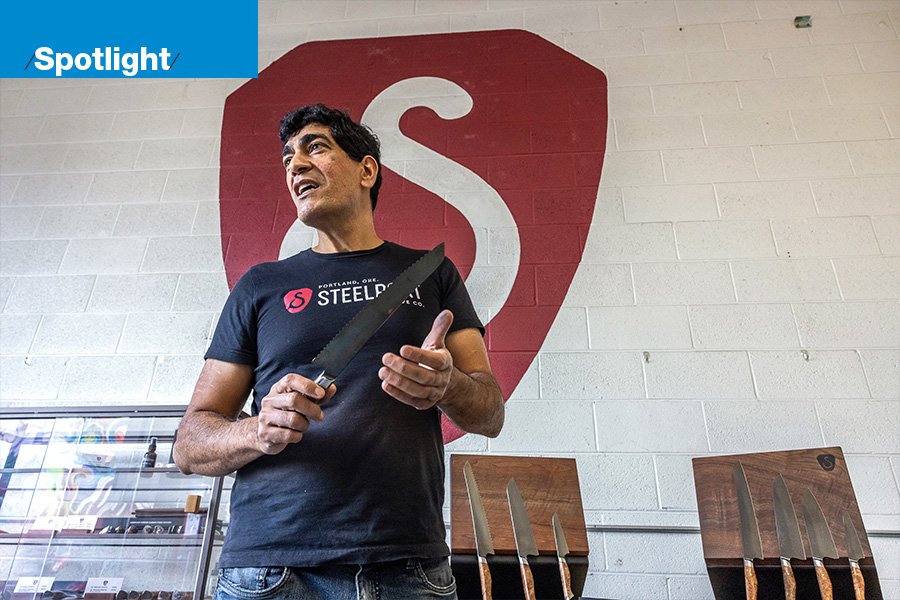
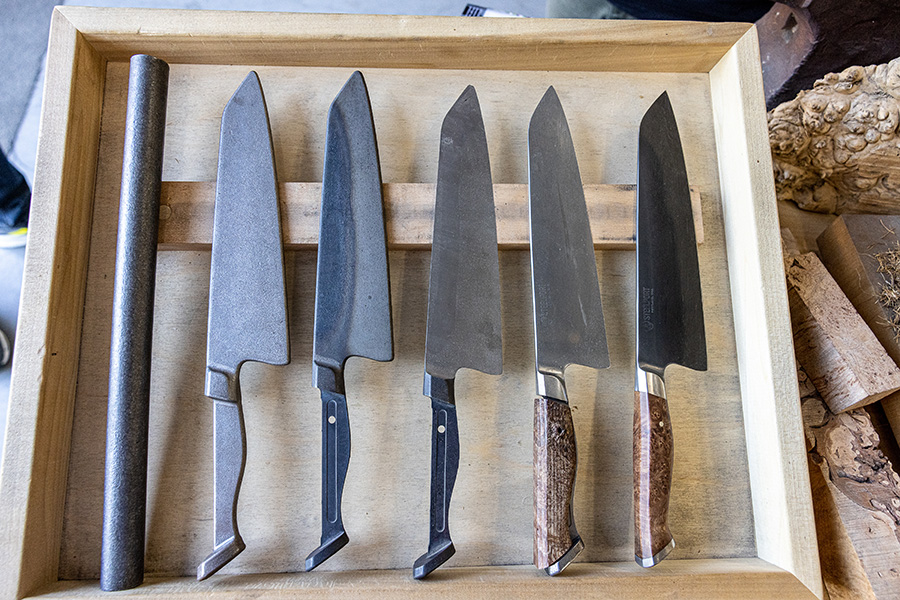
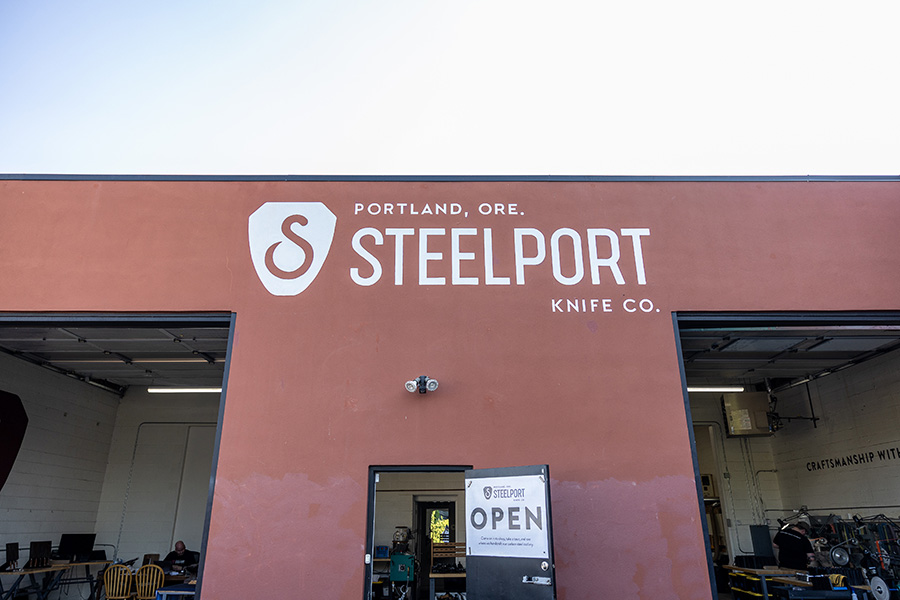
Steelport has a factory on Sandy Boulevard and makes exquisite carbon-steel kitchen knives — arguably some of the best in the world, with a price point to match. A full, six-piece set of the American-forged 52100 steel knives, complete with a patented magnetic knife block, will set you back about $2,750. For $1,000 more, you can add an eight-piece steak-knife set that comes in a walnut box. They’re meant to be heirlooms passed between the cooks in the forks of the family tree.
Scheels is a dealer. That’s why Khormaei was there.
“I was looking at the kitchen-knife display and I was lamenting that they had four or five of our knives but the rest were very standard Japanese and German knives,” he said. “I don’t necessarily like to do a lot of competition, but I was thinking, how long is it going to take to have more American-made knives?”
Khormaei has taken a particular pride in his work with manufacturing and selling American-made metal. In 2012 he launched the Portland-made cast iron cooking company Finex, purveyors of the octagonal cast-iron skillet, now owned by Lodge, which has been the only acquisition in that company’s 126-year-long history. Steelport, Khormaei’s post-Finex act, isn’t just American-made but, specifically, Portland-made — at least mostly. The steel billets do come from a Rust Belt mine and end up at a factory in the Midwest, where they’re hammered into a rough, dull blank at a high-volume factory that specializes in forging Harley Davidson engines. After that, the remaining 133 steps that it takes to make a Steelport knife happen in Portland. That includes the intricate labor needed to transform a single piece of Oregon bigleaf maple wood into a handle. The sharpening and refining happen there on Sandy Boulevard. As a final step, Steelport blades get dipped in cold-brew Coava Coffee Roasters coffee.
“Very Portland,” Khormaei jokes. “The acid seasons the metal unlike anything else we’ve tried.”

At Scheels Khormaei looked around some more and happened upon the cases of outdoor knives: Gerber Gear. Leatherman. Benchmade. Columbia River Knife and Tool. Kershaw. He was stunned. “Every single one of them was not only American-made but made in Portland,” he recalls. “I’m like, wait, what?”
Khormaei flew back to Oregon and dug deeper into American knife making. He discovered something even more remarkable, a tidbit he took to Congressman Earl Blumenauer of Oregon’s 3rd Congressional District. They had breakfast one morning. He presented Blumenauer with figures that showed about 30,000 knives a day are made in Portland.
“I told him that, by my estimate, over half of American-made knives sold in the U.S. are actually made in Portland,” Khormaei recalls. “I said, I wonder what would happen if we got all of these companies together?”
Blumenauer saw the potential of this “emerging story.” “He said, ‘Ron, that’s a great idea,’” Khormaei recalls.
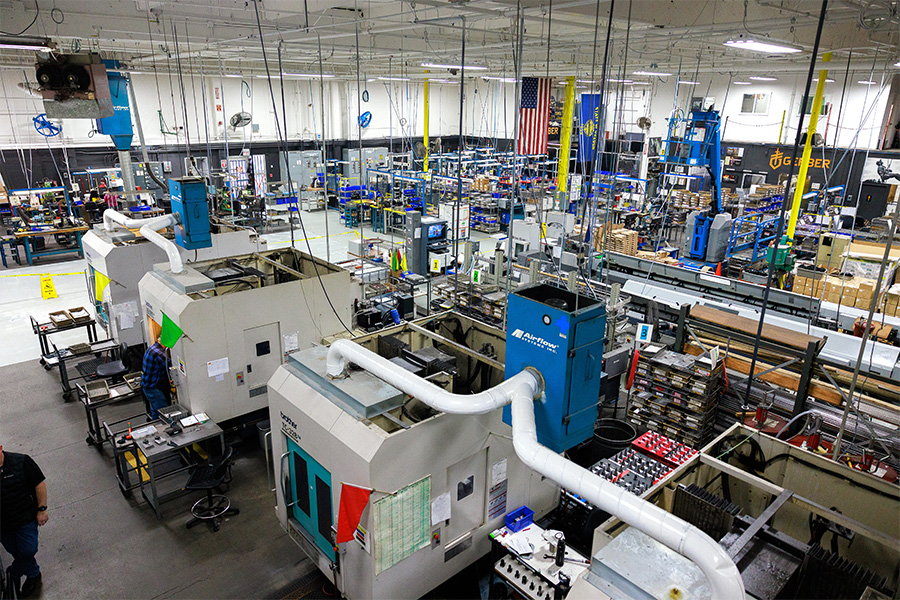
A few months ago, on August 24, 2024, “Knife Day,” that great idea came to fruition. That’s the day the Portland Knife Center of Excellence was born. The PKCOE, as it’s known for short, brings together five of Portland’s leading knife manufacturers — Steelport, Gerber Gear, Benchmade, CKRT and Leatherman — in an attempt to elevate Portland’s place on the global stage, plopping it along side cutting-edge cities like Solingen, Germany; Seki City, Japan; and Thiers, France; which are all known as the places for knives.
In doing so, these companies hope to develop talent within the next generation of knife makers. They want to create jobs, attract conventions and spin off tourism opportunities. Beyond the business, there’s an emotional component, too. “It will be an inspiring story to tell to help revive our beloved city,” Khormaei said in a presentation announcing the center’s creation.

To be sure, the center has no brick-and-mortar HQ, at least not yet, and exists pretty much only on paper. (And at least one company, Kershaw, never expressed any interest in joining forces at all. “They’re probably wondering, ‘Who is this Ron guy?’” Khormaei says.) But the idea of branding Portland as the “knife-making capital” of the U.S. could go a long way toward growing a manufacturing ecosystem that floats all boats.
“It’s a little bit like the Nike and Adidas world, where you have these two brands creating all of these offshoots,” says Ashley Williams, head of marketing for Gerber Gear. That company, one of the oldest knife makers in the Portland area, has recently expanded into the culinary hardware space, too, with a top-notch camping cook set that retails for about $200.
“The city becomes a magnet and attracts all sorts of designers and engineers and entrepreneurs, and with knife making in particular, that’s great because there are manufacturing steps that you can’t do in-house,” Williams says. “So you farm those out, and if you have that ecosystem, there will be people within that geographical area that can do it for you.”
That idea exists across numerous manufacturing sectors and other industries, of course, and is nothing new to Oregon. Redmond, with its advanced metals manufacturing industry, has become a firearms hub. Prineville and The Dalles have their data centers. Bend continues to lean into its momentum as a place for brewing beer and cultivating niche outdoor companies, with business alliances like the Oregon Outdoor Alliance and an Oregon State University–Cascades “outdoor products” degree. That course of study includes running an outdoor company, the SnoPlanks Academy, which designs, manufactures, and markets skis and snowboards.
Making Portland a knife capital is a move that stems out of the 19th century, with Oregon Iron & Steel Company’s founding in Lake Oswego, just south of Portland, in 1882, though other companies came before it. The Rose City had a great demand for steel — hello, bridges — and numerous steel manufacturers sprang out of that ecosystem. In fact, Steelport must use two other metallurgical facilities within Portland to complete the complicated heat treatment that Steelport knives require. “We couldn’t do that in Sacramento, for example,” Khormaei says.
It’s that sort of building on the momentum of what’s already there that fuels the idea behind the Portland Knife Center of Excellence. In claiming the title, there are numerous other benefits across other sectors of the economy. Maybe there could be a knife center display at PDX, for example, something to pique the traveler’s curiosity. Better yet, imagine a tourist-focused campaign that drives visitors to these factories for hands-on experiences, much in the same way that you can, say, make your own Swiss Army knife at a Victorinox factory in Switzerland.
“Portland is a city of makers,” says Marcus Hibdon, communications director for Travel Portland. Perhaps one day there could be a “knife trail” in the way that there are “food trails” along the Coast and in Central Oregon, but Hibdon says there haven’t been any discussions about that yet.
“The city very much makes sense as a hub for knife artistry, as the craft of it is an intersection of our culinary, artisanal and entrepreneurial communities,” Hibdon adds. “Innovative Portland-based knife brands are a part of the Portland story.”
Click here to subscribe to Oregon Business.