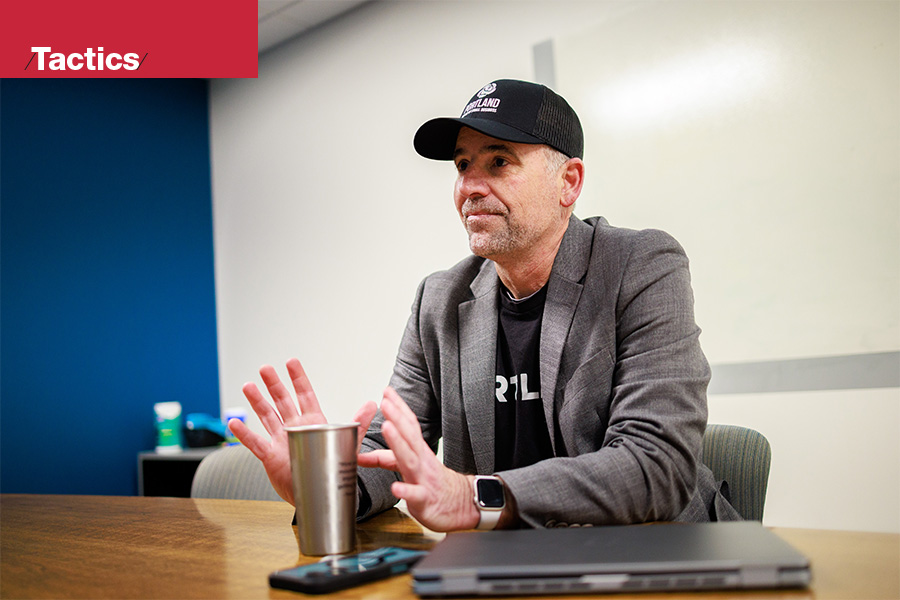
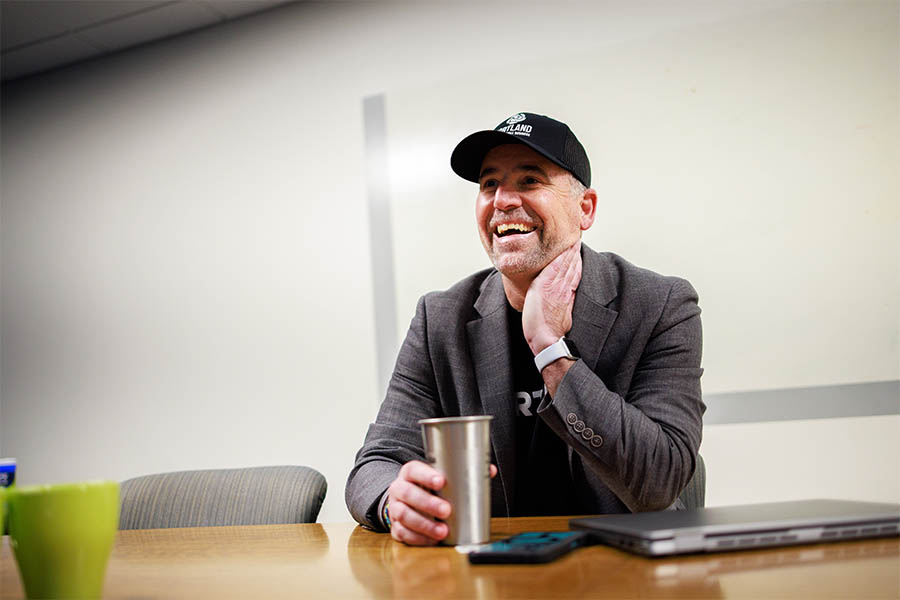
Daugherty was hired last fall to lead Prosper Portland’s Office of Small Business, launched this spring as a first point of contact between business owners and the city.
Mitch Daugherty launched his first business partly out of necessity. He’s advocated for entrepreneurs ever since.
Or as he puts it: “All I’ve done is run small businesses and nonprofits.”
Daugherty launched Arizona Outback Adventures — an adventure travel firm since acquired by REI — after graduating with a degree in conservation biology in 1995 and struggling to find work in his field of study. After leaving AOA, he founded Morange Design, a full-service design firm he led until 2021.
When he moved to Portland in 2003 looking for design work, Daugherty got involved with Oregon Entrepreneurs Network and served on the board for seven years, two of them as chair. From August 2014 until October 2024, Daugherty served as the director of Built Oregon, an organization he co-founded at first to tell the stories of small businesses across the state, and that has since launched a mentorship program, distributed more than $300,000 in grants to BIPOC-owned businesses and launched a festival celebrating Oregon-based consumer products.
Last fall Prosper Portland — the City of Portland’s economic-development agency — announced that it had hired Daugherty to run its Office of Small Business. When this issue went into production in late April, Prosper had planned to officially launch the office in May and had hired four additional staff to report to Daugherty.
“What the city was missing was that part of supporting small business where if you’re a small business, you can come to a front door and talk to a human being, and they can help you navigate all the challenges of city governments,” Daugherty says, noting that a number of other cities already have an Office of Small Business or something similar. The creation of the new office grew partly out of COVID, during which Prosper created a website with guides for navigating grants and small-
business loans, and resources for creating a small-
business website.
In April Daugherty spoke with Oregon Business about what he wants the new office to do for Portland business owners.
This interview has been edited for space and clarity.
You’ve mentioned being familiar with some of the challenges that small businesses face in Portland. Can you elaborate on that?
Every small business faces different challenges, whether you’re a creative agency or food and beverage manufacturing company or retail business. For the retail business, it might be foot traffic, or public safety, or any of the challenges around unknowns, around tariffs increasing, goods going up or the cost of labor. Whereas for food and beverage manufacturers, it might be access to capital, getting new markets, how do you grow outside of Oregon?
So what we’re really trying to do is not make this an umbrella agency where every small business is the same, because we know every small business is different. Every business district is different. Every part of the city is different. So we’re really approaching it from a one-on-one, human-empathy-focused approach. We want to know what your business is, what your exact challenges are, and then try to find the resources to help people.
Certainly the things that I hear from folks [in the business community] are just figuring out what’s the right point of contact, how to get somebody on the phone who can be a liaison to the city, whether they’re concerned about public safety or, very specifically, permitting.
I will say when this office got funded, permitting was top of the list. And I will say, over the past months, the permitting team over there has been amazing. They’re helping us write all the website content. There’s going to be a permitting page on the website. There’s no getting around [the fact that] permitting can be difficult and slow, but we’re also trying to work with them on thinking about the process and walking me through it. Our liaisons kind of walked through it last week step by step. Then there were certain points where they even realized, “Oh, that wording is a little bit confusing.” So it’s almost like, how many times can we maybe work with them to bring in small-business owners or those who don’t understand permitting and be like, “Let’s walk through it and just see if we can make it a little better.”
But by and large, they’ve been amazing to work with so far. They really kind of see us as a partner in helping small businesses. A lot of it’s just knowledge of “Don’t sign a lease before you actually talk to permitting,” because a lot of small businesses don’t. And then there’s a change of occupancy, and then once that triggers, everything happens, like sidewalks, trees. So their big thing is just talk to us first, because a lot of small businesses don’t have an architect or a developer who understands the permitting process.
We still have really high retail vacancy in downtown and in a lot of the urban core. Do you see the city as having a role in filling some of those spaces?
I think there’s a role in working with partners on those. One of my approaches is, with the business districts, all the neighborhoods, and then also downtown: How do we make these businesses that are here right now sustainable and successful, and then recruit around them? Yes, there are a lot of vacancies, but if we fill these three vacancies and then these three closed, it’s just kind of a whack-a-mole.
What are you hearing from businesses that are really established in business districts that are suffering?
I think it’s, one, all the costs have gone up just in general, and two, there’s just an uncertainty about everything. That can range from taxes to tariffs, the cost of goods to access to capital like SBA loans. Everybody is so worried about all these layers, let alone getting enough foot traffic in the door to buy their locally made products, or their beer or their coffee or something like that. It’s different in every area. Downtown’s a lot different than Multnomah Village. Multnomah Village is doing well because the community supports it. And I think there are other districts that have communities around them, but there are certain areas where public safety is still an issue, and vandalism, and I don’t think we can shy away from some of those issues when dealing with supporting small business.
It sounds like you see your role as less in recruitment than in just supporting the businesses that already exist, and even sort of nurturing them and building business districts around those businesses.
At least from the office standpoint. I think from a Prosper standpoint, there’s the Business Advancement Team, which does a lot of the recruitment and retaining of businesses, that works with [Greater Portland Inc.], that works with Business Oregon, so you have the three layers of those all working on that aspect.
But I think that I will say, from 2010 to 2020, when they recruited businesses here, a lot of them were recruiting based on getting talent here too, and the talent wanted to be here because of the neighborhoods, the local coffee shops, the craft-beer scene, the foods.
The role also for us is to show that part of Portland’s appeal to recruit companies is supporting the small businesses that make people who come here to work for that company want to live here, want to engage in the community, just like they have for the past 20 years. I think that’s sometimes missing a bit — like the neighborhoods and where these people are actually going to live.
The housing piece is beyond your purview, and yet it really does underpin everything, doesn’t it?
The housing piece, the lease rates — there’s a lot of stuff that’s out of our purview, as you say, but these all affect small businesses. I think there are definitely some challenges for Portland’s future, but I think that when you drive around some of these neighborhoods, you start to see it over the last year and a half: The foot traffic’s up, you feel the vibrancy coming back. I walk by bars and restaurants in Montavilla or Hawthorne and they’re busy on, like, a Thursday afternoon at three o’clock. So you can see those signs of resurgence in a lot of the areas around, too.
What are things that give you some hope about this office moving forward?
I think what gives me hope is the same thing that’s given me hope for the past 15 years: It’s the founders and business owners themselves. When you take the time to meet them and build those relationships, you realize whether it’s Ian [Williams] at Deadstock [Coffee] or Brianne [Mees] of Tender Loving [Empire]; they’re the ones building this city from the ground up. When the story of Portland gets told, it’s usually told through that lens instead of the big companies.
I can sense the turning around of Portland over the past year, and so now it’s really around, how do we kind of help it move a little faster? And I think that is giving these small businesses the hope and the support needed to become sustainable, then profitable. Because for a lot of small businesses, profitability is the hardest one.
Click here to subscribe to Oregon Business.