
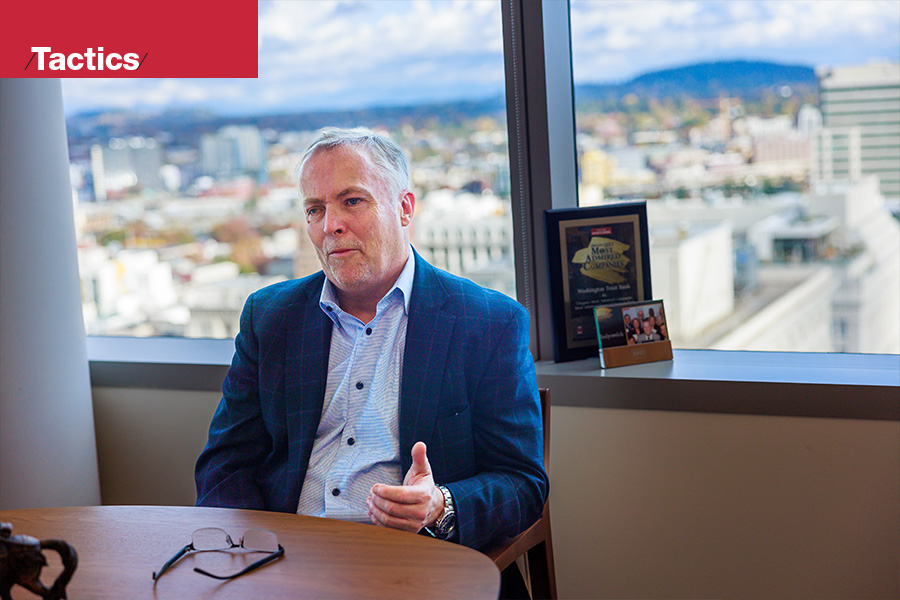
The president of Washington Trust’s Oregon region talks about why the 122-year-old community bank is planting a branch in Vancouver.
Mike Williams is relatively new to Washington Trust Bank, but he’s worked in banking for 30 years, and Washington Trust has been in the game for over a century.
Williams joined Washington Trust after a 30-year career in banking that includes leadership roles at Columbia Bank, HomeStreet Bank and Northwest Bank. Originally from Montana, Williams started his career in banking after graduating from the University of Montana, then moved to Boise and Seattle before being transferred to Portland in 1996.
Based in Spokane and founded in 1902, Washington Trust operated primarily in Washington and Idaho until 15 years ago.Washington Trust has a smaller market share than most banks operating in Oregon (see our Banks Powerlist, p. 47, for a detailed rundown) but is, according to Williams, the second-largest family-owned bank in the country. It’s a full-service bank with retail, commercial and private banking services, as well as mortgage lending and investment services.
“It’s really unique, the way we operate the company. It’s for the long term,” Williams says. When he spoke with Oregon Business in October, Washington Trust was preparing to open a branch in Vancouver, Wash., adding to a portfolio of more than 40 other branches throughout the three states in which it operates. That branch opened Nov. 12 in downtown Vancouver. Williams also spoke to OB about what makes Washington Trust different from other banks — even other community banks — and why employees tend to stay with the company for decades.
This interview has been edited for space and clarity.

You’ve talked about making decisions for the long term — for 20 years from now — as opposed to managing quarter to quarter. What does that look like in practice?
Our culture here is better than I’ve ever seen anywhere. The bank really approaches it from the standpoint that if you take care of your clients, you take care of your employees, and you give back to your communities. Everything else just takes care of itself. That’s how they operate. It’s deeply rooted from the top down. When I hire people, I want them to want to be here as badly as I want to have them. As a result, we have very little turnover, and that’s true with clients and staff. We have employees here every year who are 40 years with the company and retiring, or have been with the company 30 or 35 years. That’s very common here, which is not so much in banking.
How does that thinking change investment strategies?
As far as where we expand, we tend to stick with our markets, meaning the three states we operate in. I’ve never really heard discussions about how we need to go to Utah, or we need to go to Montana. We continue to build out our existing markets: Oregon, Idaho and Washington is our focus. If we see opportunities in these various towns and cities, and we think we can attract a team of people, that’s really where we start. We’ll bring in an office and set up the infrastructure and everything else to support growth in that marketplace.
In the last decade or two, we’ve seen a lot of mergers and acquisitions, especially in the community bank size range. I think someone like Washington Trust is becoming ever more important the three states [where we operate]. Right now we’re expanding into Vancouver, and that’s a market that at one time had a preponderance of community banks, and over the last several years a lot of those have been bought up or merged. I think it’s leaving not a complete void, but more so of a void.
What effect do you see that trend having on customers?
I think it leaves them fewer options. National banks have about 80% of the market. That leaves one-fifth of it for the community banks. So when you see the community banks shrinking in numbers, it’s probably realistic to think some of that [market share] is going to drift up into the national banks.
When customers that fit our size and our niche are with banks like us, including our bank, we know our clients. We get to know them very well. We understand their business. I think we have really good-quality, experienced staff and commercial lenders. And I think those are the benefits they get being with a community bank.
Who are your clients?
We have them at all size levels, from small business up to, you know, companies with 300, 400, 500 employees. That includes professional service firms. We also handle a certain amount of investor real estate — commercial real estate, investment and then private banking. That’s quite a gamut. We’re not all things to all people, but we can really sit down and look at someone and say, “Well, let’s talk,” and we can figure it out if they’re a good fit for us. You know, we want it to be a fit both ways, similar to hiring. I think, in the long term, the customer wins when someone does that.
What is the timeline on the Vancouver expansion?
Our commercial team has been brought on over the last 18 months or so. What we do, typically, when we go into a market is we set up a temporary office, and then they go to work trying to build our brand in that market, working with their clients and prospects and people they know. And we can’t take deposits in that market yet, because we don’t have an office, but they go to work, basically. Then we begin the process of bringing in what we call a financial center. It’s about a 7,400-square-foot office, totally remodeled. We’re excited. We have a real good base of clients that will come on as we open the office. My experience has been that we will probably be pretty busy in year one, because when you open the office, it becomes real, like, “OK, you guys are here.”
One of the trends that I have found really interesting in banking in the last few years is the number of retail locations that are closing — particularly in rural areas, but it’s also happening everywhere. What are your thoughts on that?
Having branches can be expensive. As we all know, technology has changed things a lot, and you can have more clients in a market and less traffic through branches. I think there is a need for a certain baseline of branch operations in Vancouver, and I think we’re looking to add perhaps a couple more branches in that market. Ideally, I would love to see another office in Portland, more toward the Tualatin-Tigard area. Once you plant one in that market, you can reach down to to Wilsonville and even south of that if we need to. I think if they need to, they can be spaced out farther. But there just doesn’t need to be one on every corner. We have a fairly heavy network of branches in the Spokane and northern Idaho markets, but that’s where our roots are. I think we’ve showed we can really develop a good business without having a heavy branch presence in these metro markets.
Are there other trends — either in banking or, you mentioned, commercial real estate — that you’re keeping your eyes on?
The way you survive 122 years in this business is, there’s two secrets to success, and that is granularity in your lending and diversification. We’ve just managed our loan portfolio well. We work with low-income housing; we’ve done regular apartment lending, industrial; we have retail, you know, have offices. Outside of urban markets like Portland, that space still remains fairly healthy, but again, we’re very diversified.
What do you do when you’re not at work?
Now I have two college kids, so I’m not quite as busy. I like to play golf, I like to ski. We like to fish. Now we travel a little bit more to go see them and catch games and whatnot. I’m just a regular family guy, to be very honest with you.
Click here to subscribe to Oregon Business.