

Portland Metro Chamber says Trump tariffs are already having an effect.
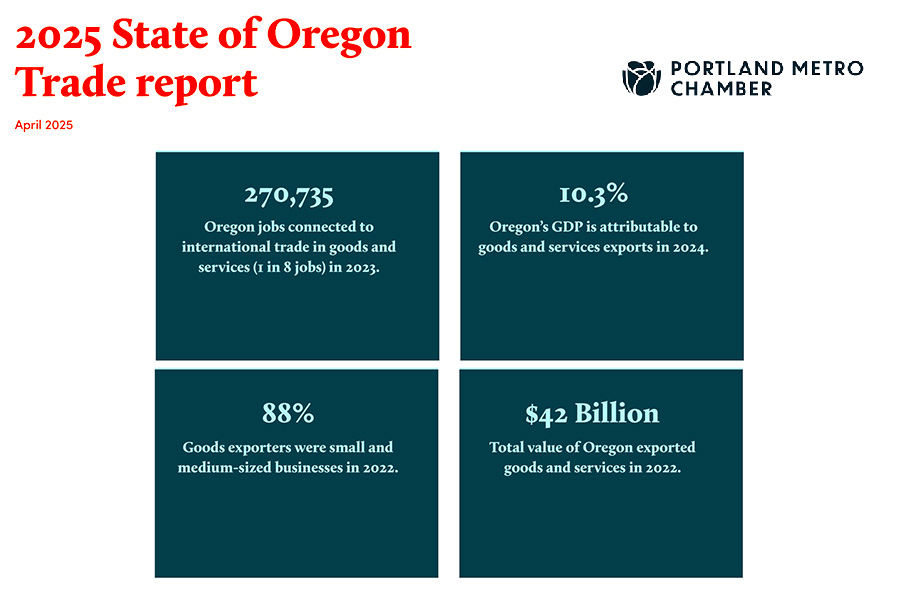
Trade activity in Oregon has already begun to slow as a result of President Donald Trump’s sudden and dramatic shifts in U.S. policy, according to the latest annual trade report by the Portland Metro Chamber.
Uncertainty has hung over the Oregon economy since Trump’s Liberation Day tariffs were announced April 2, inspiring a wave of retaliatory tariffs and rocking the global economic order.
They could ultimately mean greater reliance on trade with Mexico, one of Oregon’s top export destinations and a frequent target of Trump’s attention, according to the Metro report, which was conducted by Portland consultancy ECONorthwest and which looked at national trade figures since 2018. Sponsors of the study include several regional governments, Intel and the Port of Portland.
As countries respond to Trump’s tariffs, they may cut Oregon and its electronics and auto parts out of global supply chains, squeezing companies that operate on already-thin margins.
“Oregon’s economy is deeply rooted in global trade and therefore deeply exposed to changing conditions,” reads the study. “With new and proposed tariffs escalating, the stakes are high for the state’s exporters, especially in sectors like semiconductors and agriculture.”
Around one in eight Oregon workers are employed in trade-related positions, concentrated in sectors like transportation, logistics and warehousing. These jobs are often well-paid, earning about 12% above than the statewide average for all industries. In addition, a sizable chunk of the Oregon workforce is employed in indirect jobs, which supply goods and services to trade-related businesses, and “induced” jobs that benefit from wages spent by indirect and direct jobs.
As for economic impact, most trade-reliant businesses in Oregon are small businesses, defined as businesses with fewer than 500 employees. Small- and medium-sized businesses account for 88% or $7.2 billion in value.
Large corporations are often better situated to withstand the vicissitudes of volatile global markets. Smaller companies with thinner margins are more exposed and vulnerable to policy shifts, reads the Metro report. “Their resilience matters and not just for their own survival, but for the stability of Oregon’s broader trade ecosystem,” it states.
A coastal state heavily represented with high-value, globally integrated goods, Oregon is highly trade-dependent. It was one of 11 states with a trade surplus in 2024, meaning it exports more than it imports. The state’s top export by value is semiconductors, which are part of a complex supply chain dependent on global, seamless travel. Oregon exported nearly $13 billion computer and electronic products, which is far higher than the next largest categories of machinery ($6.2 billion), transportation equipment ($4.3 billion), chemicals ($3.7 billion) and agricultural products ($1.8 billion).
In light of the changes, Oregon may become more reliant on trade with Mexico, which received $6.26 billion in exported goods from Oregon, including a large share of auto parts. That figure is up considerably from 2018 and represents 18% of the state’s total exports. Sales of electronics, machinery and agricultural products — industries in which Oregon is competitive — have also grown since the enactment of the 2020 U.S-Mexico-Canada Agreement. This means tariffs with those countries could spell trouble for local producers.
In recent years, growing demand and shifts in global supply chains have caused Oregon’s trade partnerships to evolve considerably. Last year, the state’s top export destinations were Mexico, China and Malaysia.
On the import side, Japan, Canada, Israel, Germany and Vietnam remain top trade partners. But a new player, Taiwan, now accounts for 15% of foreign imports to Oregon. Imports from Taiwan rose from $435 million in 2018 to $4.5 billion in 2024. The rise is explained by increased demand for semiconductors and component parts.
Many Oregon agricultural exports end up in Asia. Japan, once a top trade partner with Oregon, still receives a high number of bulk commodities like wheat, hay, wood and seasonal fruit and berries.
Since 2018, imports from China have declined 17% and now represent less than 10% of Oregon’s imports.
Click here to subscribe to Oregon Business.