
In the mid-2010s, thousands of Oregon entrepreneurs joined the ‘green rush’ made possible by legal recreational marijuana. Others decided to serve the industry with ancillary businesses that seemed safer. Where are they now that the boom’s gone bust?
When Oregon’s first legal recreational dispensaries started to come online in late 2015, Doc Collins, co-founder of weed-focused marketing firm Hood Collective, remembers clients showing up with duffel bags full of cash.
“They didn’t know what to do with it all,” he tells Oregon Business. “Obviously, they couldn’t put it in the bank.”
“The picks and shovels were definitely out,” Collins adds, using a metaphor that evokes the California gold rush but can also refer to a particular strategy for cashing in on a major economic boom. It’s thought that during that gold rush, those who did best weren’t miners but those in ancillary industries that supplied the tools of the trade, i.e., picks and shovels. There’s at least a kernel of historical truth to the claim. Levi Strauss made a fortune selling blue jeans to miners, and the company he built is still around today. The concept has become a shorthand for an investment strategy that focuses not on the hot new industry but the industries that serve it.
In the mid-2010s in Oregon, plenty of entrepreneurs set about chasing the cash windfall promised by legalization — but a great many others, like the Hood Collective, decided to stick with picks and shovels. The cannabis industry distinguishes between businesses that require a state license —“plant-touching” companies like growers, manufacturers and sellers — and non-plant- touching companies, which don’t require a license. In Oregon the latter group forms a supportive ecosystem for the plant-touching companies. They make products like grow lights, fertilizer and smoking devices. They provide professional services like accounting, business consulting and legal advice (especially important in an industry as heavily regulated and taxed as cannabis). They run testing labs and ad firms, pot magazines and delivery services. Apps for finding weed. Apps for managing supply chains.

Like all gold rushes, Oregon’s mid-2010s green rush was short-lived. So what does that mean for the vendors that popped up to serve it?
Ancillary pot businesses depend entirely on the health of the plant-touching sector. And plant-touching businesses face extensive state and federal regulations, and often local policies. They bear a heavy federal tax load of up to 80% and a lack of access to banking and capital. They can’t sell in other states (due to ongoing federal prohibition, marijuana products must be sold in the state where they were manufactured). And adding insult, rising labor and material costs squeeze at the margins.
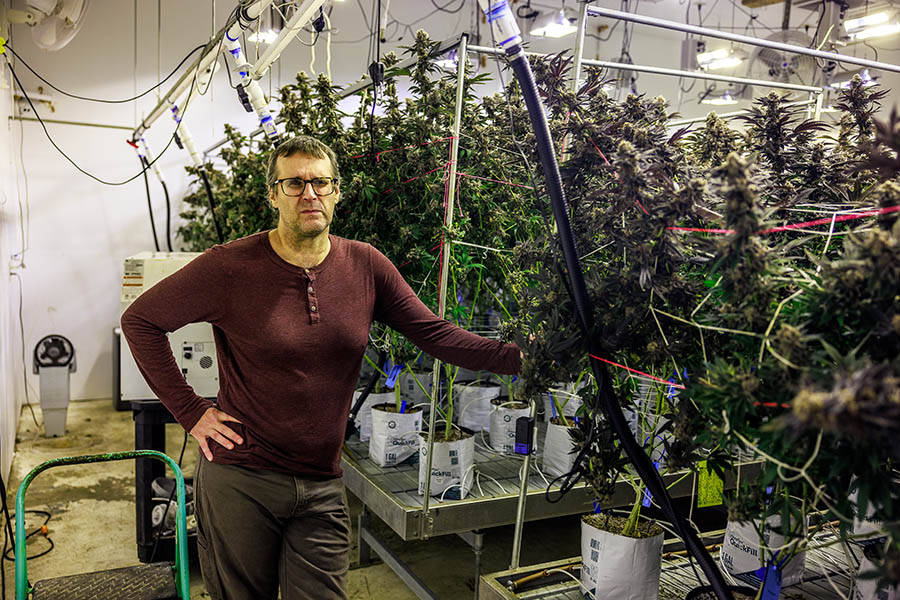
Market saturation and a change in growing conditions caused the bottom of the market to drop out, and by 2017, Oregon’s green rush was over. In March of this year, the price of a gram of cannabis was about $4, and sales had fallen by 4%, according to data released by the Oregon Liquor and Cannabis Commission.
“We thought, ‘This seems too good to be true,’ and immediately, it was too good to be true,” Collins says.
Green slump
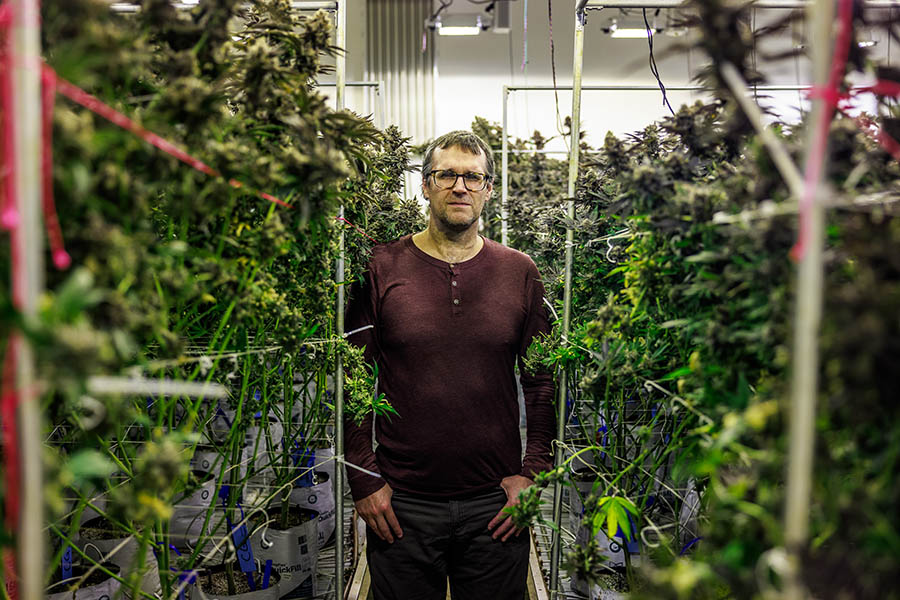
In the space of a decade, marijuana has become a major U.S. industry with $31.5 billion in revenue last year ($1 billion in Oregon). But experts say Oregon’s pot industry is one of the country’s least healthy. Among the first states to legalize, it didn’t set an upper limit on marijuana business licenses, which led to more product than Oregonians could ever consume. The state today struggles with rock-bottom wholesale prices, million-pound stockpiles of unsold inventory and stagnant demand.
While $1 billion in revenue might sound lucrative, given Oregon’s extreme market saturation, for most businesses it’s not. Spread over 2,400 active licenses, $1 billion in revenue works out to around $400,000 per business, and that’s not much to operate on. Companies often have little left over to spend on tax prep, marketing and other ancillary services, according to Mike Getlin, an Oregon City weed farmer and board president of the Cannabis Industry Alliance of Oregon (CIAO).
“Most of these businesses aren’t raking it in,” Getlin says.
When weed was legalized, a lot of people wanted in on the action but, for whatever reason, didn’t want to go through the licensing process, according to Jesse Bontecou, CIAO’s executive director. “Starting an ancillary business was the easiest way for some investors to get a toehold in the industry.”
But, they soon learn, even the pick-and-shovel merchants are affected by bust cycles.
“Nine years in and you’re seeing fewer booths at the conventions,” Bontecou says. “After the boom times, there’s been a lot of bust. And it goes beyond healthy competition.”
A number of once notable ancillary companies have gone under, including security firm CannaGuard Security and law firms Lotus Law Group and Green Light Law Group. In fact, most of the Oregon companies ranked on Cannabis Business Executive’s top ancillary businesses lists from the years prior to the pandemic no longer exist. Portland point-of-sales service provider Greenbits, which sold to Dutchie in 2021, is a rare exception.
Though most ancillary pot businesses are small mom-and-pops, some — like Bend-based retail software platform Dutchie — have received billions in investment and today operate in nearly all states. Some were well established in the traditional economy prior to legalization. These include ScottsMiracle-Gro, now a major player in the ancillary space through subsidiaries like General Hydroponics and Botanicare.
Oregon’s cannabis economy bears some similarities to the Silicon Valley tech boom of the early 2000s, according to accountant Andrew Hunzicker, who runs a training company for CPAs in the marijuana industry called Dope CFO.
In the prior tech boom, investors regularly injected capital despite heavy losses and uncertainty because they believed in their products and their industry.
“It’s very typical in a startup industry,” Hunzicker says. “Facebook didn’t make money for 10 years. Neither did Amazon or Google.”
Poor prospects
In human terms, the outbreak of delinquent payments has led to countless lawsuits, home-loan defaults, repossessed vehicles and arrests as desperate business owners turn to the illicit market. Predatory lenders circle desperate business owners offering loans of up to 40% interest. According to Portland-based marijuana economist BeauWhitney, the market downturn in 2017 was trailed by a wave of grower suicides.
And the fact that cannabis is still illegal at the federal level means there are few legal remedies for those ripped off. In Oregon, a policy of Gov. Tina Kotek mandates businesses to pay all tax debt before they’re allowed to renew their cannabis license. Whitney says the law has hindered pot companies trying to catch up on late payments.
In late 2022, cannabis and psychedelics-focused Green Light Law Group sued seven former clients for around a quarter-million dollars in unpaid legal bills. The next year, the firm itself was sued by its landlord for $1 million for breaking its lease two years early.
It was a stark reversal for a once high- flying firm. Only two years earlier, managing partner Brad Blommer trumpeted a new headquarters that occupied the entire 13th floor of the Wells Fargo Center, calling it a commitment to downtown Portland and a call to action for their industry.
“We see a bright future for Portland and we strive to be part of the tide that will revitalize our great city,” reads a news release. “Because we have a lot of office at the new space — more than we need for our law firm, in fact — we have some exciting plans in the works.”
Those plans involved strengthening lobbying efforts and assuming a greater role in the national-legalization debate. But Blommer hadn’t made a great bet. Downtown Portland is still struggling. Legal clients failed to materialize in sustainable numbers. And many of those who did show up asking for help couldn’t pay.
A recent business-condition survey found that nationwide, 27% of cannabis business owners are profitable. The implication is bleak.
“That means 73% are either breaking even or not,” Whitney says. “The industry is in crisis nationally, and it’s even worse in Oregon because Oregon has a much more mature market. It’s a real tough environment to conduct business, and it’s having this ripple effect not only within the cannabis industry but outside it as well with the ancillary operators.”

Blommer and his fellow managing partners at Green Light Law Group deny the claims against them and have filed counterclaims in their ongoing lawsuit with their landlord. The partners are represented by Matt Goldberg, whose own cannabis-focused firm, Lotus Law Group, recently dissolved, he says, due to the breakdown of his personal relationship with co-founder Allison Bizzano. Goldberg headed across town to Harris Sliwoski, which he says is well positioned to be a leader in cannabis law. He insists an Oregon firm can survive on pot law alone.
“It is a viable business,” Goldberg says. “At a certain point, cannabis law is just business law.”
Green wave
When the market slumps, some non-plant- touching companies expand to other sectors. Others explore opportunities in the next gold-rush state, where a familiar cycle plays out. A law is passed, followed by a two- to three-year period where first licensees make a lot of money — the so-called first-mover advantage. Then more businesses sprout as the initial enthusiasm starts to die down, causing the market to shrink. Businesses pop up along the border and take market share. A first mover itself, Oregon initially got a lot of business from non-state residents, but that dried up as other states decriminalized.
The latest Last Frontier is Ohio, the most recent state to legalize marijuana for recreational use. Attorneys in the cannabis space are reportedly looking into taking the Ohio bar exam. Florida — which has a recreational-use proposition on the ballot this fall and which has allowed medicinal use since 2016 — is another trendy pick to become the next Colorado or Oregon.
Another factor is the possibility of federal legalization, which would certainly alter the decade-long pattern of state-by-state boom-and-bust cycles. Legalization is popular globally, not just in the Pacific Northwest. The Biden administration recently announced a federal rescheduling of marijuana, which is expected to decrease the tax burden facing pot businesses. CIAO and others are attempting to make permanent the moratorium on new cannabis business licenses. And further reforms might not be far off.
Collins, of the Hood Collective, thinks starting at a low point in the market was a blessing in disguise; it meant his company had to grow slowly and adapt to economic realities. For years he and his business partner performed straightforward work for clients and charged competitive rates. Meanwhile, their main competitor and its five founders oversaw a large portfolio of ambitious projects. Collins didn’t see how their model could work. Soon enough, it didn’t.
These days, around 80% of the Hood Collective’s business comes from out of state — much of that from national brands — because there’s not nearly enough business in Oregon to get by. The largest marijuana companies (often celebrity-owned) tend to use the country’s largest ad agencies, Collins says. Small local cannabis companies still solicit him on projects. Often, he advises against using his services.
“A lot of companies are already behind the eight ball when they get here,” he says. “I tell more people than you know, ‘You’d be wasting your money.’”
The gold-rush framing doesn’t perfectly explain Oregon’s weed industry, according to graphic designer Anton Kimball, who’s designed logos and packaging for major brands like Guinness, Nabisco, Clorox and Nintendo, as well as around 30 cannabis companies. These days, pot is much less a part of his business. “It really has slowed down in Oregon. And with all the consolidation, it’s hard to keep up.”

Kimball thinks because the pot industry is so young, business owners are slow to apply marketing models that have proven successful in other industries like food and beverage. “One thing to keep in mind is that most people who get into the pot industry love pot. They’re doing something they really care about. They never thought of this as a fad.”
Hunzicker, aka Dope CFO, thinks more people are in the marijuana industry than most people realize.
“You come to my hometown of Bend and ask, ‘Who’s ancillary?’ Well, there are law firms that serve the cannabis industry, marketing companies, testing labs — they’re ancillary. But I’d go further and say Home Depot, Lowe’s, McDonald’s, Subway — they all sell to cannabis firms all day long. That makes them ancillary. We’re all serving cannabis out here.”
Click here to subscribe to Oregon Business.