

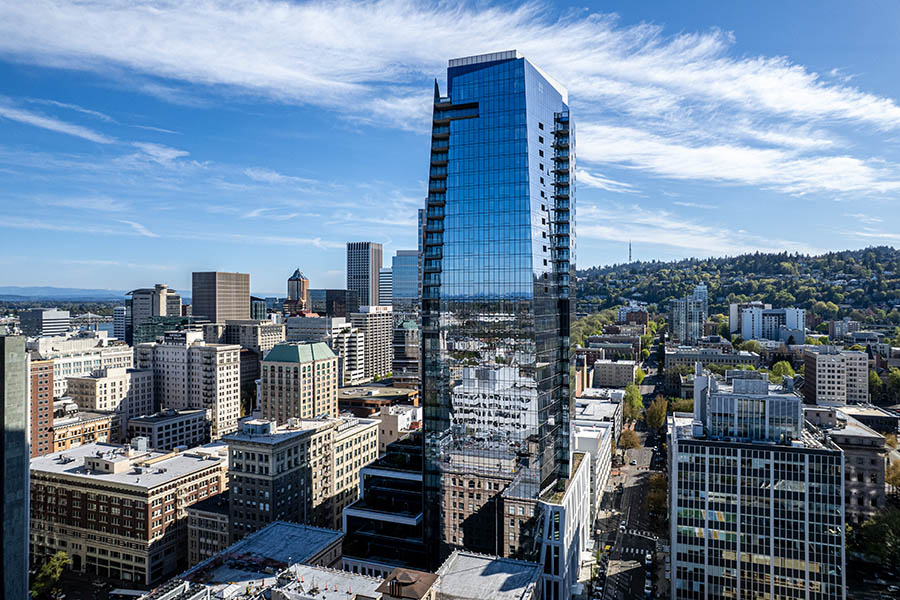
Block 216 was one of the most expensive projects in Portland history.
A new and prominent addition to the Portland skyline appears headed for sale.
The high-end mixed-use Block 216, aka the Ritz-Carlton Tower, beset with challenges since its construction, has experienced difficulty selling office and residential space and even booking rooms in its namesake ultra-upscale hotel. Today, the tower, one of the most expensive constructions in Portland’s history, has leased only around a dozen of its 132 condos and a quarter of its office space.
Business lender Ready Capital, which holds a $510 million construction loan on the high-rise, had suggested the building’s owners were ready to transfer the property to avoid a messy foreclosure as the property is “completely underwater,” The Oregonian reported this week. The lender said last month it intended to seize the property.
That action led a smaller lender to attempt to block the transfer of the building though a judge this week declined the motion. The entity, titled Broadway EB-5 Fund, had issued a $49 million loan to help build Block 216.
The 35-story tower is owned by businesses tied to Portland developer Walt Bowen’s BPM Real Estate Group. New York-based attorneys for Ready Capital said in court all investors had lost money on the project. Bowen, for one, staked his legacy on the project and invested heavily from his own pockets, according to a writeup in Willamette Week.
The project’s investors received breaks on capital gains taxes on top of any return from the project, known as opportunity zone investments. The city of Portland also agreed to accept nearly $8 million to allow Bowen to get around affordable housing requirements — money officials now say the city will likely never get back. Flock, the food hall at the bottom of the tower, received $3 million from Prosper Portland, the city’s economic development arm.

The project replaced a popular block of food carts in the heart of downtown, opening in 2023 with condos and hotel rooms starting at about $450 per night, with premium suites costing more than $1,000. Further litigation could result from opportunity zone investors, according to attorneys.
At an April 9 hearing in New York, where the construction loan was established, a judge denied Broadway’s motion to block the transfer, which has yet to be filed in an Oregon court. An attorney for Ready Capital said in court this month appraisers had recently valued Block 216 at $85 million less than its initial construction cost. “There’s no money to repay anyone,” attorney Jean-Marie Atamian is quoted as saying.
A Portland native, Bowen got his start developing apartment buildings and senior housing in the Western U.S. He scored big in Portland in the decade prior to the pandemic with an office in the Pearl and a 19-story downtown tower occupied with a Radisson hotel and Amazon office space. He secured the bulk of funding for his next project, billed as Portland’s first five-star hotel, in less than 30 days. Though he acknowledged at the time the city’s building boom might be winding down, the timing of the project proved to be far from opportune.
The COVID-19 pandemic, which shuttered numerous downtown businesses, hit less than a year after construction began, u By October 2023, when the hotel first opened, the look and feel of downtown Portland had changed dramatically, with commercial vacancy rates yet to return to pre-pandemic levels — as well as property damage due to downtown protests in 2020 and the twin crises of homelessness and drug addiction that have reached a fever pitch in recent years.
Click here to subscribe to Oregon Business.