
Oregon Humanities runs on the notion that conversation can heal divided communities. Federal funding cuts mean an uncertain future — but the conversation isn’t over yet.
This is the second story in a package of three articles about nonprofits, published in the Q4 issue of Oregon Business. Click here to read the introduction to the package.
Lowell Greathouse understands the power of an empty chair.
When Greathouse leads conversations for Oregon Humanities, he likes to leave one empty chair should a latecomer arrive. If someone does come to occupy the chair, he pulls out another one.
When Greathouse pulls out an extra chair at the Jacksonville public library, someone asks: Isn’t there a name for when you leave a chair empty? A retired Methodist minister, Greathouse briefly explains the concept of the “chair of Elijah” — a Jewish tradition where, at some special events, a chair is left empty to welcome the ghost of the prophet Elijah should he return.
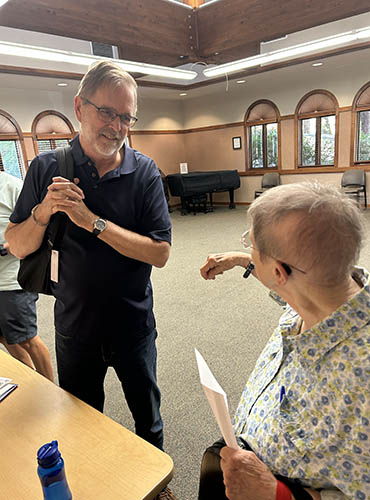
Photo by Garrett Andrews
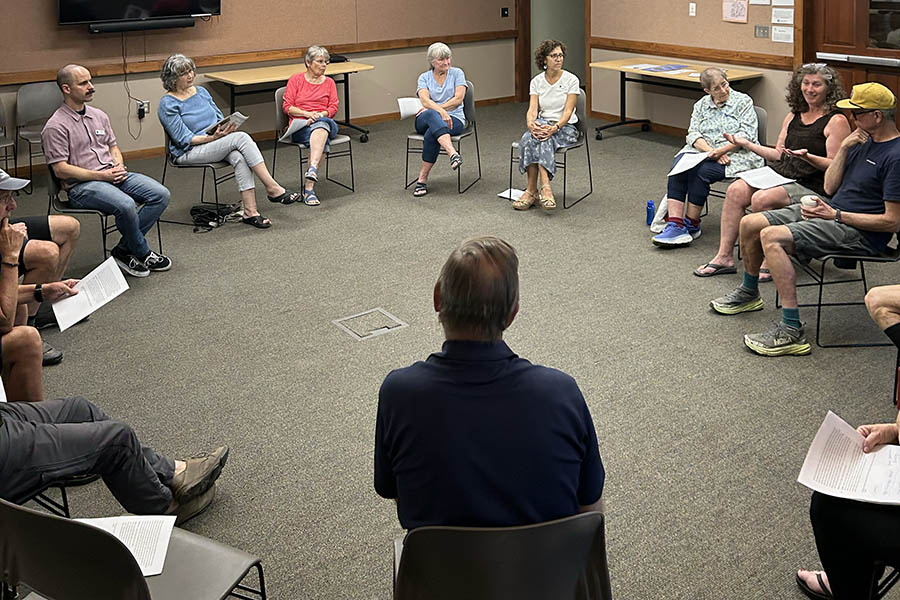
The nonprofit trains facilitators like Greathouse to provide ample seating for participants in the “reflective conversations” it hosts throughout the state, to send the message that all comers are welcome. Today’s conversation, part of Oregon Humanities’ Beyond 250 programming series, has a prompt chosen by Greathouse: “Talking About Values Across Political Divides.”
It’s a question that feels especially pressing in 2025. Polls find Americans increasingly politically divided and holding “unrelentingly negative” views of their political institutions. Researchers cite the structure of the U.S. political system, an ongoing geographic “sort,” and the disorienting and divisive impact of social media.
Greathouse says he’s seen neighbors become friends, strangers find agreement and things get a little heated. He worries the weather — topping triple digits on a mid-August afternoon — will keep people away.
In the end, around a dozen people show up — a good crowd given the weather. And when a late arriver snags the last available seat, Greathouse adds another chair to the circle.
Missed Connections
This year has been a roller coaster for Oregon Humanities, an organization whose mission includes grantmaking to other Oregon nonprofits and events like the conversation at the Jacksonville library, meant to train people in how to have difficult conversations. Changes at the federal level have forced OH leadership into lots of difficult conversations — about what programs to fund and who keeps their job. The organization is fighting back, and court victory this summer means the organization gets to hang on to federal funds for now. But they know the fight isn’t over.
On the evening of April 2, the National Endowment of the Humanities (NEH) announced it would cancel all recurring contracts with the nation’s 56 state and regional humanities councils. Here in Oregon, the state humanities council — also known as Oregon Humanities — lost nearly half its budget overnight.
The White House — acting through the newly created Department of Government Efficiency and billionaire presidential advisor Elon Musk — explained the cancellation of NEH grants as a repurposing of funds “in furtherance of the president’s agenda.”
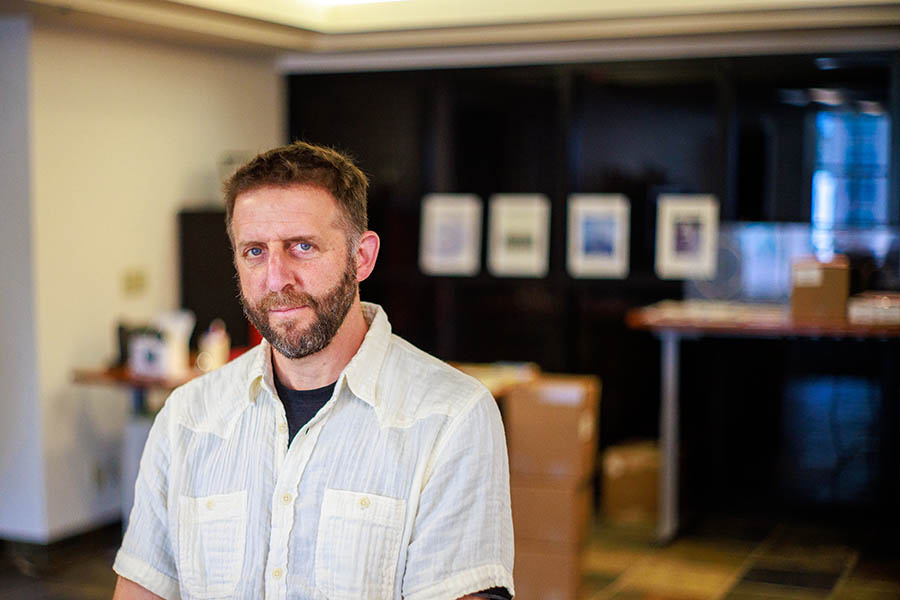
Given Trump’s rhetoric during the 2024 presidential campaign, Oregon Humanities executive director Adam Davis had expected some kind of run-in with the budget knife when Trump took office in January. But, as Davis reminded himself, Congress had already approved his organization’s 2025 funding in March as part of a continuing resolution.
That turned out not to matter.
“A late-night message saying, ‘Your funding for the rest of the year is eliminated’ was a lot to adjust to,” Davis says.
Oregon Humanities entered the year with 14 full-time employees, six contract employees and an annual budget of $2.5 million. After losing its entire share of federal revenue, it’s been reduced to 10 full-time workers. Its board of directors is now mulling three separate financial outlooks, the rosiest of which has next year’s budget down $500,000. The organization sued the federal government over the cut, and while a federal judge ruled in its favor, the victory was a moral one if not a material one, with Judge Michael H. Simon agreeing that the president abused his powers and effectively freezing the funding.
Whatever the number, what it means for Oregon Humanities is less; less money for partner organizations in rural parts of the state — libraries, schools, museums and municipalities. Fewer events around the state. Fewer connections made, fewer stories told.
One surviving effort is the ongoing Beyond 250 project, which includes work with libraries around the state to host public conversations like the one Greathouse facilitated in Jacksonville. Meant to get Americans talking about shared values like equality and justice, the “250” refers to the years since the signing of the Declaration of Independence, and the “Beyond” stands for the “next” 250 years.
Following the cancellation of $65 million to U.S. humanities councils — an amount representing less than 1% of the overall federal budget of $6.76 trillion — the NEH released updated funding priorities. The agency now says it’s “especially interested” in projects on the nation’s semiquincentennial, and that “As per longstanding agency policy, NEH-supported projects must not promote a particular political, religious or ideological point of view and must not engage in political or social advocacy.” In April The New York Times reported that $34 million in NEH funds from cancelled grants would fund a statuary park Trump announced in 2020, intended to honor figures such as the Wright Brothers, Lauren Bacall and Kobe Bryant.
Human Interest
Oregon Humanities was formed in 1971, but can trace its origins to the 1960s, when a coalition of educational organizations — reacting to increased investment in hard sciences as the Cold War and the space race ramped up — called on Congress to establish a permanent funding source for the humanities. The National Endowment for the Humanities was born under the auspices of then-President Lyndon Johnson’s Great Society, which dramatically increased funding for social programs of all kinds. In 1971 Oregon was among the first six states to form its own humanities “volunteer council” to distribute NEH funds locally. By the end of the decade, all 50 states would have a citizen-led council.
In the years since, Oregon Humanities has built up a roster of programming that includes the long-running Conversation Project and Consider This events; print publications like its eponymous magazine; and podcasts like The Detour (“exploring tough questions about how we live together”) and This Place (Oregonians spotlighting their hometowns). And as a grantmaker for the NEH, it’s distributed $16 million to rural organizations since 2020, from the High Desert Museum to the city of Astoria to the Confederated Tribes of the Umatilla Indian Reservation.
In his fight against Trump’s cuts, Davis has taken on a more public-facing role, making his case with national outlets like The New York Times and National Public Radio. And though he’s led hundreds of community conversations on politics, and trained thousands of meeting facilitators in civil discourse over a three-decade career, Davis admits he was “tested” in a recent interview with conservative Portland-based radio host Lars Larson.
Davis had never before listened to Larson’s show, which is carried on more than 100 affiliates (“Giving you the right information on the left coast”).
Davis started by telling Larson about his organization’s mission, its role as grantmaker and the conversations around the state that get neighbors talking about issues that matter to the
“Don’t take this the wrong way. But all the things you just mentioned, we do on this show every day, and it doesn’t take any government money at all,” Larson said. “Why should the government be funding it?”
Davis had been listening to Larson’s show prior to his segment, a first for him.
“As I listen to your show,” Davis replied. “I hear a tremendous amount of distrust for the people who aren’t in the room or who aren’t listening to your show. And our goal is essentially to rebuild public trust, person-to-person, small group by small group, by getting people together and talking. And I think any functional democracy, anytime we’re trying to work together and make decisions, we need to trust each other more than we do now.”
Larson asked why he should work to engender trust in untrustworthy people. After a back-and-forth during which Larson asked about “dim bulb Joe Biden” and Teslas defaced with swastikas, and a question about violence from the left, Davis, sounding a touch frustrated, said, “I’m going to push back a little with the way you’re putting the question. I don’t tend to see the world as ‘either you’re on one side or you’re on the other.’”
But in some situations, there are two sides. For example, a lawsuit has a plaintiff and a defendant. This summer Oregon Humanities sued the federal government over the abrupt cancellation of its funds. Davis tells Oregon Business that while sitting in court at oral argument, he was struck by the fact that the defendant — his adversary — was the NEH, the government agency that gave life to Oregon Humanities and was for five decades a steady partnership and funding source.
“It was very strange to feel just how much this long partnership suddenly shifted,” Davis tells OB.
Test Case
At the core of Oregon Humanities’ court case is an argument about the Constitution, says Anna Sortun, who represented the organization in court. She’s also a member of Oregon Humanities’ board and a managing partner at Tonkon Torp, one of the largest law firms in the state. As Sortun explains, the nation’s founding document assigns to Congress the “power of the purse” to make funding decisions, and establishes a clear separation of powers to rein in the president. Oregon Humanities and Oregon attorney general Dan Rayfield filed the suit in July; the Federation of State Humanities Councils, an umbrella organization for humanities councils based in Arlington, Va., joined the suit.
The government’s position is essentially that the president has broad powers to accomplish his agenda. If the executive decides to shift course, he’s allowed to do so under the Administrative Procedure Act midway through the budget cycle as he deems necessary, lawyers for the government have argued.
On Aug. 6., Judge Simon issued a decision agreeing with Oregon Humanities on all but one of its arguments.
Simon’s decision does not return the grant money to the humanities councils, though it prevents the government from spending it elsewhere. The federal government can still appeal to the Ninth Circuit Court of Appeals. According to Sortun, the Supreme Court can also weigh in and determine the case never should have been heard by a district judge like Simon, and that this type of case instead belongs before the Court of Federal Claims.
While it was a positive result for the nation’s humanities councils, they’re still operating without their congressionally appropriated funds, says Phoebe Stein, head of the Federation of State Humanities Councils. Many have laid off staff, cut programs and canceled programs. And as of early fall, Congress had yet to pass a long-term funding solution for the NEH.
“Any kind of waiting for further legal decisions means immediate impact — to the delivery of services and of grants of programs to local communities throughout the entire nation,” Stein says.
Talking in Circles
Back in Jacksonville, a small Southern Oregon tourist town, meeting facilitator Lowell Greathouse establishes up front the importance of creating “space and grace” for others as they discuss differences across political divides.
The nationwide epidemic of disengagement and division is tough to spot in this circle. Most group members, based on their comments, lean left politically. A number remark on their privilege as white baby boomers. They listen actively and empathetically. They’re horrified by what they see in the news. They find it increasingly difficult to stay engaged with the real world, which seems to be on fire. They have relatives being pulled into their own realities — instead of engaging with the one we share. They’re driven to act, but their actions feel insufficient.
Heads nodded as a woman described the cycle of outrage and grief, which has intensified since Trump took office.
“I write letters and I donate, but it all just feels so passive,” she said tearfully.
Soon enough the talk is over. Ninety minutes feels hardly long enough to scratch the surface with these issues. But then again, scratching the surface is kind of the point, Greathouse says. Hopefully, participants continue these conversations over the ensuing days and months.
Some civic-minded groups in the U.S., like the Better Angels Society, organize educational events that ask participants to identify themselves by political association. Adam Davis is staunchly against this approach.
“We do see a pattern of people who probably lean left being drawn to many, though not all, of our events,” Davis says. “I think of political differences and many other differences as on a spectrum rather than a binary. And I think there’s generally a good deal of diversity in every room if you start looking at it that way.”
Still, one gets the sense that the people this group should be talking to are not there. But for now at least, there’s a chair waiting for them.
Click here to subscribe to Oregon Business.