

Wyden and Merkley condemn the cuts as ‘ludicrous;’ Former Bonneville administrator says Trump is ‘playing with fire.’
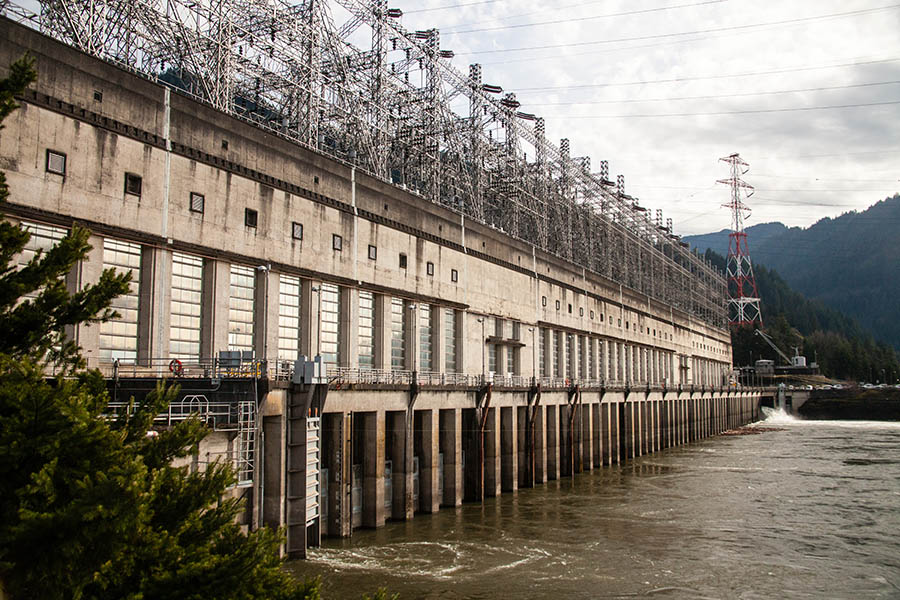
The Pacific Northwest will experience more and longer power outages as a result of deep cuts to staff at the Bonneville Power Administration, according to former BPA administrators.
About 420 positions have so far been eliminated at BPA as a result of President Donald Trump’s efforts to greatly reduce the federal bureaucracy since taking office in January. This represents about 14% of the workforce at a utility that manages 75% of electrical infrastructure in the Pacific Northwest.
“The supreme irony is all these cuts at Bonneville will greatly increase public health and safety risks but they don’t save the taxpayer one dime,” says Randy Hardy, who held the top job at BPA from 1991 to 1997.
On Monday, Hardy and fellow former BPA administrator Steve Wright published an op-ed in the trade publication Energy NewsData, stating that service disruptions are “practically inevitable” in light of the Trump cuts. And because BPA is entirely self-funded, the cuts have no effect on the federal budget.
“It’s clear Trump and Elon Musk and the Secretary of Energy don’t know squat about how to run a utility,” Hardy tells Oregon Business.
Before joining BPA, Hardy was director of Seattle City Light from 1984 to 1991. Wright led BPA from 2000 to 2013.
“It is difficult to estimate the risk of outages from these kinds of workforce reductions, because as far as we know something like this has never been tried before in the history of the electric industry,” they write. “We can say with confidence is the level of risk now with the existing workforce reductions is unacceptably high and at some point further reductions make outages practically inevitable.”
Such outages are more likely during extreme temperatures in the summer and winter, according to Hardy and Wright.
Since taking office in January, Trump has empowered the world’s richest man — Musk — to lead a radical reformation of government. A Feb. 26 memo by the director of the Office of Management and Budget outlines a process for large-scale reductions in force to begin March 13.
“The federal government is costly, inefficient, and deeply in debt,” wrote Russell T. Vought. “At the same time, it is not producing results for the American public. Instead, tax dollars are being siphoned off to fund unproductive and unnecessary programs that benefit radical interest groups while hurting hardworking American citizens.”
The order excludes postal workers, military service members and law enforcement personnel.

When Trump took office, BPA employed 3,100 people. Since then, BPA has rescinded 90 job offers, terminated around 100 probationary employees in their first year with the agency, and frozen hiring. An additional 260 employees accepted buyouts and will continue to receive paychecks through September. More departures are expected due to the end of remote work for federal employees.
Numerous lawsuits have been filed in response to the flurry of executive action intended to shrink the federal bureaucracy. Last week, a federal judge in California ruled the firing of probationary employees was likely illegal and ordered directives terminating them rescinded. That order is temporary, with another hearing scheduled for March 13, the Washington Post reported.
It’s not clear whether the California ruling will affect probationary federal workers who have been laid off. Hardy said it’s possible BPA could be granted the authority to hire back some of the 100 laid off probationary employees.
The cuts at BPA come across-the-board and include lineworkers, engineers, system planners and IT workers. They also include 20% of BPA’s power dispatchers — employees akin to air traffic controllers who keep energy transmission grid demand and output in balance.
Power dispatchers typically have 20 to 25 years experience in the field, according to Hardy.
“It’s a second-by-second operation and those are positions that are absolutely critical for maintaining system reliability,” he says.
The agency also faced stark choices in 1995 when it was significantly undercut by competitor Enron. Cost saving measures included cutting staff from 4,000 to 3,000 employees, but Hardy says those reductions were all voluntary, and critical employees like power dispatchers and line workers were “fenced off” to maintain acceptable service levels.
“We couldn’t afford to lose them,” Hardy says. “If this administration had just done that, it could have achieved significant reductions and had minimal health and safety risks. But it was too dumb to do that.”
According to Hardy and Wright, BPA management is strictly limited in what it can say. “From our experience we can presume that management is now attempting to plug round pegs into square holes and in many cases not having anywhere near enough pegs,” they write. “The point is, this is not a problem in the future. This is a problem right now.”
A BPA spokesperson declined to comment.
Oregon’s U.S. senators, Ron Wyden and Jeff Merkley, have loudly opposed the cuts, calling them reckless and ludicrous last month in an open letter to Trump. “We do not believe there is an energy emergency, but your actions certainly appear to be creating one through these cuts that actively jeopardize the stability of our energy infrastructure, right now,” they wrote.
Wyden writes that Trump’s action will raise energy prices in Oregon.
“The BPA makes money for the federal government,” Wyden writes in a statement to Oregon Business. Reckless cuts at BPA won’t save the federal government one dime, but they will undermine Oregon’s, the Pacific Northwest region’s and America’s energy supply and infrastructure,” Wyden said. “The President, on day one, declared an energy emergency, but clearly that was just to enrich his fossil fuel buddies, otherwise why go after any energy production in the U.S.?”
A representative for Merkley said constituents have raised concerns at recent town halls about potential rate increases and power unreliability.
“Nonpartisan BPA professionals work hard to provide reliable, affordable electricity across the Pacific Northwest, and citizens and local businesses depend on the agency for its critical services,” Merkley writes in a statement. “Let’s end President Trump’s ill-advised scheme so we can focus attention on the serious work needed to maintain BPA.”
The Northwest and Intermountain Power Providers Coalition publicly opposed the cuts at BPA, with NIPPC executive director Spencer Gray saying cuts to personnel could hamper efforts to accommodate new industrial loads, including data centers and semiconductor manufacturing.
With more than 1.9 million federal workers living outside the Washington D.C. area, the cuts have been felt from coast to coast. To date, they’ve largely affected probationary workers in their first or second year who have fewer civil service protections, as well as workers whose jobs are related to diversity, equity and inclusion (DEI) programs. Around the country, the losses include more than 3,000 jobs at the Forest Service, 2,000 at federal health agencies and 1,000 at the Department of Veterans Affairs.
According to the Associated Press, other known cuts include:
— The elimination of $900 million from the Education Department’s Institute of Education Services
— More than 75,000 federal employees have accepted deferred resignation packages (a court order halted the action as a judge considers arguments that the offer is illegal)
— The elimination of potentially hundreds of thousands of probationary employees who lack civil service protections
— As many as 350 employees working on the nation’s nuclear weapons program had lost their jobs.
Federally-funded research projects have been scaled back considerably, according to the Capital Press, which quotes Oregon State University’s dean of agricultural sciences. As of this week, 19 scientists had lost their positions at OSU-affiliated research centers around the state. The scientists conducted research in areas including weed control, blueberry breeding, rangeland management and hop irrigation.
Fourteen states have sued Trump and tech billionaire Elon Musk, a key adviser to the president, seeking to stop the firings and withholding of funds.
Click here to subscribe to Oregon Business.