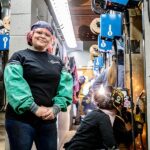

With a budget of $36 million, OCE operates 13 business enterprises at 10 facilities across the state.
With tariffs raising the cost to do business internationally, and the labor costs as high as ever in the Pacific Northwest, many companies are looking to partner with the Oregon prison system. Melanie Doolin, executive director of Oregon Corrections Enterprises, a semi-autonomous and self-funded state agency, says lately, she’s been inundated with business owners who report difficulty securing reliable labor.
Programs like OCE are common among U.S. states though Oregon’s is unique with its relative independence from the state corrections system. Doolin doesn’t miss the legislative oversight saying the freedom allows OCE the flexibility to quickly respond to a changing economy.
Last year, OCE programs made $36 million in revenue of which $30 million went back into the economy (and remainder went toward operations or reinvested OCE). Its programs are apparently popular with inmates. Though incarceration across the board has declined in Oregon in recent years — with a big drop coming after the pandemic — OCE programs remain full, with hundreds of inmate applications on file. A recurring concern, however, is competition with the private sphere. Doolin said the agency has a policy against competition with private businesses unless there are no concerns with affected owners.
OCE employs between 2,400 and 2,600 inmates — or adults in custody (AICs) in corrections parlance — in 33 operations across 10 facilities. These enterprises include call centers, multimedia design, metal fabrication, and the Prison Blues denim line. The agency states these programs offer highly transferable skills, and high post-prison job placement rates. Doolin says OCE is even helping address a nationwide shortage of Braille translators and exploring new AI technologies.
Doolin talked to Oregon Business this week about OCE’s role in a changing economy, what business owners are looking for, and whether her organization is too soft on offenders.
This interview has been edited for length and clarity.
I read that OCE tries to not compete with Oregon’s private sector. But as you expand and as you try to stay current with training opportunities, do you worry that you’ll bump into homegrown businesses more and more?
Before we start any type of new training, there’s actually a letter that goes out to that type of business from the Employment Department to see if there are any concerns from that type of business vertical. Those businesses can voice any concerns about displacement they might have. If there are any concerns, then I actually go out and meet with the businesses and we talk through them. Because the last thing we want to do is displace any type of business.
But we really don’t have that problem. As a matter of fact, we have more private partnerships that are coming to us because they just can’t find the labor. They’re really struggling, especially, you know, in the trades — they just can’t find the labor.
We just had another company reach out the other day that said, “We can’t keep people past three months.” So what we’re able to do is help with training the adults in custody to do the work that a company does, on the inside. So when an AIC gets out, they’re able to go directly to that business and start working for them. They are already completely trained and ready to go.

With tariffs driving up the cost of conducting business abroad, does OCE offer to businesses affected by tariffs?
Yes, as a matter of fact. For example, we’re able to weld some metal pieces for different types of things that are needed. We’re currently looking at whether we can make different types of bolts. We’re able to offer a lot of different things.
We haven’t had a huge increase in that yet, but I actually just received an email today about this. A company isn’t able to get what it needs from overseas. They said tariffs are causing a huge issue, so they reached out to us to see if we’re actually able to do the work for them. So it’s definitely something we’re looking at.
With its tariff policy, the White House is trying to revive U.S. manufacturing in sectors that largely left the U.S. long ago, like apparel and semiconductors. Has this been discussed at OCE? Will your organization train people to use industrial looms, things that are common in other countries but not here?
So we have had a textile factory since the early ‘90s, and we have thought about looms before. But we’re actually doing something different with our textile manufacturing right now.
What we are excited about is that if they do bring back manufacturing, especially textile-type manufacturing, that just opens up more jobs for the people that are currently in our textile manufacturing when they release.
Sounds like there’s a great need for your workers.
We hear that it’s imperative to train AICs, so they’re able to go out and help with the labor pool right now. Because right now, that’s really where employers are struggling — finding people with a specialized skill set in fabrication, in manufacturing, in warehousing. Finding people who are able to get directly to work.
Now of course your workers develop skills on the job, but what about the matter of pay? Are inmates paid?
Yes, they actually are. We call it “rewards” based on the statute. But they receive an award, and there are two different types.
So back in 1994, there was a ballot measure — Ballot Measure 17 — that said, everybody who goes to the Department of Corrections has to receive either on-the-job training for 40 hours a week, or they have to be in some type of education program. And so DOC has many jobs (for inmates), as well. You can work in the kitchen. You can work as an orderly, things like that. But if you come to work for OCE, you actually earn more than what you would working for DOC. They get their normal reward that DOC allows, and then OCE doubles that. Plus we also give different special meritorious awards and whatnot.
Then we have a program of what we call it, called tie step, and what that program is, and that’s for some of our manufacturing and products that we make that go over state line and are for also private industry, and that actually pays a prevailing wage and so that for the people that work those jobs, and there’s quite a few — that’s like our textile manufacturing, some of our wood manufacturing, metal manufacturing — those people actually receive a prevailing wage. I should say, they get a percentage of that prevailing wage. That wage goes to pay child support. It pays restitution. They get taxed on it. And there’s also a percentage that goes to Victims Assistance. And the rest goes back to room and board.
What’s the most successful of your programs?
Do you mean success by re-entry? How do you mean success?
That’s a good point. Can you provide info about re-entry and revenue?
Yeah, sure. So as far as success by revenue, that would be our call centers. We have inbound and outbound call centers throughout the state in six different facilities. This is where we actually provide the cubicle. We provide the computer. And then there’s a customer out there that provides the training and the software and items like that.
And call centers are also successful with re-entry too. Because all of our call center customers, they actually hire people after their release. Whenever they release, the customer sends them a computer, sends them everything that they need, so they could actually work from home if they want to continue working in the call center field.
We also have a multimedia design program, which includes graphic design, video design, CAD design, website design. That program has a 100% success rate as far as getting a job after release. And those jobs start at $40 to $60 an hour with the type of certification they receive.
So those are two successful programs. But all of our fabricators, they get out and they have a job right away. We had a social media post recently of somebody standing next to a CNC machine, and we were kind of bragging about him and the work that he did. And the post mentioned that he was about to get released in two months. And somebody shared the post, and a company saw it, and they reached out and said, ‘Hey, can we hire him? We need somebody that does that type of work.’ And he actually got a job just based off of a social media post.
And do you look at which program is the least successful?
From a revenue standpoint — and I would say we’re currently working on this right now — our wood and metal manufacturing is not as successful. We have a few different plans in place that we’re working on, but we feel it’s very important to continue with these trades.
Because we look at what’s out there and what the market is, and they’re heavily needed in the state of Oregon. And so we continue to build up and continue to offer those types of certification and licenses to people. Because we know it’s something needed in the state of Oregon.
Do you ever hear that your organization is maybe too effective at what you do — at serving people who should maybe be getting punished right now?
That’s a great question. What we’ve done is we’ve actually started to tell our story a lot more on social media and actually share what’s happening.
And what I’ll say is this: we focus not on people’s past but their future. Because 95% of people incarcerated are going to get out one day, and they’re going to be your neighbor. And so how can we change the trajectory where they don’t come back and they don’t create more victims? And so making sure they have stable employment when they get out, and that they have a place to live and have support, that means that they’re not going to create another victim. So we try to focus on the future.
I just had a thought — and this might be unfounded — but we talked about competition with the private sector. With the need for more job certification programs in Oregon, and higher ed being so expensive, do you worry about unfair competition in the education sector? You know, schools and private organizations offer coding certification and the like. Maybe going to prison is really the key to securing a good family-wage job.
No, because it’s so little, right? I feel like what we’re doing is so small compared to what a lot of the universities and colleges are providing out there. Our program of coding has four people in it, right? And they’re going to be in it for quite a while. So I don’t feel like we’re necessarily competing with those schools.
Click here to subscribe to Oregon Business.