
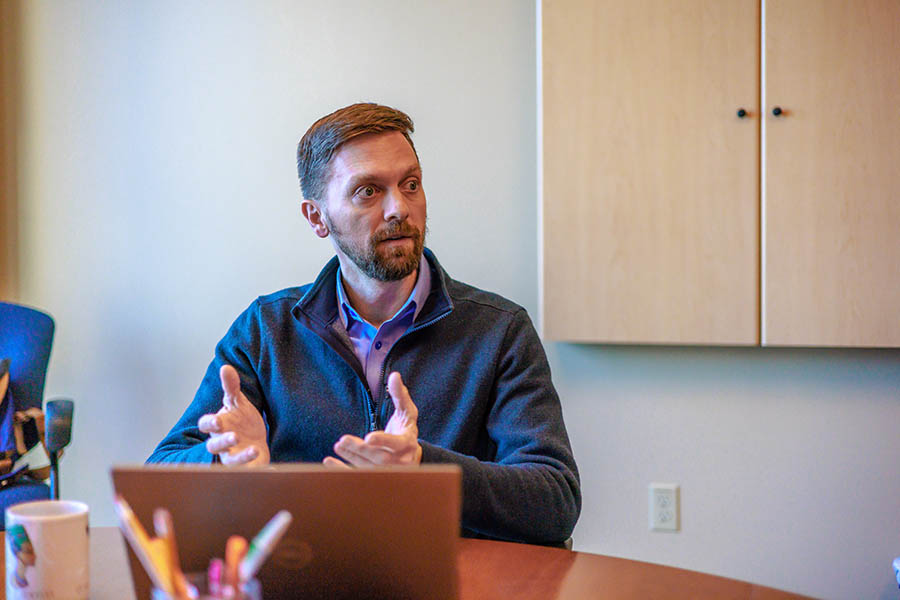
Greene discusses the just-released 2024 homelessness study, which showed an uptick in the number of people in homeless shelters in Portland.
One challenge for researchers like Jacen Greene, who study the issue of homelessness, is that the better they do their job of collecting accurate data, the greater the problem of homelessness can appear compared to other communities and prior years.
Greene is assistant director and co-founder of Portland State University’s Homelessness Research & Action Collaborative, a multi-disciplinary research center that helps lead the Point in Time Count, a federally mandated study that offers a snapshot of the homelessness problem.
Perhaps the biggest news from the center’s 2024 statewide homelessness study, released last week, is that efforts to add shelter beds in Portland have paid off, with a 24% increase in sheltered homelessness. The study also shows one in four homeless people surveyed self-report mental illness or addiction, and that homelessness is especially high in rural areas and among children. Great racial disparities also persist. And according to the 2024 study, which pulls data from several sources, homelessness correlates strongly with housing availability and cost.
Greene spoke to Oregon Business in late January about racial disparities, the Magnet Myth and the impact of homelessness on the economy.
This interview has been edited for space and clarity.
What is this data helpful in showing us?
It shows us homelessness numbers at a certain point in time. It shows us, to a certain extent, who was experiencing homelessness across different demographics. And as we compare year-over-year, it helps us answer Are there more children experiencing homelessness? Are there more people of color? If so, which people of color? And then we break it down county-by-county so we can see changes in specific counties over time.
And what’s the top line here?
The study from last year was tricky because there was only an unsheltered count in some regions across the state. Like Portland, for example, didn’t do one. So we’re missing unsheltered numbers for the county with the largest number of people experiencing homelessness. So we can’t really say with any accuracy what the unsheltered numbers were. What we can say is that sheltered homelessness was up. [The number of] people in shelters was up quite a bit, and that’s because there was a big increase in shelter beds in 2023.
To some people, a big increase in the number of people in shelter beds might sound like bad news.
It’s definitely good news. When you see sheltered numbers going up, that means there are more people in shelters who would otherwise be out living on the street or in a car or in a tent. And we also have had a big deficiency in the number of shelter beds.
Across the state, we have fewer than half as many shelter beds as we need. Like I said, we don’t know for sure about the last year specifically. And of course, a shelter bed doesn’t fix homelessness. Somebody in a shelter is still experiencing homelessness under the federal definition, they’re just sheltered. At best, it’s a temporary stop. Hopefully it’s a step towards housing for them. Given the current housing shortage in Oregon, there’s just not enough housing.

Could you speak to how the public generally views the problem versus what you see in the data?
One is that everybody experiencing homelessness, or many people experiencing homelessness, came here. We call it the magnet myth. Everybody’s from somewhere else, right? And what we find is that the vast majority of people experiencing homelessness in our communities like Portland are from here. They’ve either lived here a long time or they grew up here or they moved here for a job or to be with family and then later lost their housing. Very, very few people were homeless and moved somewhere for services.
How related is the problem to a lack of housing?
We estimate that the state needs almost 50,000 more housing units for households experiencing some kind of homelessness right now, whether they’re unsheltered, sheltered or doubled up like couch surfing.
So do you take a stance on the Housing First strategy?
Yeah, Housing First is probably the most proven and successful strategy for addressing homelessness. The idea behind Housing First is that you focus on a person’s immediate needs. And if that includes housing, you put them in housing. We do know that people in housing are much more successful at getting other needs met. It’s much easier for you in a safe, warm, dry place to make your medical appointments, to go through any treatment you may need for substance use disorder or mental health issues, to connect with employment. When somebody’s living on a sidewalk, it’s extremely challenging to do any of those things that you need to do to get back on your feet.
So we see a lot more success if people are placed into housing without barriers or preconditions and then offered services to help them out. The sort-of opposite strategy is called Housing Ready. The idea of being housing ready is that you have to prove that you are ready for housing, that you’ve earned housing. But what we see is that if you make all these hoops that people have to jump through when they’re on the street, it’s just incredibly hard for them to get there. Housing First is — hopefully still is — the accepted and encouraged strategy of the federal government.
Veterans are the only group experiencing homelessness where we’ve seen a major decline recently. They’ve actually reduced veteran homelessness by 50% through a really aggressive push at the Housing First strategy. So we know it works. That’s the only group where we’ve seen a big decline in homelessness. And it’s also the only group where we’ve really comprehensively used Housing First and fully funded it.
Do we know much about family units and how many families are homeless?
Oregon consistently has some of the highest homelessness rates among children and families with children. It’s really bad right now; just among children who are enrolled in school, we have 22,000 students who are experiencing either unsheltered, sheltered or doubled-up homelessness. That’s 22,000 across Oregon in the 2023-24 school year. That’s the highest recorded percentage of students in Oregon who are experiencing some form of homelessness.
What can you tell us as far as racial disparities go?
It’s really bad. This is something that we see across the country, and it is reflected here in Oregon as well. We see much higher rates of homelessness among Black and Indigenous people, just across the board.
Our study found that last year, American Indian, Alaska Native or Indigenous Oregonians experienced homelessness at a rate almost six times higher than their proportion of the population. Native, Hawaiian or Pacific Islander. Oregonians experience homelessness at a rate 4.3 times higher. Black, African, American or African Oregonians experience homelessness at a rate 3.1 times higher.
We see this across the country. We see this in Oregon. We see this across counties in Oregon. White people tend to experience homelessness at a rate slightly less than their proportion of the population.
What are the challenges involved in collecting the unsheltered data?
It’s really tricky. You’re going out and you’re asking people a lot of personal questions about their life. I mean, if some stranger came up to any one of us and said, ‘Tell me about your sexual orientation, identity, your housing history or domestic violence.— I mean, even on a good day, very few of us would want to answer those questions. I think it’s impressive that so many people who are experiencing homelessness are willing to answer all these questions. You know, there’s a nonresponse rate in Multnomah County of something like a third of people who were asked … so we’re missing a lot of data. We do get as complete a picture as we can. But that is one of the big challenges.
There are two elephants in the room — mental illness and substance abuse. How are you able to study those issues?
Those are questions that we ask in the Point in Time Count. In 2023 in the tri-county area, about 23% of people who are unsheltered had some sort of mental health disorder. And about 26% had a substance use disorder.

So roughly a quarter of each — that might seem low to some people.
I think what happens is that somebody who has a severe mental illness or a substance use disorder is going to be sort of more visibly associated with the things we think of when we think homelessness. You could walk past somebody who is experiencing homelessness and not think, ‘Oh, that person is homeless.’ But if you walk past somebody on the street who has a severe mental illness, you’re probably going to make that association.
I guess implicit in what you’re saying is, if you address those issues — mental illness and substance abuse — you’ve still got that 75%.
Exactly. And I think that’s something we’re often missing from the news. You know, even if we could magically shelter everybody who has a substance use disorder, we’d still have roughly 75% of people still out there.
So how tied to housing prices is the homelessness rate?
Incredibly closely tied. The federal government found that for every $100 increase in median rent anywhere in the country, homelessness typically goes up 9%. And it’s like that across the country. Anywhere you have rents going up and up and up, homelessness goes up. If you have places where rents are staying pretty stable, homelessness stays stable.
How does homelessness affect Oregon’s economy?
It’s really hard to quantify the impacts of homelessness on the economy. I’d say hysteria around homelessness does have an impact on the economy. When you get a lot of bad press about a city like Portland, when our homelessness issues are really no worse and often not as bad as many other cities, it, I’m sure, has an impact on things like tourism.
The problem is that that’s often linked to specific political agendas and not always reflective of reality. I have people who come here and they walk around downtown, they’re like, oh, this really isn’t as bad as I was expecting. It’s not always an accurate picture.
Practically speaking, what are some techniques to keep in mind when you’re out in the community conducting this kind of research?
Just talk to people like human beings and show compassion. I do interviews for our research, and I try to think about how I might feel being asked these questions. A lot of them are very personal. We try to think what’s the way to ask this in a way that’s not demeaning or dehumanizing. You have to find that empathy.
Click here to subscribe to Oregon Business.