
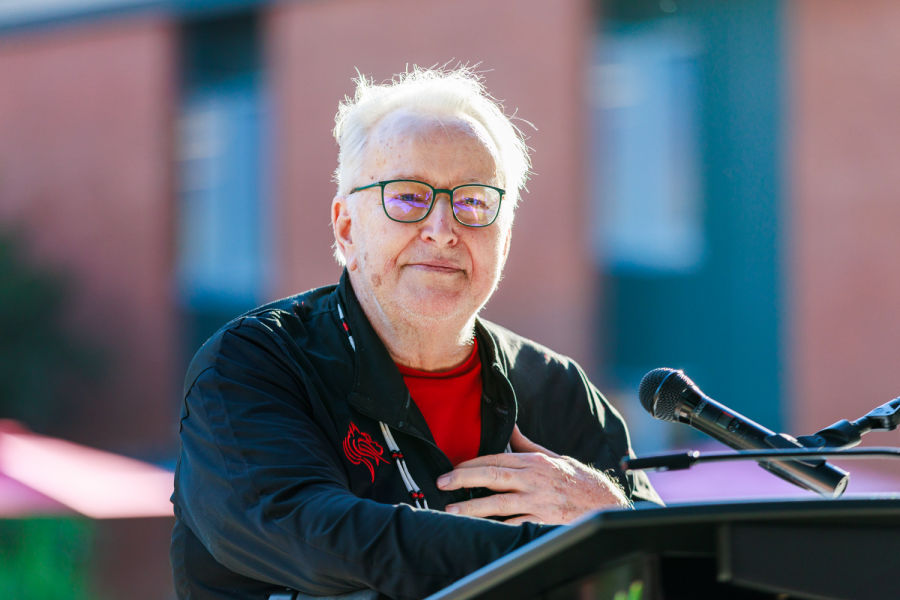
AuCoin spoke to Oregon Business about being honored by Pacific University, the 2024 elections — local and national — and why civics education is more important than ever.
Les AuCoin represented Oregon in Congress from 1975 to 1993 — a period during which both national and local politics took a very different shape than they do in 2024. On a local level, AuCoin can recall a time before Western Oregon became a Democratic stronghold; he was the first Democrat elected to Oregon’s first Congressional district, which has consistently elected Democrats since. On a national level, he can speak to an era when bipartisan collaboration was the norm.
In September AuCoin’s alma mater, Pacific University, honored him with the dedication of the multipurpose Les AuCoin Hall. The building was previously named after Harvey W. Scott, another Pacific University alumni and the first editor of The Oregonian. In 2022 the newspaper published “Publishing Prejudice: The Oregonian’s Racist Legacy,” discussing decades of racist and sexist editorials published by Scott and publisher Henry Pittock. Later that year, Pacific decided to remove Scott’s name from the building; a major renovation and a dedication ceremony later, the building is named for AuCoin.
In late October, AuCoin spoke with Oregon Business about the building dedication (“No one bothered in their excitement to check my GPA”), the upcoming elections (both local and national) and why he’s committed to advocating for better civics education.
This interview has been edited for space and clarity.

OB: Tell me about Les AuCoin Hall. Is it an academic building?
LA: Yes, it is. It’s a building that went through a $10 million reconstruction. It was a library, fairly new. I think it was dedicated in the ’60s, but it needed a seismic upgrade, and then there’s a new library that was funded by a major donor, and the lovely new library expanded space and so forth. This one is an opportunity for the school to turn it into a center for classrooms, lab space for technology, study areas, some offices. And it’s right in the center of the campus, next to the venerable Marsh Hall, which is the flagship of the university on the campus. So it’s pretty exciting and very, very up-to-date, modern. Unlike me — I’m 82 years old — this is brand-new.
When the library was built, I was working at the university as a public information officer. I used to walk by the construction site every day to have a morning meeting with the president to kind of think about what we were going to do that day. If somebody had told me, as I looked at the excavation, “Someday, son, this building is going to be named after you,” I would have told them you need to be fitted with a straitjacket, for God’s sake.
How long did you work as a journalist before you went into politics?
In my senior year of high school, I was finishing the sports page of the Redmond Weekly, from March through August of that year, 1960, and then I left to go to Pacific that fall. And so that was my only actual commercial experience of journalism. But I had really loved journalism, the classes in journalism and worked part-time at The Oregonian. And then, after one year, I joined the Army. For three years, I worked as a public information specialist, both in the South and then in Germany, then came home and resumed my studies and graduated, and the rest is history.
What got you interested in going into politics?
I was in the segregated South. Nashville, Tennessee, was the closest city. I would do, as many of us would do, weekend passes there, and just strolling on a weekend day, I got caught in the middle of a race riot in downtown Nashville, and I saw the bared teeth and scowls of screaming mobs trying to get at Black children who were trying to integrate a lunch counter, young children and older children. I never had seen anything like that in my life, and it left an indelible memory.
Shortly after that, [John F.] Kennedy gave that famous speech about integrating the Alabama schools, saying that if a Black person cannot send his kids to the school of his choice and cannot vote for the people he wanted, who among us would be content to take his place? I heard that sitting in the enlisted men’s club in Fort Campbell. I knew then that, No. 1, Kennedy was the person I could really get engaged with, and that race was a moral issue that I had to do something about. That was the beginning. When I was in Germany, in the barracks one night, soldiers were polishing their brass and shining their shoes and finishing their showers, a couple of them were playing cards at a bunk in the middle of the bay. And the news came on over the radio that Kennedy had been shot, and we all stood around listening and learned that he died. Those experiences combined told me that just to be in journalism is not enough. I had to be also an actor in some way.
What are your thoughts on the current moment? Starting with the upcoming national election, although there is a lot going on locally, too.
This is cardiac arrest time for so many of us; I think everybody sees this as quite a fraught moment. I cannot believe that a convicted felon is running as strong as he is. And to me, it’s not just a question of two different parties or two different candidates. To me, the fact that somebody who is a demonstrated liar, a convicted felon who talks about unleashing the military against American citizens and talks about immigrants not just as cat and dog eaters but as vermin — for that person to be that close in what could be almost a tie vote is astounding to me.
But I think I know exactly why, as the reasons are ones that I’ve been concerned about for a long time, one of which is the demise of journalism. Advertising revenue from American daily newspapers has dropped by almost two-thirds from where it was just about 10 to 15 years ago. One of the major channels is not neutral. It’s not your Walter Cronkite type of journalism. We have the atomization of the industry, and then this ability to dial in and dial out, and we’re left with a situation where, today, if we reading the news, people are actually debating facts — not ideas, not opinions. They’re debating facts. These are the underlying problems I see that lead us to an election like this. How do you get across governing values in that kind of a climate? It’s very, very hard.
I think we have a lot of work to do nationally, as well as in the state and local governments. Specifically, civics needs to be a requirement, both in high schools — maybe even junior high schools — and also as in higher education. That doesn’t mean memorizing the Constitution; it means getting in and understanding what a democracy is all about. You have to go back to understanding the ideas of the Enlightenment. The founders were inspired by the idea of honest debate, of facts, reason, the real theory of representative democracy. It’s one of the reasons I’ve been focusing all my attention on education.
On a local level, Portland is changing its form of government, and I’m still wrapping my head around it. Do you have any thoughts on the city elections?
I spent all morning yesterday trying to figure out how to prioritize six choices, and like in my city commissioner race, none of whom I know. So I had went through every single name, looked at every one of their endorsements, did as much research as I could online, finding information that was not extensive by any stretch — and was exhausted and didn’t finish the job. I’ve got to return to it today.
I’m glad it’s not just me.
It’s not just you. My God, I’ve never been so exhausted as a voter in my life. I was wary and didn’t buy the arguments in the first place, but the way [charter reform] was sold was, “This is going to open up the process and engage and empower more people who normally haven’t been empowered.” I’m saying, given the experience I just had yesterday morning, wait ’til the votes come in. I think you’re going to find that a lot of people are not being empowered. This particular version of ranked-choice voting — I think they’re going to find what an ordeal that is. Secondly, when you have this many people — three people in each commissioner district and a weak mayor with an unelected city manager — my understanding of politics, and I’ve lived nearly two decades of it, is that’s a guarantee that the mayor could very well just be a figurehead. And then, in the meantime, it’s an opportunity not for responsibility-taking among city commissioners but for finger-pointing.
I understand the motives to reform what we had before. It was a misbegotten construction that should have been reformed a long time before [it was]. But to go from that mess into this one, it’s just jumping out of the proverbial frying pan into the fire. I think that Seattle has a better approach. There are other ways to do it.
I felt like we were overdue for a change; having just five at-large commissioners for a city this size didn’t make sense. But we’ll see, I guess.
At the state level, I can tell you one ballot measure I’m voting against is ranked-choice voting for the state offices. Let’s not jump into yet another fire.
Going back to education, when I was in the Legislature, we were one of the national leaders in supporting higher ed. Now the level of support is 34th nationally. How do you educate people to take the jobs of the future when you’re starving them for the educational background they need to face those jobs? We need to create civic literacy, but also just math and sciences.
Pulling from my experience on the board of Southern Oregon University after I left Congress — I taught down there for about four years as an adjunct professor — the Higher Education Coordinating Commission is, in a modest way, the Department of Higher Education, but it isn’t. It’s just become a new one, and it’s showing a real bias against our regional schools [like SOU and Eastern Oregon University]. I think that real attention needs to be paid to how we govern the schools; if they’re going to have independent boards, let them govern themselves, for gosh sakes. On top of that, tuition and fees in Oregon for the public colleges are the highest of any other western state. I think politics have come into this. There’s a growing feeling that higher ed is for effete snobs. So support has been dropping, and of course the victims are the students who aren’t rich, who have to pay the tuition and fees and go into debt, and then they’re settled with that debt when they finally graduate, if they do. I would give anything to support candidates that would address those general problems in the state of education, per se — both higher education and public schools, too.
Click here to subscribe to Oregon Business.