

The former state legislator and middle school teacher talks college affordability, changing demographics and student mental health.
Oregon invests less in higher education than all but four other states, a major factor in the state’s higher-than-average tuition.
It’s just one of the existential issues challenging Ben Cannon, who as executive director of the state Higher Education Coordinating Commission, advises lawmakers on higher ed policy.
“It starts with public investment,” he says. “There’s no question that’s the biggest contributor to college affordability.”
Cannon began his education career in the trenches: teaching middle school. A West Linn native and Rhodes Scholar, he subsequently ran for the Oregon House of Representatives in 2006, serving three terms representing the 46th District, which covers portions of northeast and southeast Portland. He left to serve as former Gov. John Kitzhaber’s education policy advisor. After the Higher Education Coordinating Commission was created in 2013, Cannon was appointed its first executive director, a position he’s held ever since.
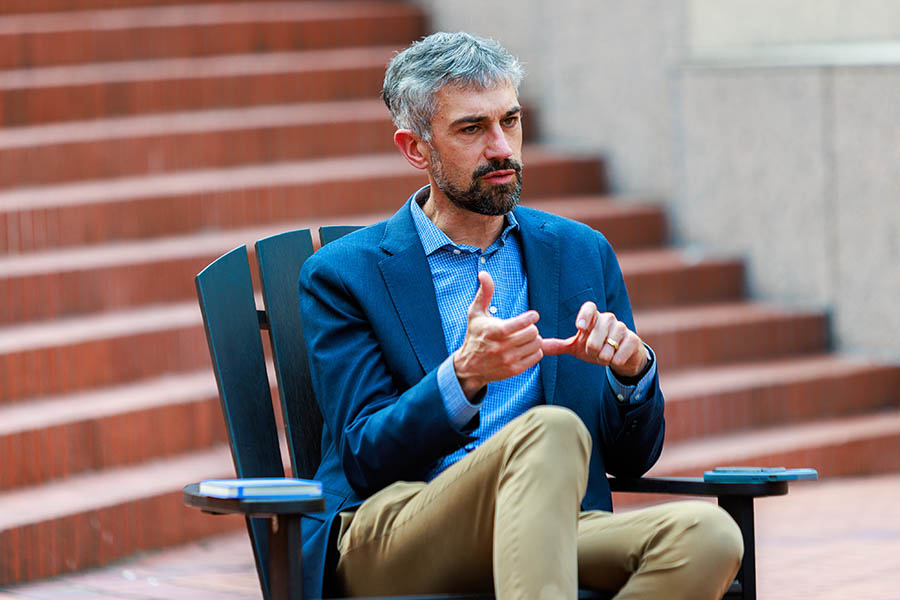
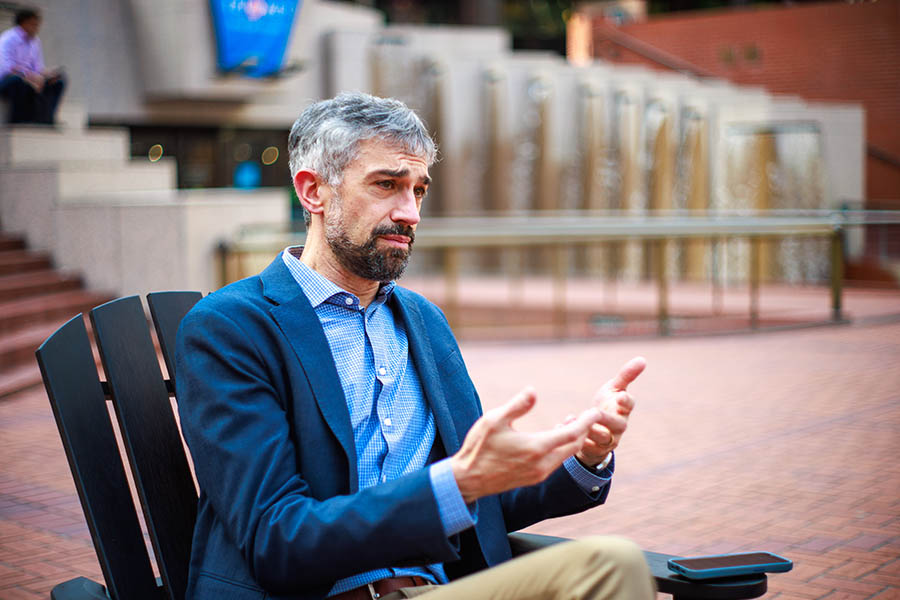
Through an accident of scheduling, Cannon, 49, met with Oregon Business at the publication’s former address near Portland’s Pioneer Square, where he discussed workforce demands, the pandemic’s effect on higher ed and trends in public opinion.
This conversation has been edited for length and clarity.
How has higher ed in Oregon been affected by the Trump administration?
Well, there’s been a lot of noise. I’ll begin with the direct effects, and those have included cuts to grants — particularly research grants that colleges and universities receive. That impacts the economy. That impacts students. It impacts knowledge and innovation. Those have been significant.
Federal research funding into Oregon is about half a billion dollars annually for Oregon’s public universities. Some of that has been disrupted since the administration came into office. Most of the other impacts are what I would put in the category of “threats,” or actions the administration has taken that have been held up by the courts, and so haven’t yet come to pass.
Sticking with the research budgets, for example, the administration has attempted to apply a very strict cap on the proportion of that research funding that could be used to cover overhead costs or indirect costs for the institutions that’s being held up by the courts. But if that were to come into effect, it would have a many hundreds of millions of dollars impact on Oregon universities, including Oregon Health and Science University.
(Editor’s Note: Cannon’s conversation with OB took place before the passage of President Trump’s budget bill, signed into law July 4. Early versions of that bill included cuts to funding for Pell grants, but the final bill increased Pell grant funding, though eligibility requirements have changed. The bill also eliminated the Grad PLUS loan program, which allowed students to borrow funds to cover their graduate programs, including housing and food expenses, and eliminated some protections for borrowers struggling to pay back student loans.)

What’s some of the research we’re in danger of losing?
It includes research in wildfire mitigation and mitigation of health hazards associated with wildfire. It includes some work around seismic resilience. It includes programs and efforts to bring undergraduates and populations that typically don’t get to experience research into research settings and in the sciences and elsewhere, to give them that experience.
It is such a wide range of activities that don’t even really fit a particular discernible pattern.
Is it the case that with cuts at the federal level, the state is now going to have to pick up a bigger chunk of the bill?
Well, it remains to be seen. The state also faces a challenging fiscal environment. This current legislative session has contained a lot of discussion about higher education budgets, not a lot of talk about new investment in higher education.
I think we’re all in a wait-and-see mode about what the federal impacts may be. We’re cognizant that higher education is not the only area of the state budget that’s potentially highly impacted by federal cuts. People are very worried, for example, about what federal Medicaid cuts would mean for the state budget, and the pressure that would put on other areas of the state budget like higher education.
(Editor’s Note: After OB spoke with Cannon, the state legislature passed SB 5525, a $3.9 billion higher education budget that includes a slight bump in education funding relative to last biennium. Critics say it falls short of what Oregon colleges and universities need to be financially stable.)
Are things better or worse for community colleges?
That’s a really difficult question to answer. Community colleges tend to be somewhat easier ships to turn than universities. Another way to put it is that they can be more responsive to the changing market and changing community expectations than universities. And that’s an advantage for them.
I think universities are attempting very hard to catch up in that respect. You see them moving into, for example, shorter-term training programs that students increasingly desire. That’s one advantage community colleges have.
I imagine this next question would be the same if we were talking today about a President Harris instead of a President Trump. Do you find yourself in the position of defending higher education and a college degree these days?
National data tells us that public confidence in higher education has diminished over the last decade. That’s true of a lot of institutions: media, big business, et cetera. But it is certainly true about higher education, and so part of what we attempt to do at the HECC, and on behalf of Oregon higher education, is explain to the public and the policymakers the value that our colleges, universities and training programs continue to provide. The relationship between post-secondary education and earnings – which continues to be significant – the impact that it has on social and economic mobility for Oregonians. The contributions that it makes to the economy. To general prosperity. To tax revenue. So yes, we are very much in that conversation.
What can be done to make college more affordable?
We – the commission – historically promote direct state investment in grant aid to students that they can take to the college or university of their choice, public or private. Over the last decade, we’ve more than doubled the state’s investment in the Oregon Opportunity Grant, which provides those vouchers for students to use at the college of their choice.
Continued investment in programs like that help, and then efforts to bring down the cost of operating institutions and providing education, including through greater levels of collaboration and shared services between institutions. That can also help lower those costs for students.
With a few years hindsight, what did the pandemic do to higher ed?
That’s a great question. It shifted a lot of learning into the online space. And what’s striking is how much of that shift has been sustained even post-pandemic. We did not snap back to a fully in-person model.
The rates at which Oregon students today are experiencing education through the internet are almost as great as they were at the height of the pandemic. And that’s a function of our schools, their faculty and students becoming much more comfortable with learning in an online setting – appreciating the ease and the flexibility.
But I think there are costs that come with that, as well. I want to be cautious here because we are still learning about this. There are undoubtedly benefits, but it can also result in lower engagement in the learning process on the part of a student – less of a connection to faculty and support services, and less connection with community, and the benefit that being part of an in-person learning community can provide.
How else are higher ed students different today?
Well, they’re increasingly diverse. Again, looking back over the past 12 years of data, the proportion of nontraditional students, low-income students and students of color has grown significantly. We expect that to continue.
Students today are even more likely to be working significant hours outside of the classroom, and students present themselves with greater means for support, including academic support, but also the social emotional, housing support, food support.
How are current workforce demands reflected in higher ed? What are the trends?
Our workforce needs today are growing, and they continue to rely greatly on post-secondary education. We’re particularly concerned with the growing need for highly educated folks in the healthcare workforce. There’s manufacturing and advanced manufacturing. Those jobs very often require some post-secondary education and training. And there’s education. There’s an increasing need for teachers, and for social workers.
Forty-eight out of the top 50 occupations that the Oregon Employment Department categorizes as high-demand and high-wage over the next decade require a post-secondary credential for the applicant to be competitive. So, for jobs that pay well and that are in high-demand, some post-secondary education is virtually a requirement for an individual to be successful.
Will the president’s budget affect workforce development programs?
If the president’s proposed budget, or the current reconciliation bill that the House passed and the Senate is considering, were to be adopted, that would diminish federal funding for workforce development in Oregon.
I know demographically, things are going to look a lot different in the future; there are smaller generations coming up. How is that going to affect higher ed? Are institutions going to have to close?
We’re going to have to sustain our existing institutions. So no, we hope very much not to see any public institution in Oregon close. They’re too important for their communities. However, given the kinds of demographic and economic and technological and competitive challenges that institutions face, it’s going to require changing some of the operating models, including much greater levels of collaboration partnership between institutions in order to maintain their presence in communities.
I’d also say we do have opportunities to potentially offset the declining number of young people by reaching some of the nearly 700,000 adult Oregonians who have some college but no degree. That’s a real opportunity.
Are there other bright spots for you?
Well, we dealt with the pandemic — we got through it. We have some new and successful models of learning in an online setting that have expanded access.
We have a practically brand-new campus of Oregon State University in Bend that is a real gem in the Oregon university portfolio. Over the last decade and a half, we’ve made enormous investments in capital infrastructure at our public universities, and that is really showing. We’ve improved the physical infrastructure of our institutions immensely. I think that’s a real positive.
And I think we’re now paying much more attention to meeting the needs of all students. I think there’s a greater recognition of the obligation of our colleges and universities to meet students where they’re at, including by doing some things that historically they wouldn’t have thought they needed to do. Students who maybe didn’t weren’t highly successful in high school and require some additional support, what we used to call, and sometimes still do, remediation. I think we’re doing that in better ways than we ever have.
Click here to subscribe to Oregon Business.