Q&A: Victoria Venturi of Paper Epiphanies talks greeting cards and a whole new business model.
When it opens today, the new terminal core at Portland International Airport will feature a vivid new retail space that would represent a major jump for any small retailer-manufacturer, let alone one focused on greeting cards. For one thing, most greeting-card stores don’t stay open nearly all day, every day.
Paper Epiphanies’ rental agreement with the Port of Portland, operator of the airport, requires it to remain open 17 hours a day, 365 days a year.
“You have to learn to catch your breath while you’re running,” says CEO Victoria Venturi, who’s hired four new employees to staff the 1,000-square foot space just outside a TSA screening area, her company’s second brick-and-mortar location.
Founded in 2014, PiPH, as it’s called, manufactures dozens of card lines sold in 2,000 stores around the world, from small mom-and-pops to Barnes and & Noble. Every card produced is conceived by local artists and writers and printed on recycled cotton on one of the company’s two vintage Heidelberg windmill letterpresses.
Globally, greeting cards are a $15-billion per year industry. Venturi cites market research that 90% of cards are sent within 48 hours of purchase. It’s one reason she says they perform so poorly in online sales. It’s also why the new PiPH space at PDX will have outgoing mail service — in the form of a prominent 6-foot oversized mailbox — so best-wishes, condolences and good luck can be issued as soon as the feeling strikes.
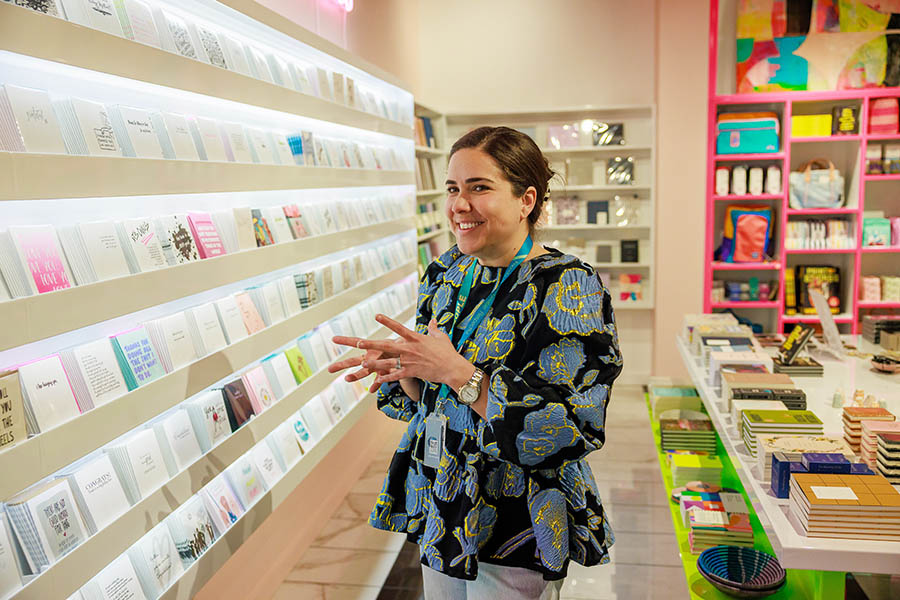
The PDX location is modeled on the brand’s flagship store in Hosford-Abernethy at Southeast 25th Avenue and Southeast Clinton Street (staffed 10 a.m. to 5 p.m. five days per week). It will offer unique and relatable cards for new mothers, cancer survivors, people in recovery and other populations. The focus on women’s empowerment is evident in its marketing as well as its business model. If you don’t consider the greeting card industry female-centric, consider that, according to Venturi, 95% of greeting card purchases involve a woman as the sender or recipient (meaning only 5% of card purchases are male-to-male).
Venturri and co. are betting big their idea takes off and the PDX store will be the first of many airport locations. Days ahead of the terminal grand opening, a sleep-deprived but cheerful Venturi talked COVID, effective greeting-card messages and why it’s important for founders to let their employees do much of the creative heavy-lifting.
OB: This seems like a big leap for any business. What led you to this point?
VV: We started out as a wholesale business selling to other stores around the world. Some people go in the reverse direction where they start a retail shop and then expand into wholesale. So we kind of went about it differently. Being a writer and writing cards, I sort of came at it that way.
Our wholesale business expanded quickly, and then in 2020, when most of the world shut down, people actually started showing up at our warehouse trying to buy cards. At that point we didn’t have a brick-and-mortar, and people were asking, “Hey, is your space open to the public? Can we come in and buy cards?”
So we saw our e-commerce spike during the pandemic — and people were showing up at our warehouse — and I just thought: We really need an avenue where we can reach our customer directly. We can’t be boxed out by other stores. We can’t have them control the narrative. Our brand is so specific, and it’s hard selling our cards to other stores because they would only carry five, or 15, of our cards. And you can’t really tell that full brand story with just a few of our styles. You really need to immerse yourself in our brand. So we sort of doubled -down on Portland and opened our first brick-and-mortar store during COVID in 2022; the reverse of what many people were doing.
And around that time, I started to research where there’s the most foot traffic in the world. I thought, it’s got to be someplace like Madison Avenue in New York City, or a place like that. But I quickly found out, it’s airports, which actually makes sense. So I did a deep dive on airports and, simultaneously, I found out that Portland is doing this massive remodel. I wanted to find out more, but you can’t just walk up and knock on the door of the airport. You can only apply when there’s an RFP. And when an RFP comes up, it’s sort of a now-or-never moment. Sort of like kismet. Things have to align.
How did you raise the money?
It was the first time we brought in outside capital. We were a completely bootstrapped
company up until that point. And first, we did a friends-and-family round to make this store possible. That was exciting and also stressful in its own right.
As a founder, it’s something that I hadn’t done. But I think that it’s really helped me sharpen my skills. To be able to get into the airport, I had to lay out my financials in a really succinct way. I obviously had to have an incredible business plan. I had to have my business audited and I had to show my numbers. So I was prepared to have those conversations. But I think for me, the scarier part was to have people in it with me. To fail on your own is one thing, but to bring people in with you, that’s the scary part. But it’s also the exciting part. People are so excited about this, and the people who have joined us for the next portion are people who watched us grow the brand for a decade. They’re people who believe in our company and they align with our values. And so for me, it feels really good to know those people are on the road with us. No pun intended.
Something like this hasn’t been tried before, at least not here. What gives you confidence it will be successful?
The Port provides every store’s revenue to you, including the pre-security stores. So we
looked at every store in the old airport, and you start to notice it was sort of this dark corridor with no visibility. But this [location] is almost unprecedented. Every single passenger will come through here. So even after running our pro forma, I actually feel like we’re going to over-index what we can do.
Can you talk about the design?
I worked with Arielle [Weedman] at Weedman Design Partners. They’re awesome and they really helped bring a vision to life. It’s tough when you’re working with an existing brand — it’s a blessing and a curse. We have a very distinct aesthetic. Our flagship store was designed by Mandy Riggar, an amazing woman designer. When you walk into that store, you very clearly see that it’s a brand. We have these floors. We have the pink neon, which is one of our signatures.
The art over here [gestures] was done by our artist in residence. We have a very robust artist-in-residence program that we run through our flagship store. Every quarter, we invite a woman artist into the space. She keeps 100% of the proceeds, and at the end of the quarter, we actually create a card line together and we distribute the card line nationally. And so that [gestures] was done by an artist named Abby Houston. And that art will rotate out quarterly depending on the artist in residence at our flagship store.

What makes a good greeting card?
Well, let’s take one from one of our newest collaborations. [Pulls a card off the wall.] This one says, “What is being alive if every moment isn’t tragic, random and magical? Happy Birthday.” So it’s like a different take on those traditional birthday cards you’ve seen. This one is by Bella, who’s a local poet in Portland. She was an artist in residence last year in our store.
There are others that I’m really proud of. [Scans shelves.] Here’s one from our Fourth Trimester collection. It says, “You smell. Your nipples hurt. Your clothes don’t fit. You kind of miss your old life. Your baby feels like a stranger. And it’s all completely normal. This is hard and you are strong.” It’s validating. It validates that new motherhood phase. The baby usually gets all the cards and the moms are sort of just crying in the corner. So it’s just acknowledging that moment.
We have lots of categories. We have cards for divorce. Cancer — we have lots of breast-cancer cards. A lot of cards for, like, “situationships” as my Gen Z’ers call it. Cards for relationships that aren’t about marriage. You know, that gray area. We have a new collection that just dropped. It’s about sobriety and recovery. This one’s great. It says, “I have just as much fun with you when you’re sober. Cheers.”
There are some heavy topics. [Takes a card.] This one’s really great. You have this hand
with really fun nails, and she’s picking up pills that say things like, “Stable,” “Mature,”
“Capable,” “Alive,” “Strong.” There used to be such stigma around the use of medications, and a card like this can be really validating.
How do you come up with a card? Is there an aha moment? Is it workshopped
thoroughly by a group?
People say, “Gosh, that must be hard.” But you know, it’s the easy part. It’s life. It’s just
observing what’s going on. I think the hardest part for me is just removing myself from the process. One piece of investor feedback I’ve gotten is, “You’re such a juggernaut. What happens if you get hit by a bus?” or — I don’t know. That’s the old analogy.
I have purposely tried to step into the creative director position and find people who can mimic and understand us and find creative partners, artists and collaborators who just embody what we’re about. And then I try to guide and shape them into writing for us so that — God willing, I’m here a long time — so that this brand can be scaled up and sold one day, which is our ultimate plan. So it’s not just me; there’s an editorial voice. I love to write but I also tried to strategically not write so much for our company. I only create
about 30% of our content now. So when investors ask, “What happens if you die?” You know, it doesn’t really matter as much.
So are there tons of messages on the cutting-room floor?
Oh, yeah. There are thousands of cards and journals and notebooks that never make it to the shelf. But actually, it’s helpful to go back through [the rejected ideas] and pull some out. We’re always doing that. There are always great ideas we can’t believe we got rid of.
Click here to subscribe to Oregon Business.