
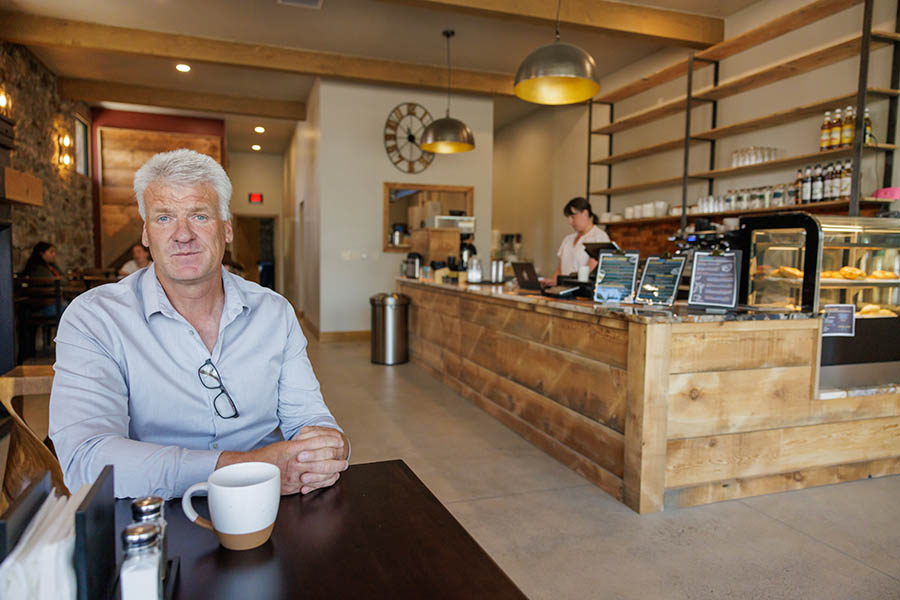
Late to arrive, money from the controversial law now funds a mix of recovery programs around the state including Burns’ Fresh Start Cafe. But progress remains slow and data and accountability lag.
Thirty-four months after Oregon voters decriminalized hard drugs with Measure 110 (and three months after legislators rolled back major provisions of the unpopular law), money from Measure 110 is fueling a transformation in Harney County.
More than one, in fact.
“We think we have a really good idea with this, and we think we’re going to be able to impact a lot of people,” says Chris Siegner, director of Symmetry Care, Harney County’s lone behavioral health clinic, which recently unveiled a novel client-based business in downtown Burns: the Fresh Start Cafe.
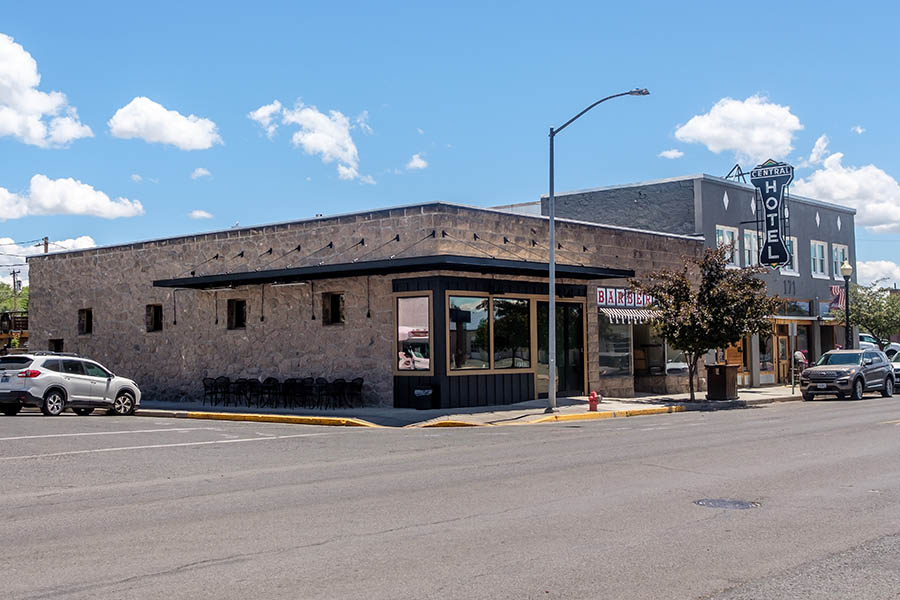
Perhaps the most obvious change is to the building itself. Constructed in 1920 at 195 North Broadway Avenue, the space was originally a general store called Smith’s Market. Then in 1955, it became a family-owned Chinese restaurant, which is what it was for most of its history, though the family in question turned over several times.
“They love their Chinese food here, which maybe you wouldn’t expect,” says Chelan Thissell-Armstrong, whose great-grandfather owned Smith’s Market. “For a lot of ranchers, it was a weekend treat.”
In 2022 Ping and John Lei retired and sold the building to Symmetry Care, which planned to convert it to a coffee shop that teaches life skills and provides work experience to people with serious mental illness and addiction. Funding from Measure 110 enabled Symmetry to purchase not only the building but a nearby fourplex to house employees. Both the restaurant space and fourplex were stripped to the studs and remodeled. The apartments got new finishes, fixtures and appliances. The cafe is now hardly recognizable with modern appointments better suited for hip Portland than tiny, windswept Burns.
While most projects funded by Measure 110 offer clean needles, counseling or methadone, the Fresh Start Cafe, which opened June 3, offers a full menu of coffee drinks and breakfast and lunch options. And despite locals who clamor about missing their Chinese food, the cafe is developing a passionate following of its own.
When Siegner visited during a soft opening, after a patience-testing two-year development process (“Nothing happens fast in Harney County,” he says), he was moved by what he saw: workers buzzing dutifully, customers enjoying their food.
“I tell you, I walked in and the reality of it just hit me in the face.”

‘Doomed to Fail’
Approved by a wide margin in 2020, Measure 110 is now widely regarded as a failure. Overdose deaths rose by 70%. Drug-treatment courts and other programs widely considered beneficial ground to a halt as public drug use soared. Portland became a punchline and a cautionary tale.
Measure 110 has two parts. And while decriminalization is that piece that drew the most skepticism from pundits, the law also allocates around $100 million per year from cannabis revenue to expand addiction-treatment services, and as critics have noted, actually getting that money to treatment providers has been a serious challenge. A January 2023 audit from Oregon’s Secretary of State found that the Oregon Health Authority was slow to disperse funds to providers, in part because of a complex and inconsistent grant-application process. A year and a half later, programs like Fresh Start Cafe and dozens of others around the state are at long last putting to use more than $300 million from Measure 110.
By the time cannabis tax dollars were finally rolled out, fentanyl — a highly potent and deadly synthetic opioid — and a form of meth health care providers described as far more dangerous than others were wreaking havoc around the state, notably in the Portland area, which was already struggling with rising rates of crime and homelessness. In fact, the timing of Measure 110 could hardly have been worse. The pandemic shuttered offices and service businesses that catered to them. George Floyd’s death fueled months of protest in downtown Portland. Fentanyl, which had already wreaked havoc in communities around the East Coast, arrived with a vengeance. Layoffs and evictions forced more people onto the street.
It was a challenging time to work in behavioral health in Oregon. And it’s not like it was easy before. Since the 1940s, Oregon has tried to move away from a model that stockpiles patients at mental hospitals and toward one that treats patients in their communities. But treatment options have never kept pace with demand, and wait lists for local providers and the state hospital in Salem have only grown.
The 2022 audit by then-Secretary of State Shemia Fagen found that the body convened by OHA to disperse the more than $100 million per year in grants had not been given the resources to be successful. That body, the Oversight and Accountability Council, was also unable to track the law’s impacts and effectiveness around the state due to a stark lack of data. Of particular note, the audit found $32 million in “Access to Care” grants was largely unaccounted for. (A later accounting by OHA found the money in question went to 66 organizations around the state, and that recordkeeping was hampered by limited OHA staff and a push to quickly get funds out the door.)
In summer 2023, lawmakers addressed shortcomings with the law identified in the audit, but it might have been too little too late. Later that year, for the first time since the 1980s, more people moved away from Portland than to it, with some former residents citing crime, high taxes and increasingly visible homelessness as the reasons for their departure. The city’s problems haven’t gone unnoticed by outlets eager to paint the city as a liberal wasteland.
When this year’s short legislative session arrived, lawmakers passed House Bill 4002, rolling back Measure 110’s decriminalization component with broad bipartisan support.
But “recriminalizing” street drugs might not be so simple. As of press time, county-level officials around Oregon are drafting local policies that would “deflect” drug users from arrest, as called for in HB 4002. But officials in the state’s most populous county, Multnomah, have drawn fire for a proposal to open a so-called “drop-off center” that wouldn’t include a health screening or follow-up services.
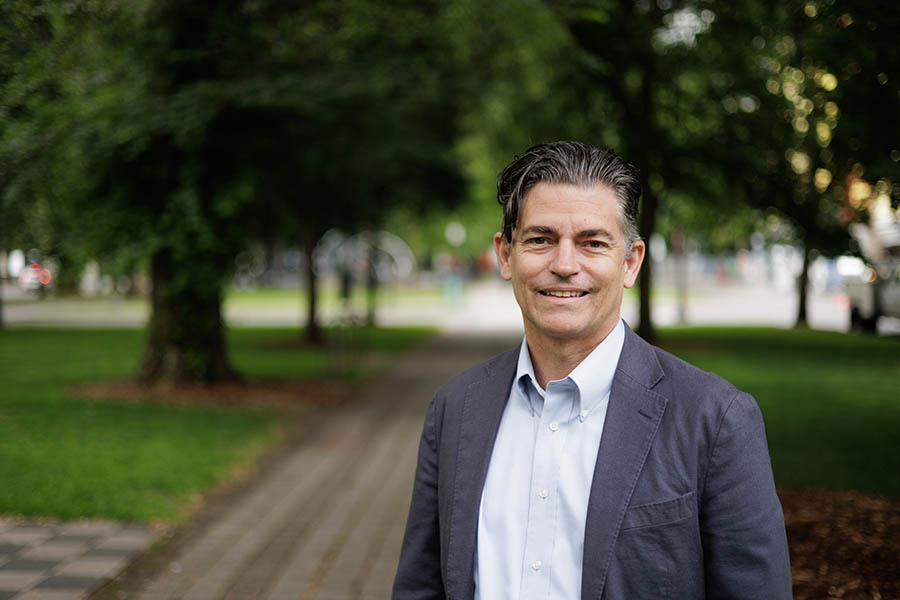
“I think Measure 110 was an important concept, but it was doomed to fail,” says Andy Mendenhall, president and CEO of Central City Concern, a Portland nonprofit that manages addiction-treatment centers, affordable-housing buildings and other programs. “We have not been able to meet the demand for people seeking treatment for substance-use disorder for years. Demand has always exceeded supply.”
“It’s easy to say, ‘These problems are all Measure 110’s fault.’ But the truth of the matter is Measure 110 took a broken system and threw it over a cliff,” Mendenhall tells Oregon Business. It probably wouldn’t have been successful even in ideal circumstances because of the gaps in shelters and housing in our region and around the state.”
Oregon has struggled for decades to adequately fund behavioral health and provide shelters and housing. Compounding matters, for the past four years, the state mental hospital in Salem has been unable to accept civil commitments, pushing people with severe mental illness back into their communities.
Mendenhall, a physician, says much of the behavior people witness on the streets of Portland and assume is related to substance abuse is, in reality, untreated severe mental illness.
“I would say, unequivocally, that a very progressive population in Portland has reached its threshold of compassion fatigue,” he says. “We live in the wealthiest country on the planet, and people are tired of seeing individuals who need to be stabilized and institutionalized and medicated, wandering the streets in a confused, disoriented state.”
There’s ample debate in the recovery community about approach. Some media outlets have focused on “harm reduction” programs that distribute clean needles and other safe drug-use supplies. Melissa Jones, the operator of Medford’s provocatively named nonprofit Stabbin’ Wagon, which received $1.5 million from Measure 110, has been especially outspoken with her views on police abolition and support for the homeless.
Tony Vezina, executive director of 4D Recovery in Portland, which specializes in harm reduction and peer services for adolescents and young adults, was personally opposed to Measure 110 because he feels some form of intervention is typically needed to spur a person into recovery.
A $5 million grant from Measure 110 allowed 4D to open new services for young adults and offer new housing vouchers to people in recovery. One-time grant money allows 4D to somewhat bypass bureaucracy when prescribing treatment, which is often when people in recovery fall back into old ways.
“In general, people agree addiction is a disease and there are different strategies about how to deal with it,” Vezina says. “Each strategy works, in my opinion, and it’s usually a combination that’s going to be effective.”
A Job Like This
Where Measure 110 was effective was in creating a pool of resources that have funded some important projects in an already catastrophically under-resourced system, though the distribution of those resources was significantly delayed. It’s increased access to detox in Southeast Portland. In Eugene it funded a drug-addiction treatment center geared to the Latino population.
To disperse Measure 110 grants, the state established a network of Behavioral Health Resource Networks (or BHRNs, pronounced “burns”). Symmetry Care is one of 12 certified community-behavioral health clinics in Oregon and also the BHRN for Harney County.
Harney is a county small in population (7,500) but enormous in area (10,000 square miles — roughly the size of Belgium). On one hand, the need there looks the same as in the metro area; fentanyl poses the same risk in Harney County as in Portland. But Symmetry doesn’t have multiple agencies to refer people to, like other BHRNs. Symmetry enrolls between 250 and 300 adults and children in services ranging from addiction treatment to care for developmental disabilities, mental health diagnosis and treatment, and even couples counseling.
The Fresh Start Cafe is the brainchild of Jason Sanchez, a clinical supervisor at Symmetry who speaks openly about his own addiction and incarceration as a youth. For years Sanchez discussed starting a “recovery cafe” where people could share their struggles without judgment and connect with services. Siegner liked the idea and suggested adding job skills and housing components. But for years the idea remained just that. Until the passage of Measure 110.
Siegner, Symmetry’s director, said after he approached the state with the idea, officials moved with a heartening urgency, and Symmetry became the first BHRN to receive funding (and it’s still the only one that’s attempted a multifaceted project like the cafe). But working with small-town governments and the state building department proved much more time-intensive, as did employee hiring and training.
Leaders at Symmetry wanted hires to take seriously the opportunity, so they held a full application and interview process. That process included making a menu item from a recipe. One man with severe mental illness and a history of addiction spent nearly an hour making a Southwestern chicken wrap, concerned that every last detail be correct.
They hired him.
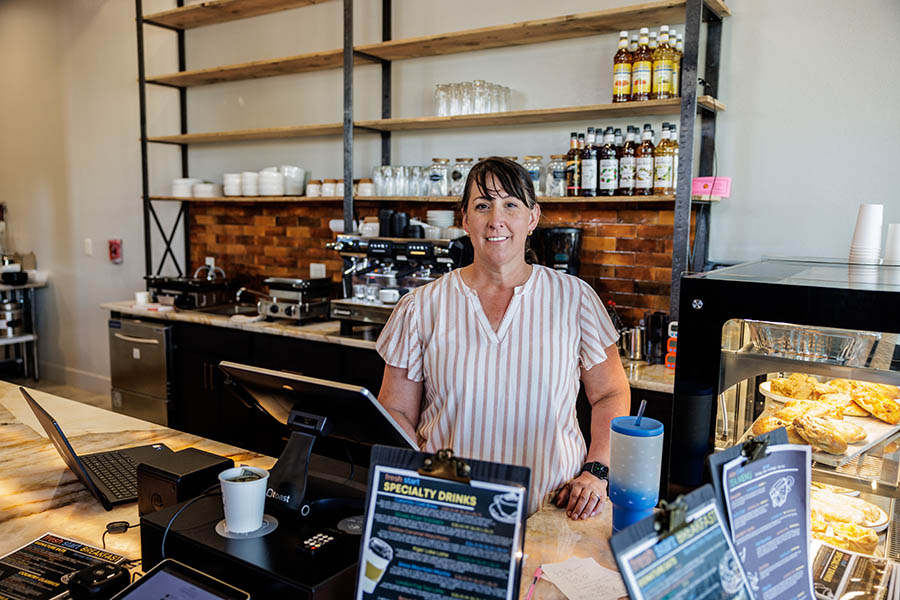
The cafe has three permanent full-time staff — a manager and two assistants. Below them are seven part-time workers, each a clinical placement from Symmetry Care. They’ll work 1,000 hours for the program before they transition to more permanent jobs and are replaced by new blood.
A paycheck from a good job can do wonders for a person’s confidence, says Fresh Start manager Stacey Radinovich.
“One of the guys who’s been with us since the beginning, since we were meeting as a group, his physical appearance from then to where he is now is just unbelievable,” she says.
A month after opening and one employee still thanks his bosses each day. That man, Tim Marchand, 55, has worked lots of places in his life but, until a month ago, not in a restaurant.
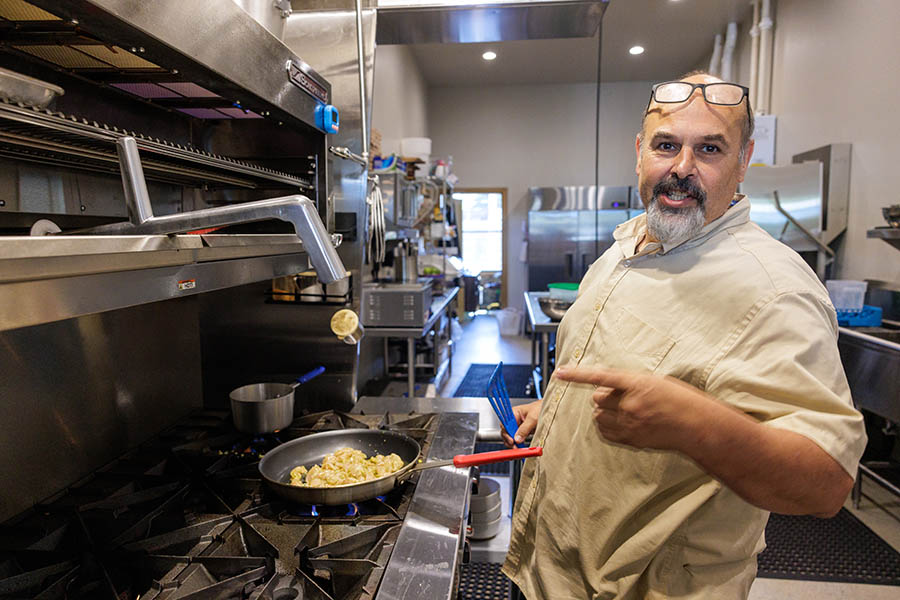
“I’ve never had a job like this or wanted a job like this. But I think I’m taking to it,” he says. “It’s pretty fast-paced, so it’s not like we’re ever looking for something to do.”
Marchand has been his wife’s caretaker since she suffered a debilitating heart attack several years ago. But a drunk-driving arrest threw that in doubt as his wife threatened to leave him.
“I’ve been met with a lot of trials, and I suppose I wasn’t able to attack them,” Marchand says. “I guess I leaned on alcohol a little bit too hard. I suppose it got out of hand.”
Radinovich says coworkers enjoy working with the affable Marchand. And though humble and kind, he struggles to recognize in himself qualities he readily spots in others.
Still, he knows he’s lucky for the opportunity at Fresh Start and he doesn’t keep that to himself.
“I feel like I’ve come a long way and it’s because of Symmetry,” he says.
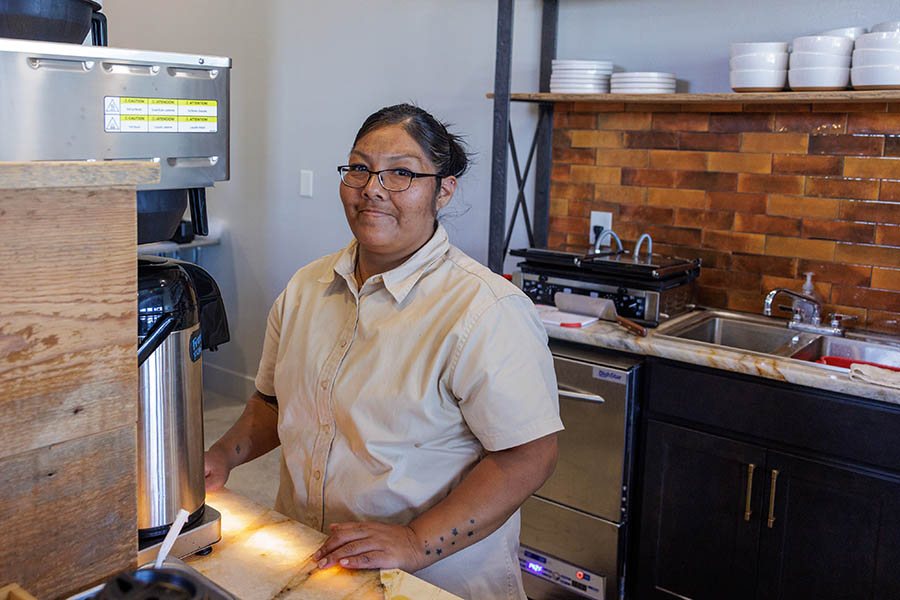
After spending half her life addicted to alcohol and drugs, Bridget Teeman, 39, has been sober now for 14 months. She’s worked hard to build back trust from her two daughters and her community. In a town as small as small as Burns and as a member of the smallest federally recognized tribe in Oregon — the Burns Paiute with 350 members — that feels especially personal.
“You have to have confidence,” she says. “And you know, the customer, they have confidence in you too. You’re making their drink, something they want to enjoy. And knowing that helps a lot.” She adds, “I can’t change what people do in this town. I can’t change other people’s actions. But what I can change is how I react — how I control my own self and my own environment.”
Funding from Measure 110 allows Fresh Start to staff a little “heavy” regardless of business in the cafe. It also funds a popular paycheck-incentive program. Staff members are drug-tested each week, and for every clean test, they earn $100. If they attend all their classes, they earn $25 on top of that. And if they’re doing satisfactory work, they earn another $25.
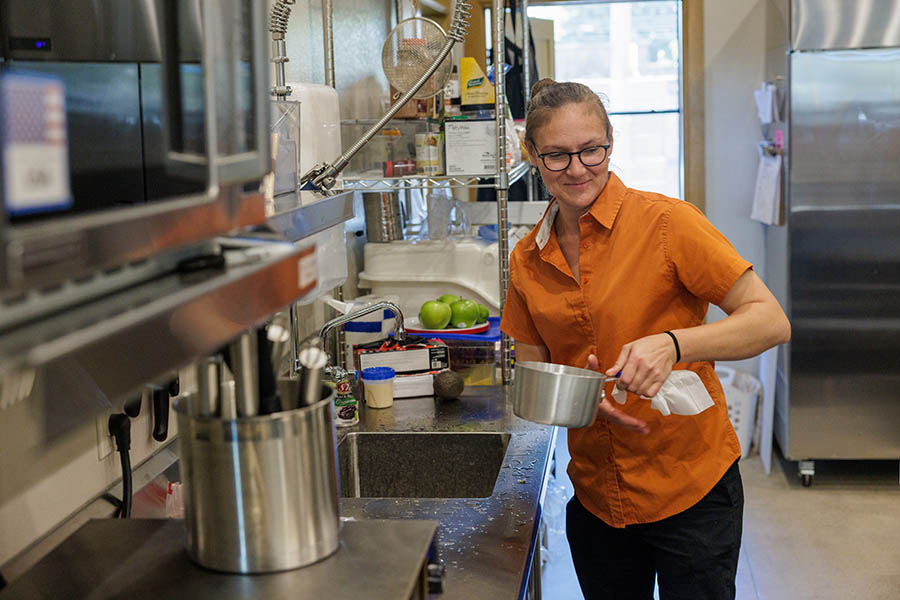
So there’s opportunity for $150 on top of a standard weekly paycheck, a fact assistant manager Chelan Thissell-Armstrong (whose great-grandfather once ran a market in the same building) has had to impress on one struggling employee.
“I told him, ‘Man, have you considered that we will virtually pay you to be sober? And I know you like money,’” Thissell-Armstrong says.
By design, Fresh Start gives employees a few more second chances than other employers might. Thissell-Armstrong is a big believer in second chances.
The youngest of three children, she was home-schooled in Burns until around third grade, when she says she became too much for her mother. “I just became like a feral child.”
At 12 years old, someone introduced her to hard drugs. Sheltered and from a small town, she assumed this was normal.
“I was about the same age as my daughter is now, which seems crazy to me — to look at my daughter and think that anybody would do drugs with her,” she says.
Thissell-Armstrong struggled with addiction for 25 years until she noticed friends in her social circle were asked to stay out of their adult children’s lives and not attend major events like weddings and births.
She didn’t like the future she saw for herself.
“It suddenly hit me that I was about to become one of these people,” she says. “I lost my daughter to [Child Protective Services]twice, and I was getting to the point where it wasn’t going to be the state making the decision; my daughter was going to start choosing to not have me in her life.”
Change can happen remarkably fast when a person starts making the right choices, she says. Thissell-Armstrong credits Symmetry Care with helping her achieve a different life. At 42 she’s been sober now for two years and was recently certified as an addiction-recovery mentor. She’s also the property manager at the sober-apartment fourplex, where she lives with her daughter, offering regular supervision and an understanding ear.
Thissell-Armstrong’s willingness to discuss her own addiction and hardship is infectious, co-workers say. It helps them express their vulnerability and share their own struggles. One employee confided things in the kitchen he’d only ever shared with his spouse.
“Chelan has turned around and become an amazing mentor to others in recovery,” Radinovich says. “I can overhear the conversations she facilitates that create so much camaraderie back in the kitchen.”
Thissell-Armstrong is still adjusting to the weight of a leadership role. “This is a crew of people that looks to me for answers, even though I don’t always feel like I have them,” she says.
One employee who’s gotten under her skin is Joe Carson. Given his impressive progress since joining the program, it hurt her when he no-showed two days in June. She knows it hurt him, too.
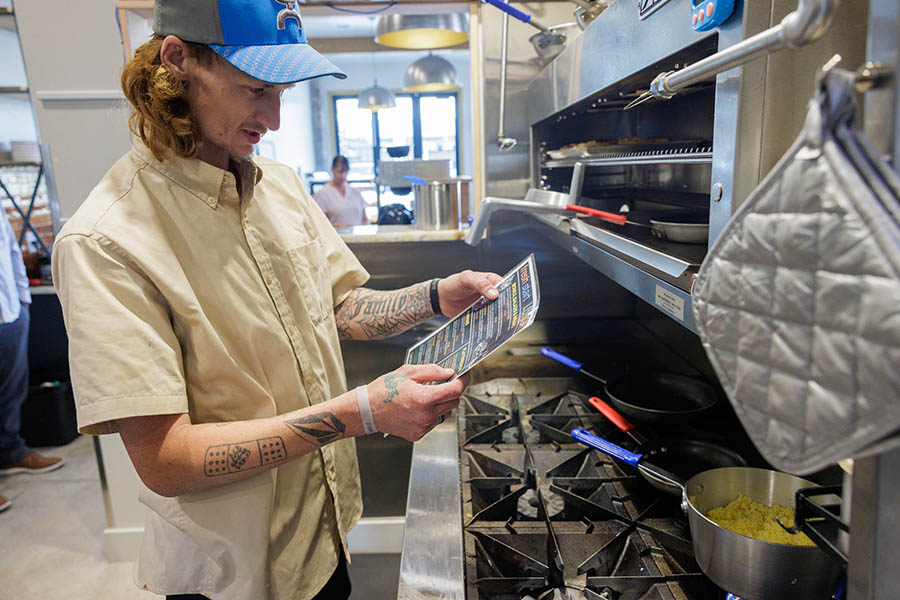
“I think he genuinely wants something different,” she says. “I have a lot of faith in him.”
In a small town, people know you by your name and by your face, and bad news about you travels fast. Shame can weigh down people in recovery and without support and a safe place to go, it can overwhelm.
Carson, 30, moved back to his hometown of Burns in 2016, and he was on his way to running his own floor-installation business until a friend introduced him to meth. He took up fentanyl around 2022, and after his best friend died of an overdose, he fell in even deeper.
Even in Burns, meth and fentanyl are distressingly easy to find.
“It just helped me forget about everything, you know, for the time being,” Carson says.
But since enrolling in Symmetry Care, he’s connected with a therapist and gotten a prescription to help deal with his anxiety. Once a month, he gets a shot in his stomach of a time-release drug that helps ease his fentanyl cravings.
He says working at Fresh Start has been one of the best things that’s ever happened to him. It keeps him from drugs and gives him confidence, support and a paycheck.
To the relief of Thissell-Armstrong, Carson’s drug-test numbers have improved and he’s on his way to that paycheck bonus.
“It helps that everybody I work with is going through the same thing,” Carson says. “We’re all addicts. When I come into work, I don’t feel like I’m being judged by a bunch of people. I’m comfortable being here.”
It’s hard to move back home after living on your own.
It’s hard to make new friends and put old habits behind you.
It’s hard dealing with anxiety and shame and grief all by yourself.
Recovery is hard work, and it never stops.
Carson would like it if his dad one day visited the cafe, so he could see how his son’s doing.
“I’m comfortable here,” he says. “This is the best job I’ve ever had.”
Click here to subscribe to Oregon Business.