
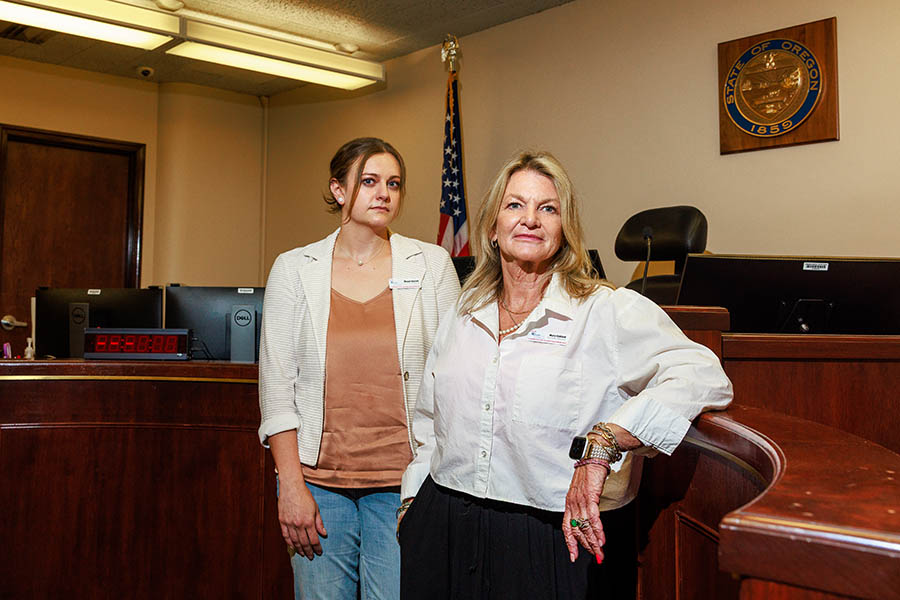
Mary Collard’s work with foster kids has always presented challenges. But funding cuts affecting CASA of Eastern Oregon, which she oversees, have presented the greatest challenge yet.
This is the third story in a package of three articles about nonprofits, published in the Q4 issue of Oregon Business. Click here to read the introduction to the package.
Mary Collard has been doing a lot with a little for a long time. But 2025 finds her doing even more, with even less, than she has in a two-decade career of working with children in foster care.
In 2002, when Collard started as executive director of CASA of Baker County, she had an annual budget of just $28,000. At that time, every county in Oregon had its own nonprofit organization dedicated to training and supporting CASAs, or court-appointed special advocates.
“I just learned by jumping in feet first and full body. I was very passionate about it,” she tells Oregon Business.
Over time Collard’s organization has expanded to serve seven counties — Baker, Grant, Harney, Lake, Malheur, Union and Wallowa — spanning hundreds of miles, and is now called CASA of Eastern Oregon. In 2023, according to publicly available tax filings, the organization brought in $458,000 in revenue but had $494,000 in expenses. The organization employs 12 staff — nine of whom are part-time — and oversees 78 volunteers serving about 300 foster kids across the eastern part of the state. That expansion happened gradually, due in part to staffing challenges — while offering a brief history of her time with the organization, Collard describes more than one situation where an executive director left the area, and the board struggled to find a new one — and to the legislative requirement that each county have CASAs available to work with kids in the foster care system.
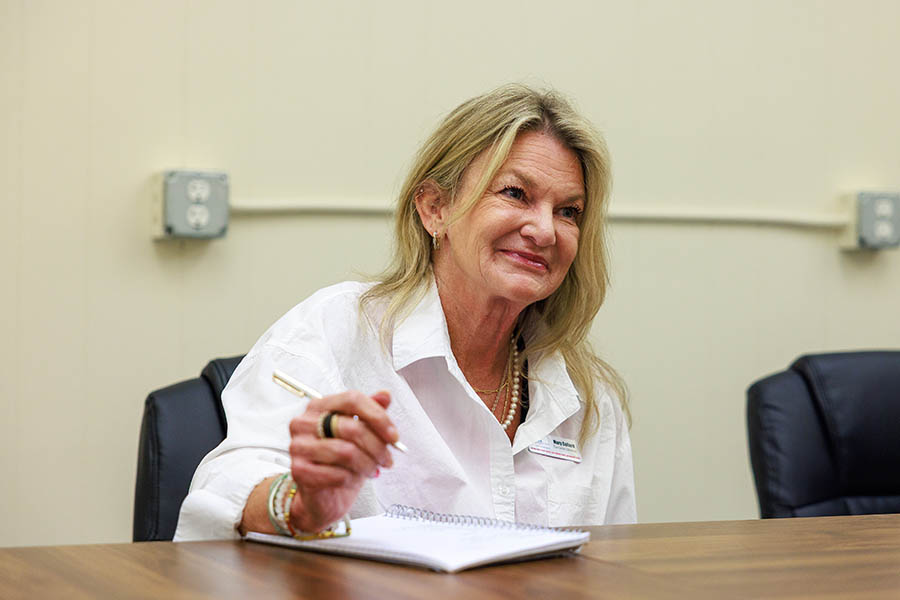
Collard started 2025 expecting to receive $80,000 in federal funds for the year; in March she learned those funds would not be coming in. That money was to come from $1.7 million in federal funding through the Victims of Crime Act and administered by the state of Oregon for all CASA organizations throughout the state but was cut by Congress in March. Federal funding that funds the national organization — and is distributed as grants to local CASA groups — did not directly affect CASA of Eastern Oregon as it was not slated to receive those grants, Collard notes. But she says those cuts will affect some of the training and programming opportunities available to volunteers in her area. Collard says she’s reduced the organization’s budget by nearly $150,000 this year to adapt to the cuts.
“This has just been a tough time,” Collard says. “This is the first time I’ve ever experienced something this drastic. With that being said, our children will never know that. It is my goal that the children that we serve will not suffer because of decisions made elsewhere.”
CASA stands for “court-appointed special advocate.” They’re volunteers who work with children in foster care and advocate for them in the court system — reviewing all relevant legal paperwork, meeting with kids regularly and advocating on their behalf in court. It’s a commitment that requires 30 hours of training and involves about 10 hours of work per month — sometimes more in the beginning of a case, and less as a case progresses, Collard says. The program was the brain child of Judge David W. Soukup, who in the mid-1970s decided kids in foster care needed more dedicated advocates in the courtroom.
According to Sally Erny, deputy chief executive officer of National CASA/GAL Association for Children, after Soukup went from presiding over a civil business court for years to a new role as a juvenile court judge, he began to struggle with the weight of his decisions.
“He talked about going home at night and, when he laid his head down, just thinking, “‘I hope I made the right decisions today,’” but having a nagging feeling he simply didn’t have enough information to do so,” Erny says. “So he had an idea to have volunteers come into his courtroom and help provide additional information.” He held a brown-bag lunch to discuss the idea soon after, and the CASA program began to take shape. CASA programs now exists in every state and in Washington, D.C., though in some states CASAs are called guardians ad litem (GAL), according to Erny.
“CASAs do a little bit of everything,” Collard says. “It is kind of difficult to describe what a CASA does exactly, because it’s going to be different from case to case, just because every child is so different and all of their needs are so different.” The key thing is having “another set of eyes on the case, another mandatory reporter checking in on them,” Collard says. Generally speaking, a CASA is only assigned to two cases at a time — either a child or a group of siblings — and that child or group of children has one person to watch over them, attend meetings, speak up for them and pay monthly visits. CASAs are also mandatory reporters, meaning they’re trained to identify signs of abuse and legally required to report potential abuse to authorities.
“Monthly child visits are huge. You build a relationship with a child,” Collard says. “I think that’s the most fun part, getting to go see your kiddo every month.”
A child in foster care does have an attorney assigned to their case, Collard says. “But when you think about that attorney, that attorney’s also got hundreds of other things going on — divorces, land disputes, DUIs. They don’t just focus on a child’s case or child welfare.” Foster kids also have caseworkers, but caseworkers also typically have at least 20 to 30 cases they are working. Judges, too, handle a variety of cases and situations throughout the day. But a CASA can focus on a specific child or family.
“Our child’s case is being listened to in the courtroom — it’s not just a case number,” Collard says. “This child has a name, has likes and dislikes.”
Much of CASA’s funding pays for the salaries of program managers, who supervise the volunteers; Collard oversees one in each county. Legally, volunteers need to have someone to supervise and train them, and Collard says it’s important that there be one in each county — someone who understands the needs of that particular area.
“They also just recruit, recruit, recruit for volunteers, just nonstop, and they do it on a shoestring budget, and they do a fabulous job,” Collard says. “Everywhere you go, we always have our CASA hats on.”
While Collard is adamant that cuts to her organization will not affect the way it serves kids, her counterparts in other parts of the state, like Betsy Stark Miller, executive director of CASA for Multnomah, Washington, Columbia and Tillamook counties, say cuts will have an effect on kids — specifically on the number of children they are able to serve — and on staff, who have not received pay increases despite ongoing inflation.
In Eastern Oregon, program directors have not had hours cut due to the funding cuts, Collard says. But she herself has. In March Collard laid herself off temporarily; now she is billing 10-hour weeks, but still effectively working full-time — logging volunteer hours for a workload that includes grantwriting, regular check-ins with program staff around the state, and recruitment and fundraising.
Beyond her own hours, Collard has closed two physical offices — one in Malheur County and one in Union County. The Baker County office has moved to a smaller space where utilities are provided.
Employees at those offices now work remotely, but in addition to workspaces, the offices served as storage for items community members donate for foster kids. Each kid, when they get moved to foster care, gets a duffel bag from CASA as soon as possible with age-appropriate items: a blanket, a stuffed animal, a book that’s age-appropriate, hygiene items (including diapers for kids who need them), socks and other items. The organization also regularly helps provide kids with things like sports gear and gifts for birthdays or Christmas. Now many of those items have been moved to storage lockers — which, while still an expense, are cheaper than office spaces — or in the case of Baker County, to a much more packed storage area.
“I mean, is it inconvenient to have to go get stuff, you know, out of a storage unit? Yes, it is. But it’s necessary right now. The Baker office, because it was downsized it looks like Santa Claus threw up in there,” Collard says, laughing. “It is so jam-packed.”
CASA of Eastern Oregon has also cut its budget for volunteer recruitment — canceling billboard and newspaper and print ads — due to budget cuts.
Fundraising from the private sector is a challenge, Collard notes, with fewer businesses in the communities her organization serves — and the fact that CASA of Eastern Oregon must compete with so many other organizations for donations. But, Collard says, local businesses in the counties CASA of Eastern Oregon serves, have stepped up, and says in recent months the organization has received a $90,000 grant from Braemar Charitable Trust, as well as grants from Ford Family Foundation and the Roundhouse Foundation.”
“The businesses around in all of our towns, they’re hit up by everyone,” Collard says. “That makes it difficult, and therefore, it doesn’t make it impossible.” Where CASA organizations in more-populous areas may bring in six figures at a fundraiser, her organization was thrilled to bring in $4,000 at a cornhole game in Ontario.
“People here love cornhole,” says Megan Van Zelf, the outreach manager for CASA of Eastern Oregon, who is based in Malheur County. “We have a silent auction. We did a snack bar. It’s not only a fundraiser, it’s also trying to raise awareness, trying to get our name out in the community. Fortunately, we have built some pretty good community partnerships over the years, but we’re always trying to do better.”

Collard is the longest-serving CASA director in the state of Oregon. Before she started working for CASA Baker County as staff, she was a CASA volunteer herself. Before that, she was a foster parent and a stay-at-home mother. (Foster parents are now called resource parents, Collard notes.)
She had had a number of foster children in her care over the years, but most did not have CASAs. Then she happened to take in two children who did have advocates and was “blown away at the difference — how smoothly their cases went, how I felt like the children had another voice besides just mine.”
“A lot of people don’t understand that when you are a foster provider, you don’t get all the information. You don’t get any of the legal information, anything like that,” Collard says. “You get whatever [the Oregon Department of Human Services] shares with you, but a CASA has all of the legal documents. They have everything, the same as the attorneys do, as [the Child Welfare Division] does. They are party to the case. And therefore, the CASA can have a broader picture of what’s going on in the situation.”
And while Collard’s work is mostly supervisory and dedicated to the big picture, her commitment to the small picture is what keeps her committed — and hopeful.
“I’m not doing it to be a martyr or anything like that,” she says of her willingness to work for a fraction of her former pay. “I simply do it because I believe in our mission so much that I know we’ll get everything built back up and be normal again.”
Early in her time in Baker County, she says, she remembers sitting in court and listening to attorneys go back and forth, referring to the youth whose case they were discussing with male pronouns.
“It was one of those names that could be a girl or a boy,” Collard recalls. “And I finally stood up and said, ‘Your honor, this is a little girl.’”
“Something that stays in the forefront of my mind is a quote by Ashley Rhodes-Courter, who wrote a book called Three Little Words — a former foster child and now a very well-known author and speaker,” Collard says. “She states that every child deserves to have at least one person who knows the color of their eyes. And I use that a lot with their advocates, because it is important.”
Click here to subscribe to Oregon Business.