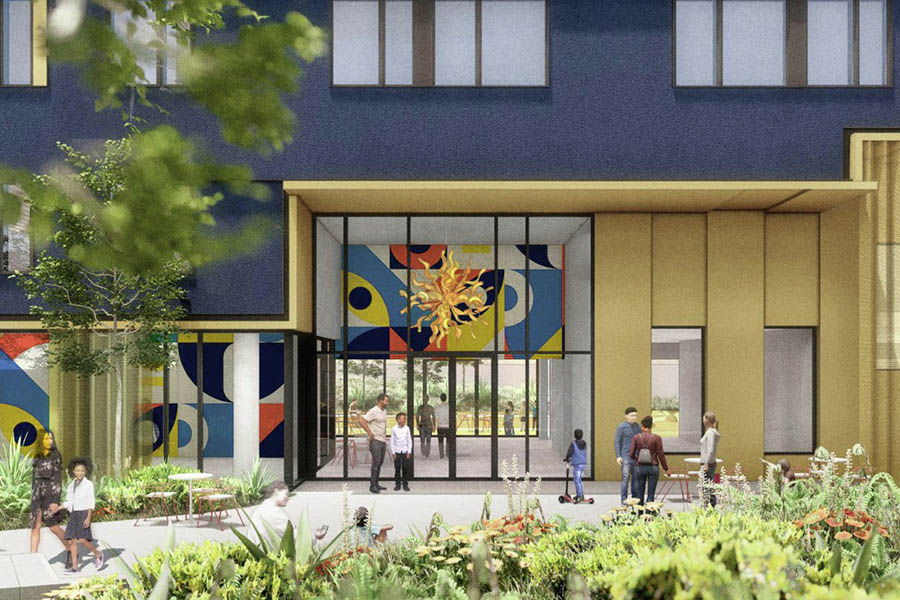
The 94-unit Albina One attempts to “re-root” Black families in the Northeast Portland neighborhood.
This weekend leaders behind an ambitious project to redevelop Portland’s historically Black Albina neighborhood will commemorate a major milestone.
The Albina One affordable-housing project will open officially with a ribbon-cutting event Saturday followed by a daylong block party featuring Black artists, vendors and community groups. It’s a key component of a broader redevelopment of 94 acres north of the Rose Quarter in historically Black Albina, a victim of urban renewal and current home to the Moda Center and Portland Public Schools administrative office.
The $66.7 million, seven-story Albina One contains 94 units, 75 of which will go to residents with financial need and a “historical connection” to the area under the city’s Preference Policy, which “aims to address the harmful impacts of urban renewal by giving preference to housing applicants with generational or historical ties to North/Northeast Portland.”
In July nonprofit developer Albina Vision Trust began admitting residents to the new building at 1771 North Flint Avenue, where 80 years ago, the sounds of the nation’s premier jazz acts used to fill the streets, and where the city’s tree-planting initiative was born.
Over the years, Black and minority Portlanders have made their homes in various parts of the city, the result of misguided urban-renewal projects, gentrification and racist redlining laws. In the World War II era, Black families flocked to Oregon to work in the Kaiser shipyards. And following the Vanport flood of 1948, many displaced residents settled in the Albina in Northeast Portland.
But that was before the construction of Veterans Memorial Coliseum displaced hundreds of residents and, later, the construction of Interstate 5 slashed the neighborhood in half in 1962. The siting of PPS headquarters and a planned expansion of the nearby Legacy Emanuel Hospital did further damage. These decisions and others wiped out whole neighborhoods of affordable housing along with cultural institutions and businesses.
Saturday’s event is meant to celebrate the first families returning to the neighborhood, AVT’s executive director Winta Yohannes tells Oregon Business.
“Albina was a model for how we can live and take care of each other,” she says.
Located near TriMet’s Rose Quarter station, Albina One features an outdoor plaza, garden, child play areas and secure bike parking. One-, two- and three-bedroom units will be open to households earning up to 60% of the area’s median income. Yohannes says the project will equitably share wealth generated through development.
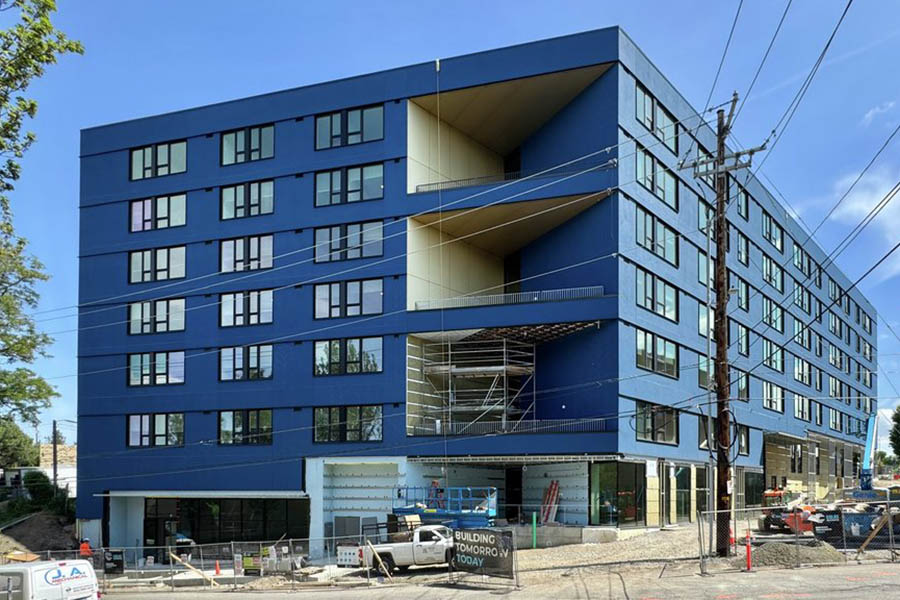
The project was co-developed with Edlen & Co. and designed by LEVER Architecture. Colas Construction was the general contractor. The project marked only the second time in the city’s history that a Black-owned construction company raised a tower crane, according to the project team.
The first was also a Colas project, a $30 million renovation of the Oregon Convention Center.
The Metro regional government provided $14.4 million for the project while its Transit-Oriented Development Plan contributed $500,000.
In his second term, President Donald Trump has tried to tie up federal grants for efforts that further diversity, equity and inclusion, or DEI, including some grants already awarded. In July Portland Mayor Keith Wilson warned that nearly $350 million in federal funds could be lost, imperiling a massive interstate project to expand I-5 in the Rose Quarter, including a cap over the interstate supported by Albina Vision Trust, which believes that cap would do a lot to repair the neighborhood.
“I don’t think of our work as DEI,” Yohannes says. “Fundamentally, economic development and building neighborhoods is local work. And the beauty of Albina Vision is that the work is long-term and intentionally so. It took 40 to 50 years to destroy a neighborhood, and it will take that amount of time to rebuild it.”
The ribbon-cutting event will be held at 10 a.m. Saturday, and a daylong “Back on the Block” party will feature Black artists, vendors and community groups. Both events are free and open to the public.
Click here to subscribe to Oregon Business.