


Firefighting foam containing cancer-causing ‘forever chemicals’ is being phased out in Oregon — but its legacy will linger.
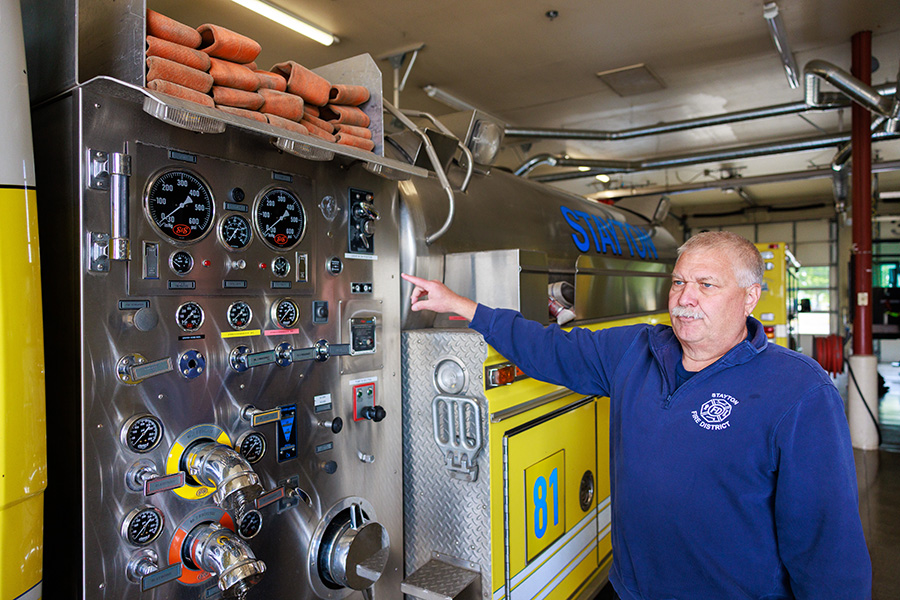
PFAS firefighting foam was common in emergency services not that long ago. But the field has a far greater focus on employee health and safety today than when Jay Alley started in the 1980s.
For decades firefighters were taught that it was as safe as dish soap. When working with it, in training and in the field, they’d often use their bare hands.
“Of course back then, three-fourths of those guys smoked like chimneys,” says Alley, now chief of Stayton Fire District. “But over the years there have been great enhancements to safety. And of course, with that comes a cost.”
Compared to even five years ago, the field of emergency services is now far more aware of the risks of firefighting foams that contain poly- and perfluoroalkyl substances, also known as PFAS, also known as “forever chemicals” because they don’t degrade in nature. Extensive and ongoing research finds PFAS can contaminate groundwater and lead to a range of human health problems. A 2016 study by the U.S. Geological Survey documented PFAS contamination in drinking water in 33 states, an estimated 45% of the nation’s tap water. Many affected communities are located near firefighting training facilities, airport hangars, military bases and industrial sites. It’s considered a major problem because exposure to PFAS is known to have harmful effects on humans, including developmental effects on fetuses and young children. Other studies point to possible links to cancer, a subject of increasing concern to firefighters, who are afflicted by the disease at a rate notably higher than the general population.
PFAS chemicals are highly resistant to heat, water and oil — properties that make them ideal for smothering fuel-based fires like those that can break out in airport hangars and garages. As a result, foams containing PFAS have been an industry standard since the 1960s, and most agencies keep small amounts on hand. But safe and effective foam alternatives now exist, and a statewide effort is underway to collect and dispose of what’s left of Oregon’s dangerous PFAS fire foam.
A bill in Salem that passed out of both chambers of the Legislature and was headed for the governor’s desk as this issue went into production has made Oregon the 16th state to ban PFAS foam and establish a date next summer to phase out all remaining inventory around the state. SB 91 passed the Senate with only one vote against. A petroleum industry group that had opposed the bill withdrew its opposition after the amendment process.
SB 91 wasn’t the only attempt to rid Oregon of forever chemicals this legislative session. A second bill, much broader in scope, House Bill 3512, targeted a host of consumer products. Supporters expected it to elicit opposition from numerous industries that rely on PFAS throughout their supply chains. And with a record number of bills before the Legislature this session, they ultimately thought the timing might be off and pulled back.

“It often takes more than one session to make sure everyone has a good understanding and is able to get behind it,” says Crystal Weston, policy director for the Oregon Environmental Council, a chief supporter of both bills. “[HB 3512] was a bit more ambitious, and with a record number of bills, it was just a bit harder to get over the line.”
Sen. Janeen Sollman, sponsor of the “foam bill,” SB 91, learned about efforts in other states to ban PFAS at a 2024 legislative conference. Back home, she went on ride-alongs with local fire agencies and learned they’d already phased out their PFAS foams, and that the Port of Portland had switched to a safer alternative at Portland International Airport. She wanted to ensure all remaining foam containing PFAS is phased out, as well.

“We need to do all we can to protect those who protect us,” she tells Oregon Business.
With a July deadline, SB 91 would allow agencies to use up existing stock, then purchase new foam that doesn’t contain PFAS, which is now readily available. For companies that want to transition sooner, a number of private businesses assist with PFAS cleanup and disposal of existing stock. The formal job of collecting and disposing of the state’s remaining PFAS fire foam would fall to the Department of Environmental Quality, which has a plan for collection and disposal involving the Columbia Ridge Landfill in Arlington.
Elimination Factor
For its fire- and water-resistance, PFAS are found today in many consumer products from waterproof clothing to carpets to nonstick pots and pans. These chemicals are also highly mobile in the environment, which allows them to travel easily through soil, water and air. Over time, they build up in the environment as well as in human bodies, and they’re now known to cause severe risks to both.
PFAS firefighting foam, developed in the 1930s, is so common today because it’s so effective, according to Karl Koenig, president of the Oregon State Firefighters Council, which represents most of the state’s firefighters.
“There’s just nothing else that works as well,” Koenig says. “But what makes it so effective also makes it so harmful in nature.”

Tracking down the last remaining PFAS foam won’t be easy. By this point, most of Oregon’s more than 300 fire stations have already switched to safer alternatives. This includes all of the heaviest PFAS users, like Portland International Airport, one of the first major U.S. airports to move entirely to the P3 alternative. Last year the Pentagon started phasing out PFAS at military installations, which helped the Klamath Falls International Airport — co-located with an Air National Guard base — receive funding to replace its PFAS fire foam.
Fire agencies around the country had been waiting for the federal government to approve an alcohol-free substitute foam. When the federal government approved Silv-Ex Class A foam in December, Redmond Municipal Airport, the state’s fourth-busiest commercial airport, contracted with a third-party cleaning company to remove its PFAS fire foam.
“It was quite the procedure,” says Dustin Miller of Redmond Fire & Rescue, which performs fire service at the Redmond airport. “And it was ridiculously expensive.”
Switching out 1,000 gallons in total — including 420 in its main engine and 200 in its backup rig — cost around $56,000.
The last remaining PFAS fire foam in Oregon is likely squirreled away in 5- to 10-gallon jugs in some of the state’s smaller mom-and-pop fire stations. Fire engines often came preloaded with it, and PFAS may be contained in an untold number of disused apparatus rusting around the state, Miller says. He knows of one old foam trailer near La Pine once owned by the Burlington Northern Railway that likely still has PFAS fire foam.
What to do with PFAS foam after it’s located is another problem. Manufacturers like 3M and Johnson Controls offer incentives for trade-ins, but this method isn’t favored by environmental advocates, who say it merely transfers the problem to other locales. The same is true for disposal in local landfills, which can allow PFAS to leach through into waterways, groundwater and wastewater streams.
The region’s wastewater-treatment facilities aren’t equipped to treat complex chemicals, according to Priya Dhanapal, the City of Portland’s deputy administrator of public works. The problem is inherent in PFAS’very design as ”forever chemicals.” Current wastewater-treatment technologies are unable to destroy the strong carbon-fluorine bond.
“This presents a significant challenge for public utilities, whose services are impacted by PFAS pollution from industries, businesses, and households,” Dhanapal writes in testimony to state legislators. “In addition, improper disposal of PFAS-containing materials can impact both drinking water and wastewater, as we’ve seen across the country.”
A 2024 study testing data from 21 Oregon wastewater-treatment facilities found that landfill leachate discharges more total PFAS than all other industrial categories evaluated combined, according to the Oregon Association of Clean Water Agencies.
Nationwide, the Department of Defense has identified more than 700 sites where PFAS has leached into groundwater, including 11 in Oregon outside military and National Guard installations. A $3.2 million cleanup is underway at McNary Field in Salem, and the Army plans to perform smaller cleanups at Camp Rilea near Warrenton and the Pendleton Armory.
As Miller of Redmond Fire & Rescue notes, a more difficult task might be to find an airport in Oregon that doesn’t have PFAS in the soil.
“It was in heavy use for decades,” Miller says. “We trained on it. So it’s there, even if we can’t see it. And it’s going to be around for a while.”
Gearing Up
After collection and disposal, much work will remain to rid Oregon of forever chemicals. That’s because PFAS is found everywhere in society, from cosmetics to furniture to packaging. And because of its exceptional heat-resistant and water-repellent properties, PFAS is also commonly found in firefighting gear.
Exposure to PFAS chemicals, even in small amounts over time, has been linked to serious health effects including thyroid disruption, liver damage and reduced vaccine response, according to the Environmental Protection Agency. Other health impacts include high cholesterol — which is notable given cholesterol’s connection to heart attack, the leading cause of death among firefighters. A study by the Department of Health and Human Services found a link in PFAS in firefighter turnout gear to cancer, which firefighters face at a rate 14% higher than the general population.
At the moment, fire agencies around Oregon are replacing their gear in a piecemeal fashion as equipment reaches the end of its life cycle. All told, outfitting one firefighter costs between $5,000 and $7,000.
“We’re always trying to keep our people safe,” says Jay Alley, Stayton fire chief. “I can justify the cost if I replace items as they wear out. But I can’t justify carte-blanche throwing everything away and starting over. Gear’s not cheap to start with.”
Click here to subscribe to Oregon Business.