
Miller talks about what looming federal funding cuts mean for Oregon: ‘The bottom line is, the only people that really are getting hurt are these kids.’
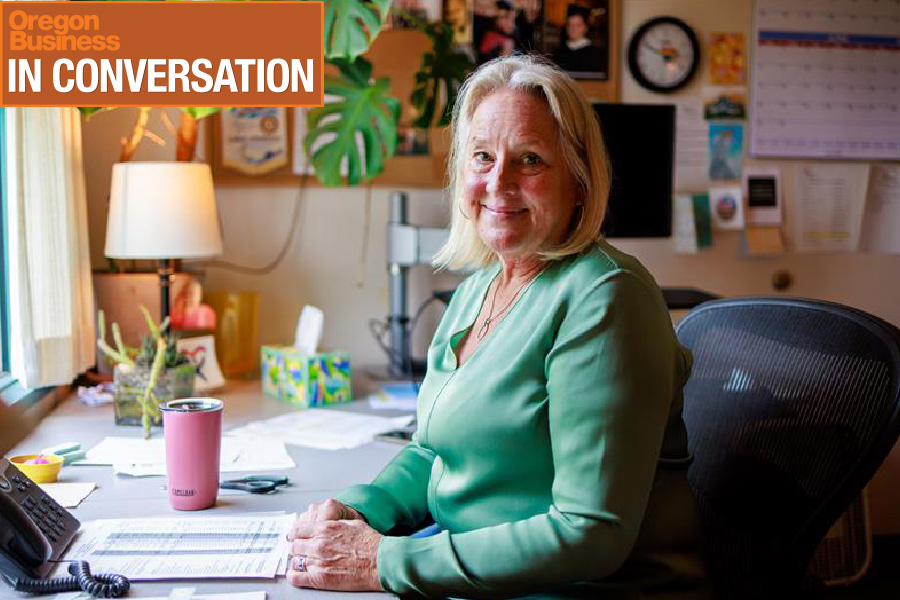
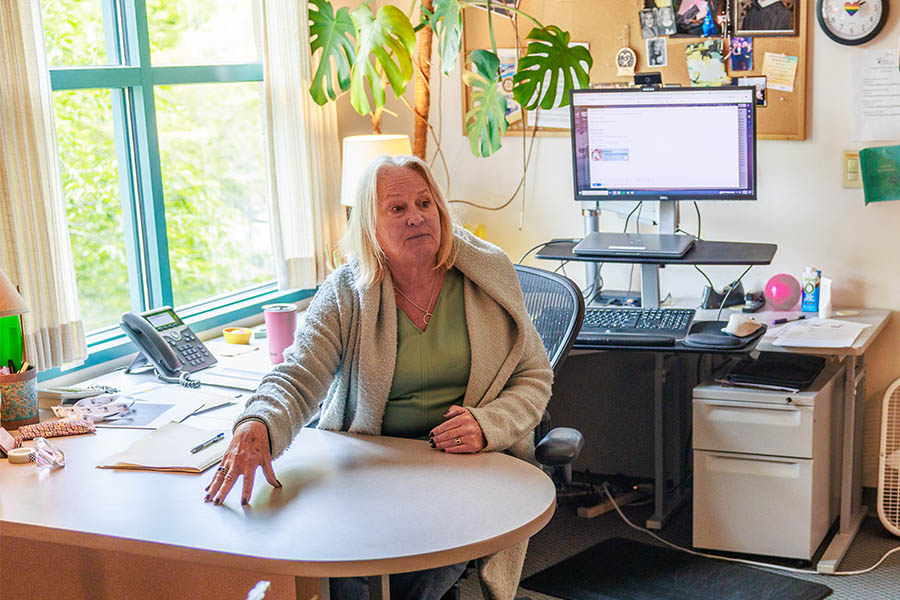
On a recent sunny weekday, one wall of Betsy Stark Miller’s office in the Multnomah County Juvenile Justice Complex in the North Tabor neighborhood was covered with a mockup of table assignments for an upcoming fundraiser.
A key concern for any nonprofit director, fundraising has taken on added significance for Miller in the past few months. A $50,000 grant approved earlier this year was suddenly revoked by executive order of President Donald Trump.
Miller throws up air quotes when she tells Oregon Business her organization — one of 950 in the national CASA network — is “lucky”that it hadn’t done anything with its allotment before the money was pulled away. Other groups around the country had spent or otherwise budgeted their grant dollars on programming or new personnel, commitments they now have to walk back.
Though he didn’t campaign on reforming juvenile justice, last month Trump abruptly terminated nearly $50 million in funding for nonprofit organizations that match Court-Appointed Special Advocates (CASAs) and guardians ad litem to neglected and abused kids and people with developmental disabilities.
Guardians ad litem and CASAs play a unique role in the justice system. They’re often the only person looking at a child’s case holistically, and for the life of a case, which can take years.
The largest and longest-serving of Oregon’s 20 independent CASA programs, Miller’s organization — CASA for Multnomah, Washington, Columbia and Tillamook Counties — served around 950 kids until recent budget cuts dropped that number to 850, though need stayed the same. The $50,000 grant was going to help claw some of those kids back.
Getting there might now have to involve Oregon taxpayers and private donors footing a greater portion of the bill. So lately, Miller’s been honing her pitch, though she admits she struggles sometimes to put into words how she feels — the importance of her mission, the value proposition for donors, the impact a CASA can have on a child — all while trying to avoid politics.
This interview has been edited for length and clarity.
What’s a CASA and what do they do?
A CASA is a Court-Appointed Special Advocate. They are volunteers, which I think is really important to note. They’re trained by CASA programs like ours to advocate for children while in the foster care system. A simple way to define a CASA is that they’re the eyes and the ears for the judges to gather as much information as they can about what’s been going on the case, from all parties, and compile it in one report that they then submit to the judge at the beginning of hearings.
Do you have a good anecdote about the kind of impact a CASA can have?
Gosh, there’s so many.
The CASA that I’m thinking of had a 12-year-old youth, and the youth refused to engage. They were housed outside of the city of Portland. The CASA drove every month — that’s their job, once a month, to visit the child. This child finally got moved into a placement in Portland. They were 15, I think, at the time. The placement did not work out. They were saying, “Well, now you’re going to live under our rules,” which is a normal thing for a resource family to do. But the CASA said, “Look, I think this child is best in an independent living program to help them become independent, because at this point there is no adoption. There is no guardianship.”
So in this particular case, eventually this CASA got to know this youth so well that they became almost a mentor-mentee relationship, which is not what they’re designed to do, but it evolved into that. The youth finished high school, got their GED, in fact, and then went to university.

What kind of person becomes a CASA?
Anyone 21 and older. No kind of background or education required. That’s what makes it so cool. That’s actually probably what makes it work so well. We have professionals. We have people who’ve retired. We have young people. We’ve got some students.
We try to match the child to a CASA with similar racial, ethnic, socioeconomic or religious backgrounds. Let’s say it’s an African American youth, we’d like to have an African American CASA for that youth. But anyone who is 21 or older. Any career, or no career, we’d love to have you be a CASA.
One thing to note is that because of the pandemic, all of our trainings are now virtual. So because of that we’ve seen our demographic change. It’s usually a lot of people like me — slightly older than middle-aged white women who are retired. Now we see more people in their 20s and 30s. It’s incredible. Even though they have less lived experience, the lens that a young person brings is pretty profound on these youths who are sort of tired of people like me trying to live their life. I mean, we all love our moms, but at some point (shrugs) … So it’s really helped with our advocacy. It’s been great.
What will the recent cuts mean for volunteers?
That’s the gut punch, I think, for our nation. The bottom line is $25 million of pass-through funding is no longer available.
There are programs in our nation that rely heavily on the (Office of Juvenile Justice and Delinquency Prevention) dollars to run their programThis means those children are not going to have an advocate do all those things that I was just talking about. It’s going to hit a few of our programs — not real hard but hard enough. It’s still going to hurt.
The bottom line is, the only people that really are getting hurt are these kids. Because now these programs are going to have to downsize. We already were predicting to downsize from serving 905 kids for this fiscal year, which ends in July, with a little under 500 CASAs. And we’re going to decrease our number to 850 this next year because of the funding deficits this year.
And this year, no one on the team is getting a salary increase, and they know it. That’s a big deal.
No cost of living adjustment?
Nothing. And they’re getting decreased support with their insurance, because we can’t afford it. We’re closing our office in Columbia County, and the two people there are going to work from home. This is in direct relation to federal funding and some state funding not coming through.
Are there larger plans you’ve had to scale back?
Yes. So my commitment has always been to serve every child. And we have roughly 1,300 kids in our four counties to serve. So I’m always talking about growth, because that’s our job. Our mandate is to serve every child. But when 24% of our $3 million budget is from the state of Oregon, and the federal funding has now been cut … It means my team is not going to be able to grow in terms of serving kids. And I’m not going to be able to change that.
But I think it’s important to note something about our team, and it’s not surprising but is remarkable. Not one person quit. Because this is happening everywhere. Nonprofits all across the nation that we interact with — mental health services, medical services, family services, domestic violence services, sex abuse services — all of them are getting hit and have to serve fewer kids.
Even after Trump’s election, did you see this coming?
No, because we were so hopeful that the lawmakers were going to follow through with what they’d said they were going to do. You know, we nonprofits have to be eternal optimists; otherwise we couldn’t do our jobs.
Trump was president before. What was it like under his first administration?
His first administration didn’t touch us. They left us alone.
So why should state and federal tax dollars go to groups like yours?
Well, one, simply put, it’s a mandate. It’s in the (Oregon Revised Statutes). State lawmakers in Oregon said in the ‘70s or ‘80s that every child shall have this.
What about federal tax dollars?
There’s CAPTA, Child Abuse Prevention Treatment Act. It also states every child shall have a CASA. So there’s a federal and a state mandate that says these services shall be provided.
And it’s an uncomplicated service in terms of who gets it. It’s very specific and very finite in a child’s life. And by the way, they haven’t done anything wrong. It’s because their families have struggled and they need some help.
But it’s much broader, deeper than that. When you say that you’re going to support these children at the most critical time in their life, and then you say, ‘oh, you know what — never mind. We’re not going to provide services for these kids.’ What’s going to happen to them? I know what’s going to happen to them.
For children in foster care, drug abuse and alcohol abuse are two of the top reasons people lose their kids. So then you have to ask this question:where do we start fixing? We’re not the at the top of the stream. We’re further down. We come in once the kids have been removed. For some reason, the state and the federal government said we have to put a dam here to help these kids before they get further down the stream, because further down the stream is incarceration.
And if you were to visit MacLaren (Youth Correctional Facility), over 85% of the youth were at one point in foster care. And what came first? It’s the chicken-egg thing. When you get a child with an advocate, it helps these kids from going from dependency to delinquency.
Why did you get into this work?
There’s a lot of different reasons. But I’m going to focus on this — I used to work at a nonprofit that provided residential mental health services for children, and I would go down to the residential program, and there would be these people who’d show up to meet with the kids, and they were CASAs.
So one day, I asked them to talk to me about their work. And I was so intrigued that here we are working hard and we’re getting paid but not a whole lot. And here were people giving their time from their day to invest in children they may not ever see again, because they believe in the cause. They believe in community, and they believe that these children are the future of their community. And they believe that every child has a right to have a healthy, safe place to call home.
Click here to subscribe to Oregon Business.