
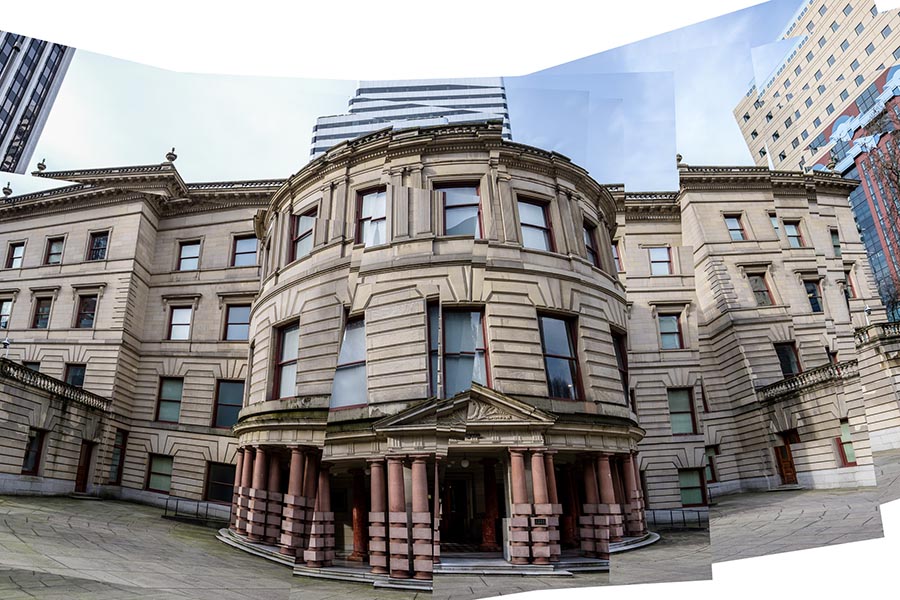
Elected leaders confront a projected $27 million shortage; Mayor Wilson walks back his plan to return city workers to downtown.
Officials in a newly transformed Portland City Hall are preparing for a season of budget cuts thanks to a projected $27 million budget gap that’s expected to keep growing.
Freshly sworn-in members of the Portland City Council, which was radically revamped by a voter-approved charter, have been briefed on the shortfall in their first meetings of their term, which began this month. The gap is the result of expenses growing faster than revenue and historically low increases in assessed property values, according to the city Budget Office.
To stabilize finances, department heads have been asked to look for areas to cut ahead of the budget year that starts July 1. Some members of the council have asked the city’s fire and police bureaus to prepare to make cuts as a show of “shared sacrifice,” despite public safety being exempt from other recent belt-tightening rounds in Portland, Willamette Week reported.
Sky-high office vacancy rates have fueled the dive in property tax assessment, while income from Portland’s 2.6% business license tax has also decreased. These revenues have sunk as expenses continue to rise due to inflation, rising health care costs, legal obligations and pressing infrastructure needs, according to the Budget Office.
The emerging stark budget situation has coincided with a radical transformation in Portland’s form of government. Voters rolled the dice in 2022 and approved a dramatic overhaul of both the way voters select city councilors and the form of government amid several crises and distrust of the city’s leaders.
Under the new form of government, the city council’s duties have shifted toward policymaking rather than management, as under the prior system. The new body faces many entrenched issues including homelessness, overdose deaths, inadequate transportation infrastructure and the need for more affordable housing.
Among the changes:
- The council is made up of 12 rather than five councilors. They represent four geographic districts — three representatives elected from each — rather than serving the city at-large, as did prior councilors.
- The mayor has a seat near the council dais but votes only when the council is deadlocked and holds no veto power. (The responsibility to cast a tie-breaking vote does not apply to the selection of a council president; this matter came up at the Jan. 2 meeting.)
- A city administrator — a new unelected official — now oversees the city’s two dozen bureaus and 7,000 employees alongside a team of a half-dozen deputies. The city administrator is appointed and overseen by the mayor. The city’s inaugural administrator, Michael Jordan, has worked various positions in public administration in Oregon including stints as Portland’s director of Environmental Services and as the chief executive officer of the state’s executive branch.

Newly-installed Mayor Keith Wilson found out days before taking office his campaign promises could face pushback, as reported by Oregon Public Broadcasting. Wilson, who campaigned on revitalizing downtown, mentioned on a conference call with around 1,400 city employees that he wants them to work from the office at least four days a week. (Employees are currently required to work 20 hours a week in the office.) The comment caused a stir among employees and Wilson ultimately walked back the plan.
(In another blow to downtown vitality, Hoffman Construction, the state’s largest privately-owned business, will move its headquarters from the Fox Tower to office space in Lake Oswego.)
The new city council’s first meeting on Jan. 2 offered hints at what factions could emerge. One of the first orders of business was selecting a council president, a newly created position expected to hold considerable sway in the new system. The president will have a hand in crafting the council’s agenda and determining which issues are discussed, according to guidelines approved by the council earlier in the meeting.
In choosing the council president, the council took 10 rounds of voting before eventually selecting Elana Pirtle-Guiney. Representing North and Northeast Portland, Pirtle-Guiney previously worked for the AFL-CIO and as adviser to Govs. Kate Brown and John Kitzhaber. She’ll serve as council president until the end of the year. A new president and vice president will be elected in January.
Pirtle-Guiney was seen as a compromise pick following an initial deadlock over Candace Avalos, who was favored by more progressive members of the council, and Olivia Clark, who’s supported by members of the business community. In the end, Councilor Mitch Green shifted his stance and joined moderate colleagues who supported Pirtle-Guiney.
Councilor Tiffany Koyama Lane was elected unanimously to serve as council vice president.
Supporters hope the new government improves accountability and outcomes. Voters in 2022 scrapped the city’s old system by a wide margin amid several crises. The reform package was drafted by a citizen-appointed charter commission.
Fewer than 50 U.S. cities use ranked-choice voting and only about a half-dozen employ a version of multi-member districts. No U.S. city uses the precise hybrid system approved by voters though several use similar models, the Oregonian reported.
Portland’s prior system of government was unique as well. In it, individual council members acted as administrators over city departments. The system was created in 1913 and withstood several overhaul attempts until several crises befell the city in the wake of the COVID pandemic.
Click here to subscribe to Oregon Business.