

Former CNN executive Rachel Smolkin stepped into the CEO role
at Oregon Public Broadcasting last fall. Here’s what she wants to do.
There were moments on Election Day 2024 when Rachel Smolkin felt like she was right back at her old job.
“I felt a little twitchy all day, like I should be up in the control room,” she says. “It was different.”
Smolkin recently left CNN, where she helped drive the national conversation as head of digital news. In September she started as CEO of Oregon Public Broadcasting, a nonprofit regional media company whose soaring fortunes have contrasted with the decline of local newspapers and other traditional information sources in the Pacific Northwest.
A childhood fan of “Sesame Street” and “The Electric Company,” Smolkin, 50, tells Oregon Business she was drawn to OPB due to its financial health and public mission, a mission that’s long involved serving areas that lie beyond the boundaries of major media markets. Only now those parts of Oregon are rapidly expanding and have come to include some of the state’s marquee locales: Eugene, Bend, Ashland, Medford, Klamath Falls.
After two months on the job, her imprint was already visible to those who knew where to look. For one, OPB’s televised election coverage last year employed the lower-screen news crawl — a feature more commonly associated with cable news than public broadcasting — to much fuller effect. OPB also now holds an all-staff meeting each morning, during which department heads share what their teams are working on. It’s another element she brought over from her old job, but Smolkin thinks the meeting underscores what public broadcasting is all about.
“I love the richness that OPB offers,” she says. “We have a very strong news department, and we also have strong coverage in arts, culture and history, and we’ve got some really good graphics and data work. People need that mix.”
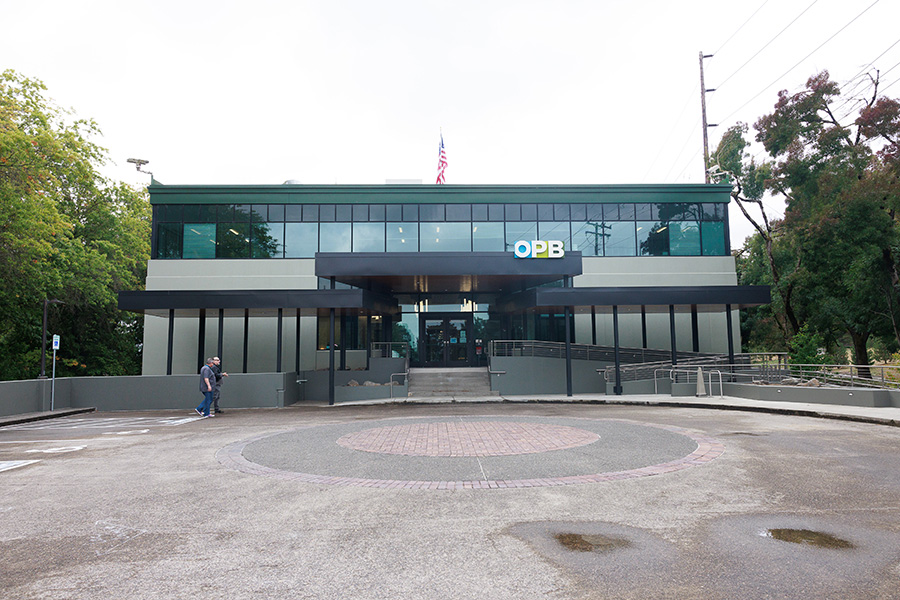
OPB has come a long way since 1922, when a physics instructor at what’s now Oregon State University built a transmitter to teach students about radio frequencies. Following a successful test broadcast featuring the Corvallis High School band, the instructor, Jacob Jordan, applied for a broadcast license. The station that would gradually morph into OPB began broadcasting in January of the following year.
The operation Smolkin inherits is a sprawling modern media company that produces popular radio (294,000 weekly listeners) and TV (447,000 weekly viewers) programming, and maintains the largest newsroom in the state. And unlike a lot of news operations, OPB appears to be on sound financial footing, per regular audits, with an annual operating budget of $51 million and an endowment of $95 million. Since the Great Recession hit in 2008, OPB has only added staff, while other local media outlets have contracted or folded. It today employs 230 people, 90 of whom are paid to create content.
Smolkin’s predecessor, Steve Bass, who retired in 2024 after 18 years as CEO, is credited with taking an organization focused primarily on TV into the digital age. He modernized OPB’s main Portland office, developed a sizable — mostly older and educated — subscriber base and diversified funding sources.
The last point is crucial as OPB’s revenue share from the government — around 9%, all of it from the federally funded not-for-profit Corporation for Public Broadcasting — is small compared to other public media outlets, many of which receive up to 30%. The existence of a robust subscriber base also provides more certainty amid uncertain government funding cycles and regular calls from the political right to defund public broadcasting.
That 9% is still important — important enough that Bass flew to Washington, D.C., to introduce his successor around to his contacts at CPB. It helped that Smolkin already lived there and is no stranger to high-pressure situations, Bass tells OB.
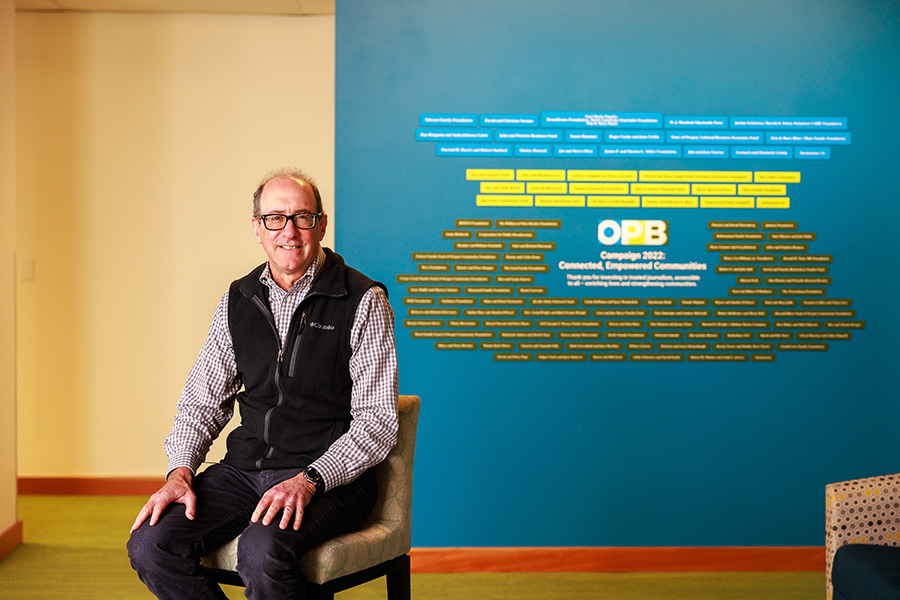
“She comes across as very warm and very personable,” says Bass. “At the same time, I think there’s a toughness there that’s going to be needed.”
Growing up in Clear Lake City, Texas, between Houston and Galveston, Smolkin says she watched PBS all day and loved two things: storytelling and theater. “My interests haven’t changed since I was a girl, really,” she says. “They’ve just evolved.”
In addition to her most recent stint at OPB, Smolkin’s résumé includes stints as assignment editor at USA Today and managing editor at the American Journalism Review. Among her lofty goals for OPB, she hopes to expand the network’s physical presence in the Pacific Northwest, hold more in-person events, strengthen content partnerships and “connect” OPB’s content spaces. She aims for nothing less than for OPB to serve as a national model for regional public media organizations.
“This is an excellent organization and we have the potential to be even more,” she says with a smile that can fairly be called intense. “And that was incredibly exciting for me.”
(OPB declined to disclose Smolkin’s salary, and she’s new enough that the figure does not appear in online financial records. In 2023, Bass earned just under $500,000 in total compensation, according to the organization’s IRS filings.)
Though Smolkin was formally hired by the OPB board, Bass assisted as adviser and candidate interviewer. He and Smolkin connected while discussing the public broadcasting mission and OPB’s member model. Bass tells OB he likes that she went back to school for an MBA, something not many working journalists do. She’ll need business savvy, and hustle, to work her new donor base, because OPB has a lot of donors — more than 150,000 per year on average, the vast majority of them from Oregon and Southwest Washington.
That number is large but not unheard of in public media, which often serves as a conduit for small-donor philanthropy, according to Damian Radcliffe, a University of Oregon professor who studies the media business.
“One of the things that public media has done so well over the years has been building this sense of membership and ownership,” Radcliffe says. “People who donate want to ensure there’s accurate news and entertainment available to everybody rather than just those who can afford to access it. That’s a lot of why people fund journalism as individuals — because they see the value it has not just to them but to society as a whole.”
For the past two decades, commercial journalism has been rocked by a series of seismic shifts. Newspaper jobs in Oregon dwindled from 4,747 in 2001 to 1,122 in 2023, according to figures reported by The Oregonian in July. There’s hardly a traditional newspaper that hasn’t had to reduce page counts or publication days for print editions. (Local magazines, including this one, are not immune: OB reduced its print run from 10 issues to eight in 2024, and will begin printing quarterly in 2025.) According to Radcliffe, the outlets that remain produce fewer stories. The stories that are produced have fewer sources. The sources that are used are less diverse.
Since 2022 researchers and students at UO’s Agora Journalism Center have studied the local news ecosystem and revealed deep deficiencies around the state. They found, for instance, underserved populations like Salem’s large Hispanic community rely more and more on social media and personal networks, while Facebook groups increasingly act as community news sources. The upside is Oregonians turn to diverse sources to get their news — TV, radio, newsletters, blogs, subreddits and podcasts — potential good news for outlets that produce content on multiple platforms.
Bass watched with alarm as his competitors in the newspaper industry struggled, and he waited for OPB’s donor revenue to drop. It never did. Though individual donation amounts declined slightly in the wake of the Great Recession, the number of new OPB donors more than made up for it. On his way to growing OPB’s donor base by around 50,000, Bass learned monthly donors were highly loyal, and many chose to give in small amounts.
“I never really thought that OPB would become a primary source of news,” says Bass, 67. “I really felt like newspapers and TV stations were going to keep doing, what they were doing and there was always going to be a vibrant news ecosystem. That turned out to not be the case, and you have to adjust.”
Compared to for-profit news outlets, nonprofits enjoy a few innate advantages, notably tax-exempt status and a revenue model less dependent on the whims of advertisers and even subscribers. In an era of shifting media fortunes, the nonprofit model is becoming more popular (see sidebar, “Going Paperless“).
The membership-funding model is thought to decrease reliance on ad revenue while keeping papers from imposing paywalls. It’s a model not unlike the one public media has used since at least the days when Smolkin watched PBS in her childhood living room.
In times of uncertainty and shifting fortunes, this represents a distinct advantage.
“Our model is free, independent journalism accessible to all,” Smolkin says. “That accessibility piece is really important. And it’s only possible because of the strong support we have from our member community.”
In recent years, OPB has expanded its digital offerings to include immersive podcasts, a daily “First Look” newsletter, a streaming app, and enterprise reporting collaborations with NPR and ProPublica.
Smolkin is willing to sound off on editorial matters, something Bass is said to have generally left to his direct reports.
“I see myself as over all aspects of OPB,” she says. “And news and storytelling are the engine for the work we do.”
She’s a true believer in straightforward, nonpartisan coverage, another plank in the public-broadcasting mission. She’s proud of CNN’s even-handedness during her tenure, which started in 2014, and its professionalism in the face of fervid criticism by Trump and others.
“When I was at CNN, we really focused on the news and serving our audiences,” she says. “We weren’t there to take things personally. We were there to serve audiences, and the team there was very conscious of that every single day.”
For journalists, their best work is the stuff of professional growth. Once, early in Smolkin’s career, she found herself in Chester County, Penn., dreading her assignment. Her bosses at The Philadelphia Inquirer wanted her to profile a man who retrieved golf balls from water hazards, or bodies of water on golf courses where balls are typically considered irrecoverable.
“I didn’t know anything about golf balls, or diving for golf balls,” she says.
But once she established rapport with the subject, she learned a fascinating story of a minister called to take an unconventional path in life. Smolkin has covered a lot since then, including Donald Trump’s rise in American politics, as well as conflict in the Middle East and the Ukraine War. But no story has affected her quite like the man who dove for golf balls.
“That might be considered a small story, but for me it was one of the most important stories I ever covered,” she says. “It showed me that each person really does have their own unique story to tell.
“The ability to really listen and hear people helps so much, in journalism as well as in leadership,” she adds. “You have to listen to what people are telling you.”
Editor’s Note: The print version of this story inaccurately reported Smolkin’s age, and the online version has been corrected accordingly. Oregon Business regrets the error.
Click here to subscribe to Oregon Business.