

Literary Arts’ investment in the Central Eastside is part of a bold expansion for the organization.
Andrew Proctor wants to know what you’re reading.
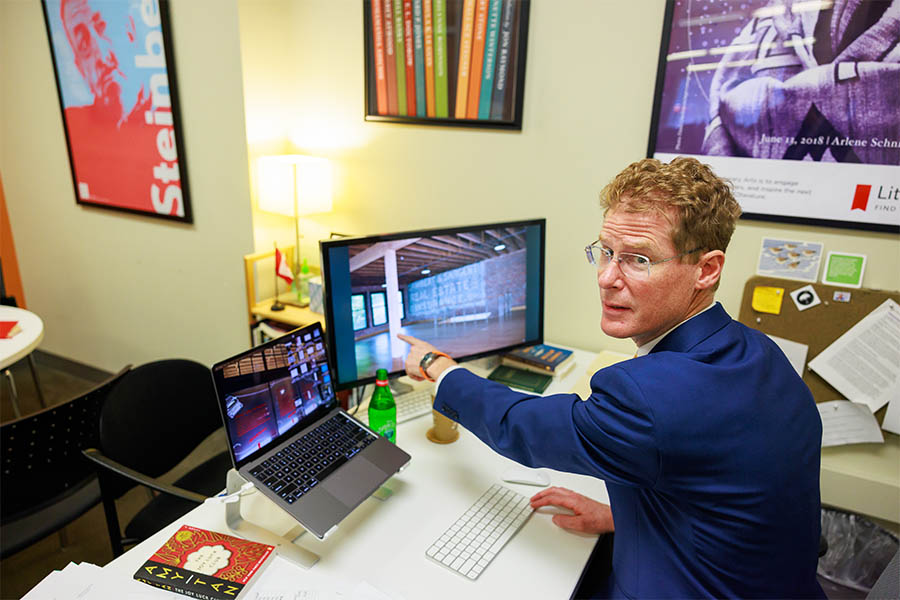
Oregon Business’ hardhat tour of the under-construction building now owned and soon to be inhabited by Literary Arts — the nonprofit Proctor has directed since 2009 — begins with Proctor asking me what I’m reading, which colleagues tell me later is a common conversation opener for him. The rest of the conversation is peppered with thoughts on books and writers — the writers who’ve spoken in Portland at Literary Arts’ invitation, the writers who sparked Proctor’s imagination as a young reader, and the way the organization is including space to read and browse books as part of its new headquarters in the Central Eastside of Portland.
“Literature was totally electrifying and felt really radical when I read it [growing up], and seemed at once so innocuous, this little book sitting on the table,” Proctor says. “That it could be so radical was a complete surprise to me, and I kind of love that about the way that literature operates. On the one hand, it looks like this conservative art form, it’s not particularly flashy. But, you know, every idea in the world that’s ever mattered is between the covers of a book.”
Proctor has served as the executive director of Literary Arts since 2009, after working at PEN America as membership and operations director and as an associate editor at HarperCollins; his résumé also includes work for the arts and culture sector overseas, including stints in London and for the Canadian Cultural Affairs Office, now known as the Department of Canadian Heritage.
This year he is shepherding Literary Arts through a major physical expansion as the organization departs downtown for a new location on the inner East side. The new location is larger —14,000 square feet, a 170% increase in space — and will be a public gathering and event space, in addition to offices for Literary Arts’ staff.
“The way this whole project unfolded was a little strange, but that may actually have been a strength in the end,” Proctor says.
In 2018, Proctor says, there was a “general idea” that Literary Arts was going to go through a transformation, but exactly what that transformation would look like was not clear. The board began developing a plan over the next two years, but then COVID-19 hit and, according to Proctor, the plan was shelved.
Then in the summer of 2020, longtime board member Susan Hammer met with Proctor to discuss a “transformational gift” to the organization. Hammer passed away later in 2020, leaving $3 million to Literary Arts. The organization used those funds to launch its Vision Plan capital campaign, with the goal of raising $22.5 million. When OB spoke with Proctor in August, the organization had raised $21.5 million. By early October, he said it was 5% from meeting that goal. He says there’s no easy way to prove this, but he suspects it’s one of the largest-known capital campaigns for a literature-focused nonprofit in the U.S.
Some of that money went toward the purchase and renovation of the building. Public records show that the space was purchased for $3.5 million in March 2022. While Bora Architecture has provided architecture and design services mostly pro bono (save fees to a structural engineer to help with the seismic upgrade), the renovation still bore a price tag of $16.5 million, including furnishings and staffing as well as structural renovation.
The rest, Proctor says, has gone to capacity building and building an endowment of $3 million, as well as a $1 million Board of Directors reserve and $2 million to support the Ursula K. Le Guin Writers Residency. Its programming includes administration of the Oregon Book Awards; educational programming including classes and oversight of the Writers in the Schools program; an ongoing arts and lecture series; and the Portland Book Festival. The organization’s head count has also increased rapidly — it was 16 in 2018, and is currently 19. Proctor says it could expand to as many as 35.
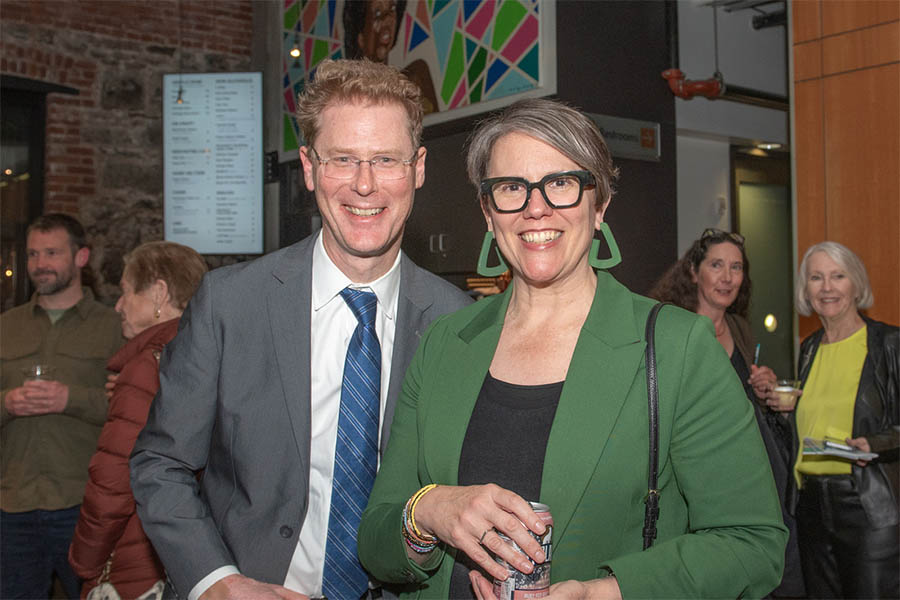
According to board chair Amy Donohue, who is also a principal at Bora Architecture, the organization began looking for a new space as its staff and programming expanded and it needed more offices. Initially, the board considered simply expanding into an adjacent tenant space. But Oregon poet laureate Anis Mojgani encouraged the board to “think a little bigger,” Donohue says.
Right now the public is welcome to visit Literary Arts’ downtown space, but people have to push a doorbell to come in, which “is not the most welcoming thing that you could do.”
“We’re really trying to make a space where people could come in, look at books, buy a cup of coffee. Maybe they don’t even know who Literary Arts is, but they’ll find out about us when they come into the space,” she says.
The new space, situated on the 700 block of Southeast Grand Avenue and originally built in 1904 as a hardware store, will include a cafe and bookstore, classroom space for writers’ workshops, and a podcast studio — where the organization will continue to record its podcast The Archive Project but also teach classes in podcast production.
It’s also a long-term home for the organization, which was founded in 1984 as Portland Arts & Lectures and currently occupies office space in the Pittock Block in downtown Portland. Purchasing a new space rather than continuing to rent the space — and purchasing the space outright so that the organization wouldn’t carry any debt — has been key to the organization’s transformation.
“There’s a way in which these campaigns can trickle out and go on forever, and you could end up in debt, and it can be very toxic. And we are very much on the path that that is not going to happen,” Proctor says. “I’m confident in that, actually, we’ll have no debt, no deficit, and this campaign will wind down this fall.”
The mid to late 1980s, Proctor says, was “an era of incredible creativity” in Portland’s arts community. “If you start looking at the history of other [Portland arts] organizations, you’ll find that their founding years are in the mid-’80s, and that’s because there was a real dearth of those organizations, and a lot of really amazing, smart, creative, industrious people started things from scratch.”
Julie Mancini started Portland Arts & Lectures with the goal of bringing important writers to town to speak. She’d get other cities’ phone books and call authors like John Updike and ask them to come to Portland, sometimes shipping them boxes of smoked salmon to pique their interest in the city.
In 1993 Portland Arts & Lectures merged with the Oregon Institute for Literary Arts, founded in 1986 by Portland attorney, writer and arts advocate Brian Booth to fund the work of new writers and recognize and support them in other ways, like the Oregon Book Awards. The organization began expanding its educational programming, adding projects like the Writers in the Schools program.
Literary Arts continues to bring writers and lecturers of note to Portland — Connie Chung kicked off this year’s sold-out season at the Arlene Schnitzer Concert Hall, touring in support of her new memoir, and upcoming speakers include historian Timothy Egan and journalist Masha Gessen.
And at the same time the organization is moving and physically expanding into a new space, it’s taken ownership of another literary landmark: This summer the organization announced plans to turn Portland science fiction writer Ursula K. Le Guin’s Northwest Portland home into hosting space for a writers residency program.
If all goes according to plan, the new building will be open in time for the Portland Book Festival in November. Proctor isn’t planning on holding any festival events at the new space, though, and is committed to making sure the festival stays downtown.
The festival — which includes vendor booths from publishers and booksellers around the country as well as dozens of readings and panel discussions — was founded in 2005 as Wordstock by Portland writer Larry Colton. Literary Arts took over and relaunched it as the Portland Book Festival in 2015. During that shift, organizers also moved the festival from the Oregon Convention Center to a cluster of venues — including the Portland Art Museum and the First Congregational United Church of Christ — centered around the downtown park blocks.
“I think the arts are playing an anchoring and essential role — maybe a sometimes unacknowledged role — in keeping downtown’s heart beating,” Proctor says. “The Schnitzer is being filled by arts and culture, comedians, and also musicians, and all kinds of things. The festival itself brings 8,000 people downtown who are taking public transportation, who are buying coffees and eating and parking and buying a lot of books.”
Proctor stresses that his organization is committed to being part of Portland’s recovery story — and that continuing to host events downtown and investing in the Central Eastside is a part of that. But he thinks leaders could be thinking bigger.
“I’m not interested in ‘Let’s bring Portland back.’ I understand the sentiment, and I totally support it, but I would prefer different words for that, because I think we have an opportunity to build something on the history of the city that is better,” Proctor says. “That’s the opportunity. We need to choose that future.”
Editor’s Note: This story has been updated from an earlier version to correct staffing numbers and to add more detail clarifying the cost of renovation. Oregon Business regrets the errors.
Click here to subscribe to Oregon Business.